An Outline of Face by Montasir Khandker
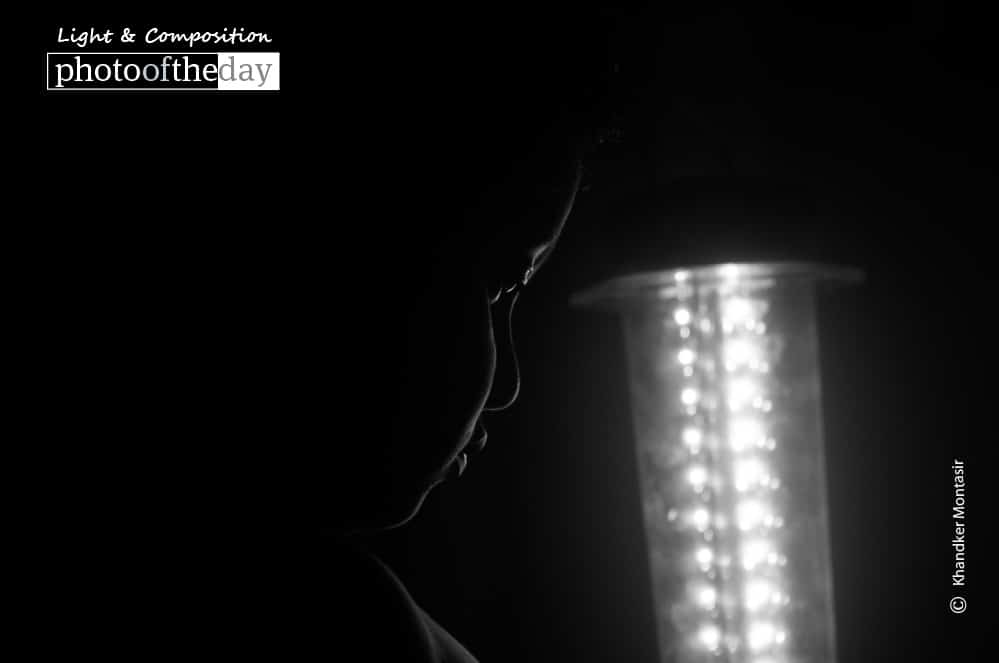
Captured during a quiet evening, this photograph highlights the delicate profile of the photographer’s six-year-old son. Bathed in the soft, singular glow of an LED lantern within an otherwise darkened room, the boy’s face is transformed into a striking silhouette of light. The photographer was drawn to the simplicity and intimacy of the moment, choosing to isolate the outline of the child's features against the shadows. This image is award-worthy for its masterful use of negative space and chiaroscuro, turning a fleeting, candid domestic scene into a poignant, artistic study of form and childhood innocence.
Montasir Khandker
Born in the district town of Bogra, Khandker Md. Montasir currently resides in Dhaka, Bangladesh. He discovered photography during his university years, eventually transforming a casual hobby into a profound creative passion. Montasir is celebrated for his keen ability to capture subtle components of the world that often escape the casual observer, treating each frame as a canvas for storytelling. His evolving expertise and distinct artistic vision continue to captivate an international audience, establishing him as a thoughtful observer of the human experience.
Resonance Score Breakdown
Transparency Note: The resonance score (12.2/20) is calculated based on social engagement metrics collected before the award announcement.
Expert Photography Reviews · 5
The Edge of a Shadow
I keep a small, silver thimble in my desk drawer that belonged to my grandmother. It is worn smooth on one side, a testament to the thousands of times she pushed a needle through heavy wool, guiding the thread to mend what had frayed.
Read the reflection →The Architecture of a Shadow
How much of a person is defined by what we cannot see? We spend our lives trying to illuminate the entirety of those we love, believing that if we could only cast enough light, we would finally understand the map of their soul. Yet, there is a profound honesty in the shadows.
Read the reflection →Reviews & Comments
Share your thoughts about this award-winning photograph. Your reviews contribute to the community engagement score.
The chiaroscuro here feels heavy, almost suffocating. By reducing his son to a mere silhouette, Khandker strips the boy of his agency, turning a child into a prop for aesthetic experimentation. Why must innocence be rendered as an absence of detail? I find myself wanting to see the boy’s eyes, to know if he’s actually present or just performing for the lens. Does this intimacy belong to the child, or is it purely the father’s possession?
Most candid shots of children are sentimental clutter, but this holds up. By stripping away the room’s context, Khandker forces us to confront the fragility of a profile. It’s the restraint that wins me over; he didn’t over-light the boy, leaving the shadows to do the heavy lifting. I’ve seen thousands of portraits, but this one makes me ache for my own son’s fleeting youth. It’s a quiet, permanent anchor in a sea of digital noise.
The frame functions as a perfect negative quadrant, anchored by the boy’s profile along the vertical axis. Khandker solves the spatial equation by balancing the dense, light-starved mass against the precise arc of the chin and nose. It’s a rigorous study in chiaroscuro geometry. I’ve spent hours tracing those vectors; the way the light defines the jawline against the void is simply elegant. It’s a rare, quiet thrill to see such complex balance achieved with so little.
Most photographers would obsess over the boy’s eyelashes, but Khandker wisely lets the shadows swallow the details. It’s a relief to see someone reject the tyranny of sharpness for the honesty of a silhouette. This approach is closer to Hiroshi Sugimoto’s long-exposure theatres than to conventional portraiture. I’m genuinely moved by what he chose not to resolve; by erasing the skin, he’s captured the very essence of a fleeting, quiet childhood. It’s beautifully imprecise.
The focal plane clings to the boy’s profile, where the LED’s singular point source renders the skin’s texture with clinical sharpness. It’s a rare moment where the lens resolves beyond human perception, capturing the subtle diffraction of light against the cheek’s fine vellus hairs. I’m genuinely moved by how the aperture isolates this silhouette, forcing the eye to confront the physics of shadow. It’s not just a portrait; it’s a precise, luminous study of optical intimacy.