Big Black Eyes by Ryszard Wierzbicki
Captured amidst the vibrant cultural tapestry of Jaipur, this portrait focuses on the profound gaze of a local child. The photographer utilized a telephoto lens to isolate the subject, drawing out the striking depth and intensity of the child's eyes against the backdrop of traditional Indian customs. The image serves as a poignant reflection on the fleeting yet indelible encounters found during travel. Its award-worthy quality lies in the photographer's ability to bridge the gap between observer and subject, transforming a candid moment into a timeless, evocative study of human connection and cultural beauty.
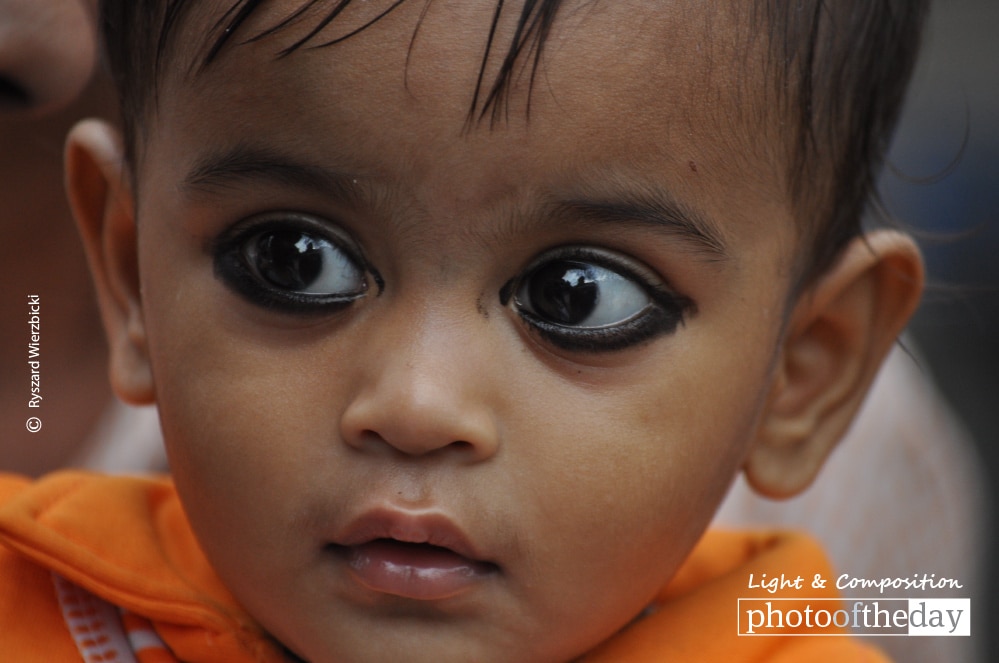
Exposure 1/250sec @ f/5.3 | ISO 720 | Focal Length 175mm
Ryszard Wierzbicki
Born in Poland in 1963, Ryszard Wierzbicki transitioned from a diverse career in social sciences and marketing to pursue a life defined by exploration and visual storytelling. After relocating to the United Kingdom in 2006, he dedicated himself to documenting the cultures of South-East Asia and beyond, often contributing his skills to charitable causes. His work reflects a deep-seated passion for travel and human connection, which he shares through his photography and his established online communities for fellow travelers.
Resonance Score Breakdown
Transparency Note: The resonance score (12.9/20) is calculated based on social engagement metrics collected before the award announcement.
Expert Photography Reviews · 3
The Mirror of the Soul
There is a quiet language spoken before words are ever formed. It lives in the stillness of a gaze, a place where the inner world meets the outer horizon without the interference of thought.
Read the reflection →The Weight of a Glance
I keep a small, tarnished silver thimble in a velvet-lined box, a relic from a grandmother I never truly knew. It is dented on one side, a mark left by years of pushing needles through heavy wool, a physical record of labor and quiet patience.
Read the reflection →Reviews & Comments
Share your thoughts about this award-winning photograph. Your reviews contribute to the community engagement score.
Darkness doesn’t merely frame these eyes; it consumes the periphery, forcing us into a claustrophobic intimacy. Wierzbicki hasn’t captured a child, but a void. I’m unsettled by how the shadows swallow the context of Jaipur, leaving only that piercing, accusatory stare. It’s a brutal reduction. When I look at those pupils, I don’t see cultural beauty. I see a mirror reflecting my own complicity in the act of watching. It’s heavy, and it’s honest.
The light here isn’t just illumination; it’s a conversation. Ryszard stood back, letting the 175mm lens breathe, waiting for the child to settle into the stillness of the Jaipur heat. Those eyes hold a depth I’ve rarely encountered in a frame. It’s haunting. I feel a sudden, sharp ache in my chest looking at them—the weight of a soul caught in a fleeting, golden moment. He didn’t rush; he simply listened to the gaze.
A telephoto lens at 175mm suggests a photographer keeping his distance, perhaps hoping the subject wouldn’t notice him. It’s a common shortcut for the timid. One wonders if he spent an hour earning that gaze or merely snatched it while passing through. I’ve spent enough days in the dust to know that true connection requires proximity and sweat. Still, those eyes are haunting. I’ll admit, they’ve stayed with me longer than I’d like to confess.