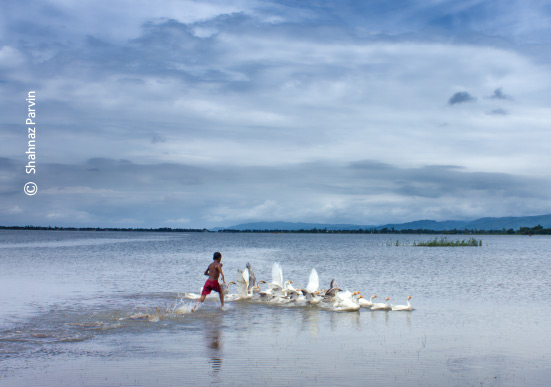
Chasing Geese by Shahnaz Parvin
Captured near the bustling bazaar of Tangiyar Hoar, this evocative image freezes a fleeting moment of childhood innocence amidst the daily rhythms of rural life. As local fishermen rested and others worked, a young boy found joy in the simple act of chasing geese. The photographer, visiting the area by boat, expertly framed this candid scene to highlight the boy's playful energy against the backdrop of the wetlands. The photograph is award-worthy for its authentic storytelling and its ability to transform a quiet, everyday encounter into a poignant, timeless narrative of life in Bangladesh.
Shahnaz Parvin
Based in Dhaka, Bangladesh, Shahnaz Parvin was a celebrated photojournalist whose work captured the heart and soul of her homeland. Renowned for her documentary photography, she gained international acclaim for her poignant coverage of culture, conflict, and daily life, consistently ranking among the world's top photographers. A dedicated contributor to Light & Composition, she left a lasting legacy through her extensive portfolio before her untimely passing in 2016, remaining one of South Asia's most influential visual storytellers.
Resonance Score Breakdown
Transparency Note: The resonance score (12.3/20) is calculated based on social engagement metrics collected before the award announcement.
Expert Photography Reviews · 8
The Weight of Unfinished Races
Why do we feel the need to pursue that which is already fleeing? There is a peculiar human impulse to chase the horizon, to run after the wind, or to follow the path of creatures that have no intention of being caught.
Read the reflection →The Weight of Unfinished Play
In the study of thermodynamics, we are told that energy is never truly lost; it merely changes form, dissipating into the ether like breath on a cold windowpane.
Read the reflection →Reviews & Comments
Share your thoughts about this award-winning photograph. Your reviews contribute to the community engagement score.

The geese aren’t merely birds; they are white ghosts fleeing into the encroaching gloom of the wetlands. Parvin captures the boy’s pursuit, yet it’s the heavy, bruised sky that dictates the stakes. I’ve felt that same suffocating silence in a Tarkovsky frame. It’s not innocence we see, but a desperate, fleeting struggle against the inevitable dark. It’s haunting. When the light fails, the boy’s joy becomes a fragile, lonely defiance against the vast, indifferent horizon.
The shutter speed hits that perfect sweet spot. It’s a freeze-frame that keeps the kinetic energy of the boy’s sprint alive without blurring the narrative. I’ve spent hours in edit suites hunting for a cut this clean; it’s the frame the editor keeps because it’s pure rhythm. The geese are mid-flight, the boy is mid-stride, and the composition holds the tension of the chase. It makes me want to jump into that boat myself.
Most entries in this category rely on the chaos of the bazaar to create interest, but this succeeds by isolating the boy’s singular, frantic joy. The low angle forces us to run alongside him, making the geese feel like a tidal wave of feathers. I’ve seen thousands of rural snapshots, but this one sticks. It’s the raw, unscripted desperation in his stride that makes me smile. Thirty years from now, that fleeting childhood energy will still feel alive.
It’s easy to snap a shutter when the geese scatter, but one wonders how many hours Shahnaz spent drifting in that boat before the boy stopped noticing the lens. The composition is tidy, yet it’s the patience that hits home. I’ve spent enough damp mornings in similar marshes to know that kind of stillness isn’t free. She didn’t just find this moment; she sat with the mud and the humidity until it finally belonged to her.
At f/10, the focal plane captures the geese’s frantic motion with surprising clarity. Parvin’s choice of aperture keeps the wetlands’ texture sharp, avoiding the diffraction limit that often softens such wide-angle shots. I’m genuinely moved by how the light refracts off the water’s surface, catching the boy’s kinetic energy. It’s a rare moment where the lens’s resolution perfectly matches the fleeting, chaotic beauty of the scene. It doesn’t just record life; it resolves it beautifully.
We look at this boy in the Tangiyar Hoar wetlands and we hear the soft splash of his feet against the water. He isn’t just chasing geese; he’s chasing the fleeting rhythm of childhood. I’ve spent my life listening to stories, and I can feel the joy radiating from his small, determined frame. It’s a quiet, beautiful song of rural life. This is a photograph that makes me want to laugh out loud with him.
Before the eye identifies the boy or the geese, a sudden lightness catches in my chest. It’s the kinetic memory of running without purpose. The blur of the wetlands isn’t just motion; it’s the frantic, beautiful pulse of childhood. When I return to this, I feel that same phantom wind against my face. It’s rare to find a frame that doesn’t just capture a scene, but actually triggers the adrenaline of a forgotten, sun-drenched afternoon.
The wetlands stretch. A vast, gray expanse. The boy is small, a blur of motion against the stillness of the water. I feel a sudden ache in my chest, watching him run. He isn’t chasing geese; he’s chasing the horizon. The frame holds so much air. It’s quiet. Nothing here is accidental. The empty corner is not empty. It’s the weight of the sky pressing down on the water. It’s enough.