Bus Stop by Keith Goldstein
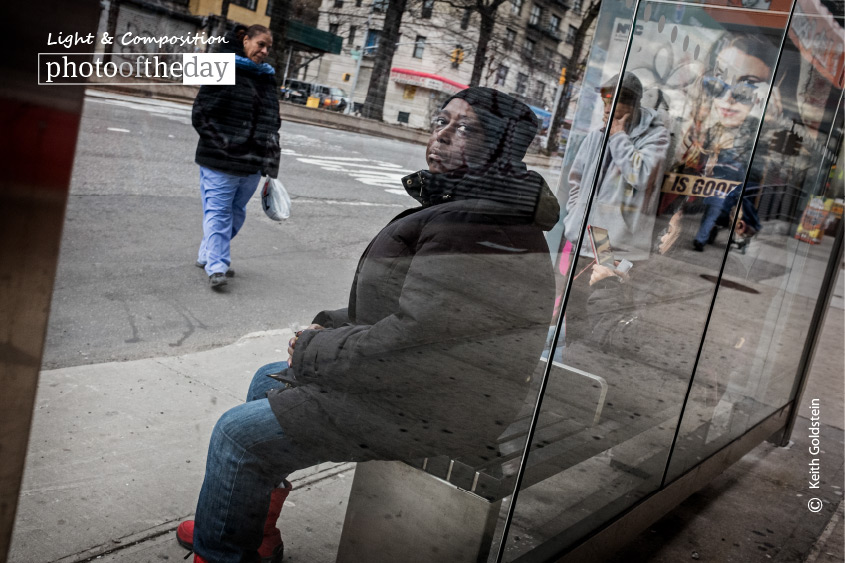
While en route to collect his son from school, the photographer encountered a woman waiting at a bus stop, her expression deeply lost in thought. The resulting image captures a poignant moment of urban stillness. The composition took an unexpected turn when the subject noticed the camera and turned to look directly at the lens, creating a powerful, intimate connection that elevates the frame beyond a simple street portrait. This spontaneous interaction, combined with the sharp technical execution, transforms an everyday commute into a compelling narrative of human presence and quiet observation.
Keith Goldstein
Born in Brooklyn in 1957, Keith Goldstein is a distinguished fine art and commercial photographer whose creative journey began with an early fascination for the medium during high school. After earning his BFA from the School of Visual Arts and an MFA from the Cranbrook Academy of Art, he developed a deeply emotive style of expression that has been exhibited internationally since 1980. Based in New York City, Goldstein maintains a philosophy of simplicity, preferring to remain unencumbered by gear to capture the authentic essence of his subjects across his diverse career as a photographer and photo editor.
Resonance Score Breakdown
Transparency Note: The resonance score (12.4/20) is calculated based on social engagement metrics collected before the award announcement.
Expert Photography Reviews · 5
The Weight of Waiting
I once sat on a bench in a train station in Leeds for three hours because I had missed my connection and the next one wasn't until dusk. At first, I was frantic, checking my watch and pacing the platform.
Read the reflection →The Weight of Waiting
There is a particular kind of grace found in the act of waiting. We often view these moments as empty spaces—gaps between the things we must do, or the places we must be. We tap our feet, check our watches, and wish for the movement to begin again.
Read the reflection →Reviews & Comments
Share your thoughts about this award-winning photograph. Your reviews contribute to the community engagement score.
The palette here evokes a Morandi-esque stillness, where the grey of the Washington Heights pavement bleeds into the muted, dusty ochre of the subject’s coat, creating a chromatic melancholy that’s utterly arresting. It’s the way the light clings to her skin, reminiscent of Vermeer’s soft, northern clarity, that makes my heart ache; one feels the weight of her solitude, a quiet, bruised indigo resonance that lingers long after the shutter’s click has faded into the city’s hum.
The frame’s geometry is tight, anchored by the vertical rhythm of the bus stop’s steel architecture. It’s a rigid cage. The subject’s gaze disrupts this, creating a sharp fulcrum that pulls the eye away from the periphery. I’m genuinely unsettled by how she anchors the negative space. It doesn’t collapse into sentimentality because the composition demands this confrontation. The visual weight is perfectly distributed. It’s a rare instance where the structure actually holds the human element.
It’s a decent enough frame, though one suspects it was snatched on a school run rather than earned through a long, cold vigil. The subject’s gaze is sharp, certainly, but it feels like a lucky collision rather than a deliberate pursuit. I’ve spent enough hours shivering on street corners to know the difference. It’s a pleasant enough snapshot, but I’m left wondering if he’d have bothered returning if the light hadn’t been quite so obliging.
The city’s harsh, flat light usually swallows the soul, but here, it’s different. She’s waiting, and in that pause, the concrete becomes a sanctuary. I’ve spent enough hours in the field to recognize that look; it’s the weight of a life held in stillness. When she turns, the connection feels almost sacred. It’s rare to find such profound silence in Washington Heights. I felt a sudden, sharp ache in my chest—a recognition of our shared, quiet solitude.
The concrete wall behind her isn’t just a backdrop. It’s a weight. She waits. The bus hasn’t arrived. The frame holds the tension of that delay. I feel a sudden, sharp ache in my own chest looking at her eyes. She’s caught in the Ma. Nothing here is accidental. The empty corner is not empty. It’s the sound of a city holding its breath. It’s quiet. It’s enough.