Sunrise at Boulder Beach by Sanjoy Sengupta
Captured at the break of dawn on the rugged shores of Basco, Batanes, this photograph immortalizes the ethereal transformation of the landscape as the first light strikes the volcanic boulders. Formed from the ancient lava of Mount Yarayu, the beach becomes a canvas of shimmering reflections and magical atmosphere. The photographer braved an early 04:30 start on the morning of his departure, driven by a desire to capture the island's raw beauty one last time. The resulting image is award-worthy for its masterful balance of long-exposure technique and the serene, evocative quality of the morning light.
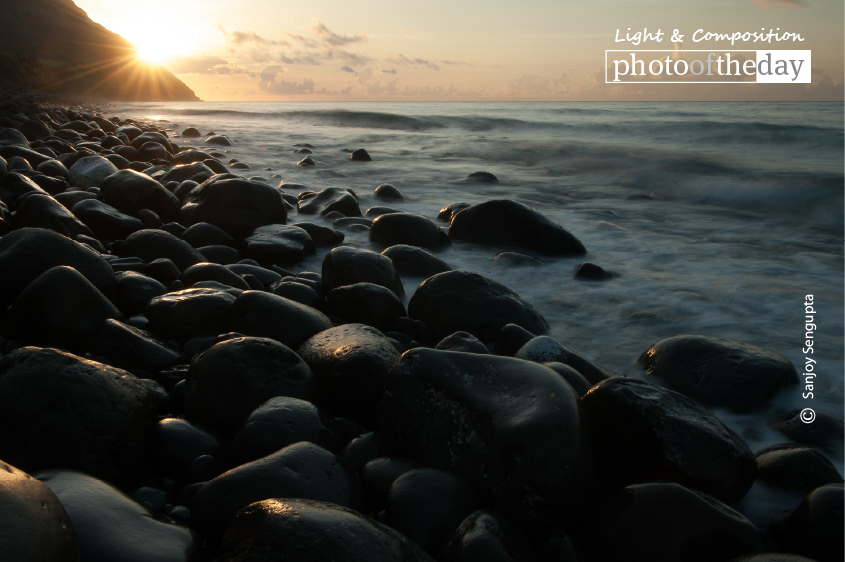
Exposure 1sec @ f/22 | ISO 100 | Focal Length 32mm
Sanjoy Sengupta
Based in Muscat, Oman, Sanjoy Sengupta is a dedicated photographer whose journey began with film cameras in the late 1990s. His transition from early point-and-shoot models to professional Nikon DSLR systems reflects a lifelong commitment to mastering the technical and artistic nuances of the craft. Sengupta specializes in capturing fleeting, cherished moments of life, consistently refining his eye for light and composition to document the world's natural beauty with precision and passion.
Resonance Score Breakdown
Transparency Note: The resonance score (11.2/20) is calculated based on social engagement metrics collected before the award announcement.
Expert Photography Reviews · 8
The Quiet Before the Noise
I woke up before my alarm this morning, which almost never happens. The house was completely silent, and for a few minutes, I just sat in the dark, listening to the hum of the refrigerator.
Read the reflection →The First Breath of Day
I remember a morning in a small coastal village where the silence felt heavy, almost solid. I had walked down to the water’s edge before the rest of the world had decided to wake up. There was an old fisherman there, mending a net with fingers that looked like gnarled driftwood.
Read the reflection →Reviews & Comments
Share your thoughts about this award-winning photograph. Your reviews contribute to the community engagement score.
The tide was retreating when he stood among those volcanic stones, waiting for the sky to wake. It’s a quiet, heavy light that clings to the wet boulders, softening the ancient lava’s jagged edges. I’ve felt that same ache of departure, the need to hold the island one last time before the plane leaves. He didn’t force the shutter; he listened until the dawn finally spoke. It’s a beautiful, patient surrender to the Batanes morning.
Before the eye identifies the volcanic boulders, a sudden stillness settles in the chest. The long exposure softens the tide into a ghostly veil, triggering a physiological slowing of my own pulse. It’s the color of that first light—a bruised, hopeful gold—that lingers. I’ve returned to this frame three times today, and each time, the silence of Batanes follows me. It doesn’t just capture a sunrise; it demands a quiet, internal surrender I wasn’t expecting.
The frame resolves into a precise 1:2 ratio, anchoring the volcanic boulders against the horizon’s soft gradient. Sengupta’s long exposure creates a vector of motion that pulls the eye across the negative space of the tide. I’m genuinely struck by how the jagged geometry of the rocks disrupts the fluid horizontal axis. It’s a perfectly solved spatial equation where the weight of the foreground mass balances the atmospheric light. It doesn’t just capture dawn; it maps it.
We often forget that the earth has a face, too. At Boulder Beach, Sanjoy Sengupta didn’t just capture rocks; he listened to the ancient, volcanic breath of Batanes. The long exposure softens the tide into a whisper, turning the shore into a living, breathing subject. It’s a portrait of a landscape that’s finally stopped to rest. I feel a profound, quiet peace looking at these stones. It’s a photograph that asks to be returned to.
The shutter stays open for a full second, turning the Batanes surf into a ghostly, velvet veil. It’s a deliberate choice. The frame holds the tension between the jagged, volcanic weight of the boulders and that soft, ethereal pull of the tide. I’ve stood on shores like this, and honestly, the silence here is deafening. Sengupta didn’t just snap a sunrise; he caught the exact moment the world stops moving. It’s a perfect, breathless cut.
At f/22, the diffraction limit inevitably softens the micro-contrast, yet it’s a necessary trade-off for that silky, long-exposure water movement. I’m genuinely moved by how the light refracts across those volcanic surfaces; it’s a delicate dance between physics and geology. While the lens struggles slightly with the extreme dynamic range, the focal plane remains remarkably sharp across the foreground boulders. It’s a rare moment where the optics don’t just record, they reveal the island’s raw, ancient soul.
Getting up at four-thirty on departure day is a chore most would skip for a hotel breakfast. Sengupta didn’t. That one-second exposure at f/22 suggests he spent a good while shivering on those volcanic rocks, waiting for the tide to soften the edges of the frame. It’s a cold, damp sort of commitment I recognize instantly. I’ve been there, shivering in the dark. He earned this light, and frankly, it’s a decent return on his investment.
Most sunrise shots are forgettable, but this one sticks. The long exposure turns the Batanes surf into a soft, ghostly veil that anchors those jagged volcanic rocks. It’s the contrast between the brutal, ancient stone and the fleeting, silky water that makes me stop. I’ve seen thousands of seascapes, yet this one feels like a quiet promise. It’ll still matter in thirty years because it captures the raw, lonely silence of a place that doesn’t care if we’re watching.