Red Blossoms by Mazhar Hossain
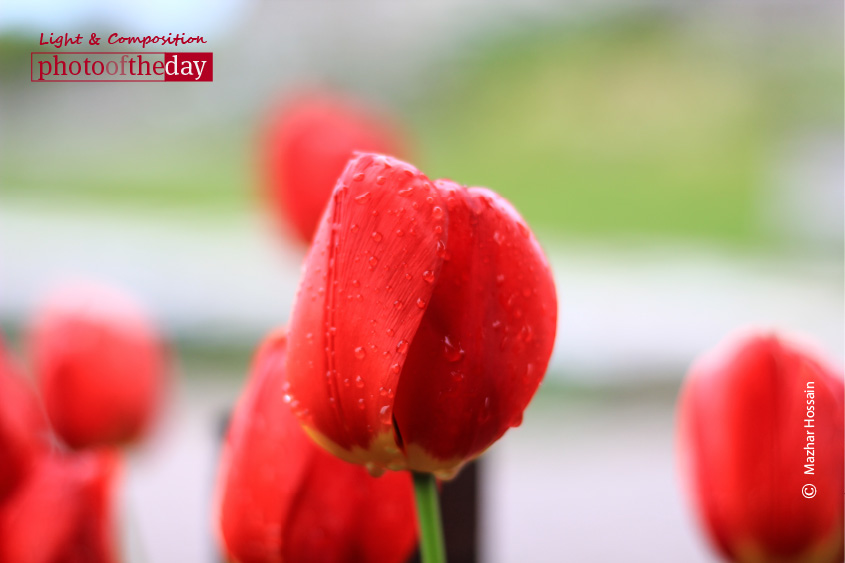
Captured during a second visit to Tobermory, this photograph transforms a gloomy, rain-swept day into a vibrant celebration of nature. The photographer utilized the soft, diffused light provided by the overcast weather to enhance the saturation and delicate textures of the tulips. By opting for a shallow depth of field, the image isolates the rich red blossoms against a soft, painterly background, emphasizing their intricate details. This work is award-worthy for its ability to find profound beauty in challenging conditions, turning a simple garden scene into a compelling study of color and atmosphere.
Mazhar Hossain
Born in Dhaka, Bangladesh, and currently based in Toronto, Canada, Mazhar Hossain is a dedicated photographer who balances a professional career in Human Resources with his growing passion for the lens. Since acquiring his first DSLR in 2010, he has focused on exploring the world through photography, with a versatile portfolio spanning architecture, portraiture, and nature. Driven by a desire to document the beauty of global cities, he continues to refine his technical skills and artistic vision as he travels and captures the world around him.
Resonance Score Breakdown
Transparency Note: The resonance score (12.4/20) is calculated based on social engagement metrics collected before the award announcement.
Expert Photography Reviews · 6
The Persistence of Color
Why do we assume that the most vibrant parts of our lives must be born from the brightest days? We often equate clarity with sunshine, believing that truth only reveals itself when the sky is clear and the path is illuminated.
Read the reflection →The Weight of Petals
There is a specific silence that follows a heavy rain, the kind that settles into the soil and holds its breath.
Read the reflection →Reviews & Comments
Share your thoughts about this award-winning photograph. Your reviews contribute to the community engagement score.
We look at these tulips in Tobermory and we don’t just see flowers; we see a conversation with the rain. Mazhar listened to the gloom, letting the soft light pull a quiet, vibrant secret from the petals. It’s a portrait of resilience, really. I’ve spent my life studying faces, but here, the red blooms hold a gaze as human as any I’ve encountered. It’s a photograph that asks to be returned to, again and again.
Most floral studies are forgettable, but this one lingers because of the restraint. By shooting at f/1.8, Mazhar forced the background into a soft, impressionistic blur that keeps the focus strictly on the tension between the sharp petals and the rain. I’ve seen thousands of garden shots, yet this one feels like a quiet, honest breath. It’s not just a pretty flower; it’s a deliberate choice to find clarity when the world is grey and weeping.
The rain-swept light hits the petals and suddenly, the frame breathes. It’s a tight, cinematic close-up where the shallow depth of field does the heavy lifting, isolating that deep, visceral red against a blurred, moody Ontario backdrop. I’ve seen a thousand garden shots, but this one holds. It’s the perfect cut. The stillness is electric. Honestly, looking at these tulips makes me want to reach out and touch the glass. It’s a beautiful, quiet sequence.
1/400sec at f/1.8, ISO 100, 50mm. It’s a razor-thin margin for error. At f/1.8, the plane of focus is unforgiving, yet Hossain nailed the stamen’s geometry. I’m usually annoyed by wide-open apertures on floral subjects—they’re lazy—but here, the isolation is functional. It strips away the Tobermory clutter. The shutter speed is overkill for static tulips, but it’s a safe, calculated choice. It’s technically sound. I’ve rarely seen such precise control in a garden.
The shallow depth of field creates a necessary isolation, yet the spatial tension remains underdeveloped. While the red saturation provides a focal anchor, the background blur lacks the structural rigor to ground the subject. It’s a soft, painterly effort that doesn’t quite hold the frame. I’ve seen enough floral studies to know that without a disciplined architecture, the composition drifts. It’s pretty, sure, but it doesn’t command the eye with the necessary formal weight.
At f/1.8, the Canon 50mm renders the focal plane razor-thin, isolating the tulip’s cellular structure from the chaotic bokeh of the Tobermory rain. It’s a delicate balance; the lens’s spherical aberration softens the edges just enough to avoid clinical harshness. I’m genuinely moved by how the diffused light saturates those reds without clipping the sensor’s dynamic range. It’s rare to see such precise control over the diffraction limit in these conditions. It’s simply beautiful optics.