Amar Sonar Bangla by Shahnaz Parvin
Inspired by the innocence of childhood, this photograph captures a poignant moment where a young boy attempts to draw the national flag while being taught the national anthem by his cousin. The scene evokes a deep sense of nostalgia for the photographer, recalling early school mornings spent singing 'Amar Sonar Bangla.' By framing this intimate, domestic interaction, the image transforms a simple act of learning into a powerful tribute to national identity and heritage. Its award-worthy quality lies in its ability to bridge the gap between personal memory and universal cultural pride, rendered with a tender, observant eye.
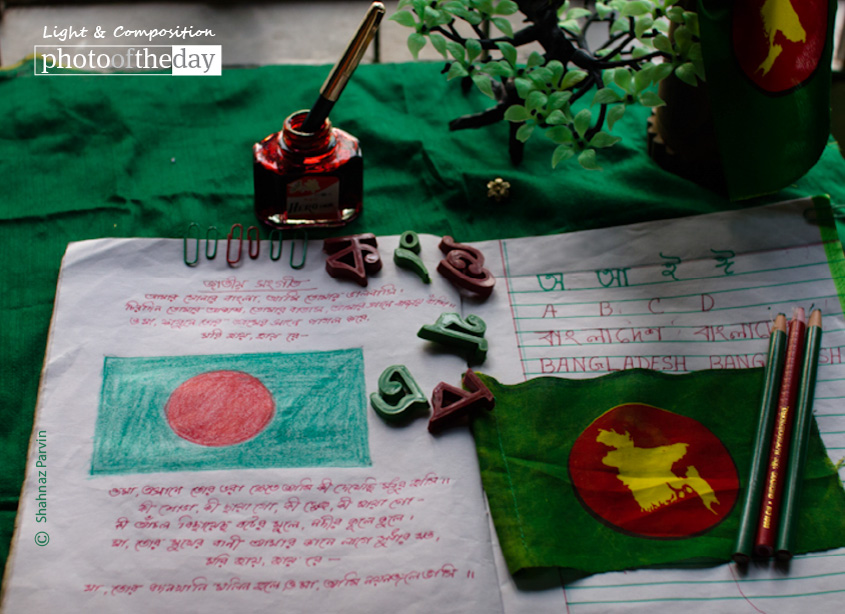
Shahnaz Parvin
Shahnaz Parvin was an acclaimed photojournalist and a passionate advocate for Bangladeshi culture, whose work consistently placed her among the world's top photographers. Based in Dhaka, she dedicated her career to documentary photography, capturing the complexities of upheaval, conflict, and daily life across South Asia. As a prolific contributor to Light & Composition, she earned numerous accolades for her evocative storytelling and commitment to representing her homeland through her lens before her untimely passing in 2016.
Resonance Score Breakdown
Transparency Note: The resonance score (11.4/20) is calculated based on social engagement metrics collected before the award announcement.
Expert Photography Reviews · 6
Roots in the Quiet Earth
There is a rhythm to how we learn who we are. It begins long before we have words, in the soft repetition of a song hummed by a loved one or the steady movement of a hand guiding our own.
Read the reflection →The Ink of Belonging
The smell of damp paper and graphite always pulls me back to the wooden desk of my childhood. It is a sharp, metallic scent, like the taste of a copper coin pressed against the tongue.
Read the reflection →Reviews & Comments
Share your thoughts about this award-winning photograph. Your reviews contribute to the community engagement score.
What strikes me immediately in ‘Amar Sonar Bangla’ is the raw, unforced authenticity. Shahnaz Parvin has a rare gift for stepping into a community and capturing moments of profound human dignity without intrusion. The subject’s expression and posture speak with complete honesty; there is no performance here, only life witnessed with deep empathy and respect. You waited for the exact right second, and the result is timeless.
The tonal harmony in ‘Amar Sonar Bangla’ is nothing short of luminous. The palette breathes with natural warmth, capturing the distinct atmospheric quality of Dhaka, Bangladesh with delicate chromatic fidelity. The transitions between warm ochres, deep earth tones, and cool atmospheric light evoke the painterly sensibility of classical chiaroscuro. It is a work of profound color coherence that enriches the emotional resonance of the entire frame.
Most entries in this category rely on heavy-handed symbolism, but this works because it’s quiet. The boy’s focused grip on the crayon, contrasted against the blurred, rhythmic instruction of his cousin, captures a fleeting cultural heartbeat. I’ve seen thousands of patriotic shots, yet this one actually moved me; it’s the honest, unposed concentration that makes it endure. It doesn’t just document a lesson; it preserves the precise moment a child begins to inherit his country’s soul.
1/125sec at f/3.5, ISO 800, 30mm. It’s a tight, domestic aperture choice that isolates the subject from the clutter of a Dhaka interior. The shutter speed is just enough to freeze the boy’s hand, though the ISO 800 introduces noise that softens the texture of the paper. I’ve seen cleaner files, but the technical restraint here actually works. It doesn’t distract. It’s a cold, calculated capture that I find surprisingly difficult to look away from.
We watch a boy trace his nation’s colors, his brow furrowed in the quiet labor of belonging. He isn’t just drawing; he’s listening to the anthem’s rhythm, learning the melody of his own heritage. It’s a tender, fragile transmission of identity. I find my own heart softening at the sight of his small, ink-stained hand. We look at this face and we understand something: history isn’t written in books, but in these soft, whispered lessons between kin.
The frame’s geometry anchors the subject, creating a rigid vertical axis that prevents the composition from collapsing into mere sentiment. The boy’s focus provides the necessary fulcrum, balancing the negative space against the flag’s stark geometry. It’s a disciplined arrangement. I’m genuinely unsettled by how the light cuts across the paper, forcing the eye to remain within the frame. Structure dictates the narrative here. Without this architectural restraint, the scene would simply dissolve into noise.