A Second before Darkness by Andrea Migliari
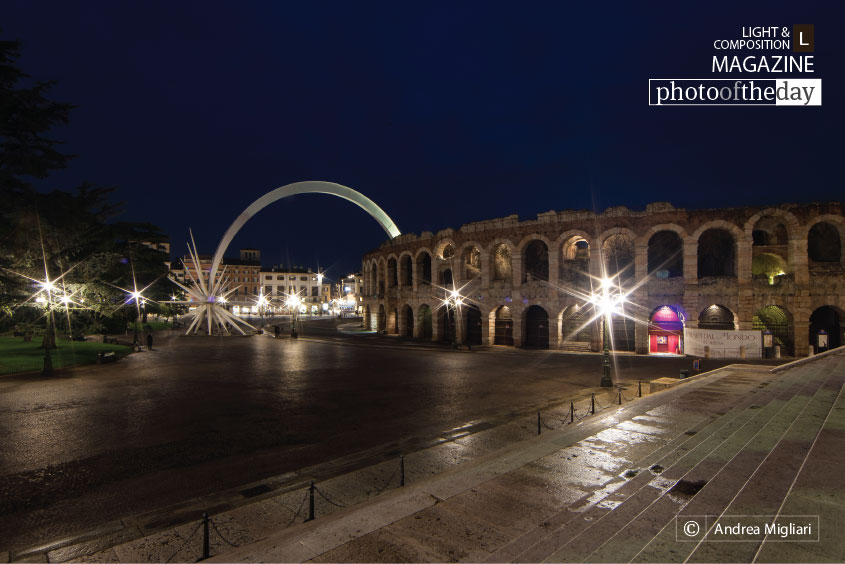
Captured in the quiet transition of late afternoon in Verona, this image depicts the historic Piazza Brà just as the sun dips below the horizon. The photographer utilized a long exposure to emphasize the stillness of the square, contrasting the modern emptiness with the enduring presence of the first-century Roman arena. By positioning the camera on the steps of Palazzo Barbieri, the photographer captured a rare, serene moment in one of Italy’s busiest landmarks. The composition is award-worthy for its masterful balance of architectural history and the ethereal, fading light that defines the atmosphere of the city.
Andrea Migliari
Born in Italy in 1981, Andrea Migliari is a dedicated photographer based near Bergamo. After early experiences in carpentry and time spent in London, he returned to his roots to cultivate a deep passion for visual storytelling, transitioning from traditional film and darkroom techniques to digital mastery. His diverse portfolio, which spans landscapes, portraits, and live music, has earned him recognition in prestigious publications like Overart and success in national competitions. Migliari continues to explore the beauty found in everyday surroundings, sharing his unique perspective through his evocative imagery.
Resonance Score Breakdown
Transparency Note: The resonance score (12.5/20) is calculated based on social engagement metrics collected before the award announcement.
Expert Photography Reviews · 8
The Threshold of Evening
There is a sacred quality to the hour when the day begins to surrender. It is not quite light, yet not fully dark; a thin, velvet veil that settles over the world, softening the edges of our frantic movements.
Read the reflection →The Quiet Between Breaths
I was walking home from the grocery store this evening when the streetlights flickered on all at once. It happens so fast. One moment the world is bathed in that soft, bruised purple of twilight, and the next, everything is sharp, electric, and defined.
Read the reflection →Reviews & Comments
Share your thoughts about this award-winning photograph. Your reviews contribute to the community engagement score.
Before the eye identifies the Roman arena, something in the chest tightens. It’s the weight of that long exposure, the way the light bleeds into the stone, forcing my own breath to slow. I’ve returned to this square a dozen times, and it still feels like the quiet before a confession. When I look at it now, I feel a strange, hollow ache—the specific loneliness of a city that has outlived everyone who ever walked it.
The shutter stays open, bleeding the day into the night. It’s a long take, a fifteen-second breath held in Verona. The 14mm lens pulls the arena into the frame, turning stone into a silent protagonist. I’ve stood in that square, but I’ve never felt it this quiet. It’s the frame the editor keeps because the cut would have been a mistake. The light is dying, but the shot holds. It’s perfect.
Verona’s arena doesn’t merely sit in Piazza Brà; it waits, anchored in a silence that feels almost tectonic. Migliari’s long exposure bleeds the day into a bruised, indigo void. It’s a haunting surrender. I’ve stood on those stones, and I’m struck by how the shadows here aren’t just absence—they’re the weight of centuries pressing against the lens. It’s a rare, cold beauty that refuses to comfort us. It doesn’t invite; it simply endures.
15 seconds at f/20, ISO 200, 14mm. Diffraction is the enemy here. Stopping down to f/20 on a 14mm lens softens the fine detail of the arena’s stone. It’s a technical miscalculation. I’ve spent years staring at these sensors, and it’s frustrating to see such clarity sacrificed for a longer shutter drag. The composition works, but the optics are muddy. You didn’t need that much depth of field. It’s a missed opportunity for sharpness.
Shooting at f/20 with a 14mm lens pushes the diffraction limit, yet here, it’s a calculated gamble. The airy disk size expands, softening the edges, but it grants the Arena an incredible, tactile depth. I’m genuinely moved by how the light bleeds across those ancient stones; it’s a soft, velvet transition the human eye simply can’t resolve. It’s not just a square; it’s a physical manifestation of time slowing down through glass. I’ve rarely seen physics feel this poetic.
The light here isn’t merely fading; it’s exhaling. I’ve spent enough evenings in Verona to know that specific, bruised violet that clings to the ancient stone of the Arena. Migliari didn’t rush this. He stood on those steps while the city’s pulse slowed, waiting for the shadows to claim the square. It’s a quiet, heavy stillness. Looking at it, I feel a sudden, sharp ache for that exact, fleeting silence before the night truly begins.
Most night shots of Verona rely on the Arena’s lights to do the heavy lifting, but Migliari chose the blue hour’s silence instead. By stopping down to f/20, he turned the streetlamps into precise, sharp stars that anchor the frame. It’s a rare, quiet perspective I’ve rarely seen in thousands of submissions. I felt a genuine chill looking at that empty square. It’s a haunting, timeless record of a city that usually never sleeps.
In Verona, the light doesn’t just fade; it listens. We look at this empty Piazza Brà and realize the arena isn’t just stone, but a silent witness to centuries of human breath. Andrea Migliari didn’t just capture a long exposure; he waited for the city to exhale. It’s hauntingly quiet, isn’t it? I feel a sudden, sharp ache for the ghosts of the crowds who once stood exactly where this stillness now lives. It’s deeply moving.