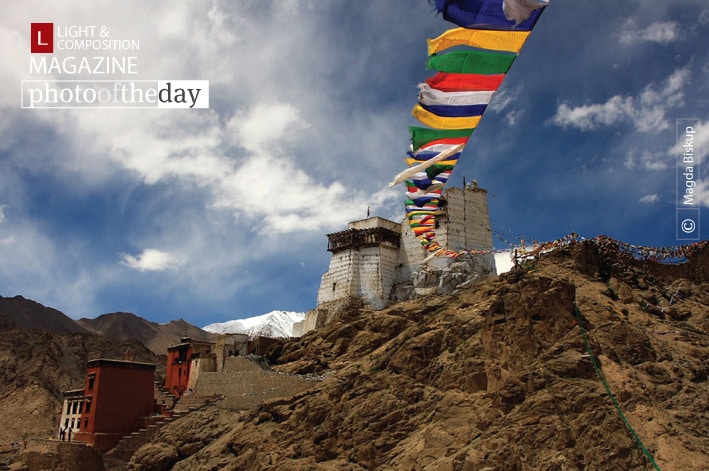
Leh Palace by Magda Biskup
Perched atop a steep hill in the heart of Ladakh, the 17th-century Leh Palace stands as a commanding sentinel over the northern Indian landscape. Magda Biskup captures the architectural grandeur of this historic site, utilizing a wide 20mm focal length to emphasize the palace's imposing presence against the vast, rugged terrain. The composition highlights the dramatic interplay of light and shadow on the ancient stone walls, showcasing the photographer’s ability to translate the raw, atmospheric beauty of the Himalayas into a compelling visual narrative. This image serves as a testament to the enduring majesty of Ladakh’s cultural heritage.
Magda Biskup
Born and raised in Poland, Magda Biskup is a Sydney-based photographer whose passion for the craft was ignited during a transformative year working in Malaysia. Having traveled through over 40 countries, she specializes in travel photography, documenting the diverse landscapes and cultures she encounters on the road. Her portfolio reflects a deep-seated love for exploration, captured primarily through her Canon 40D and a versatile range of lenses.
Resonance Score Breakdown
Transparency Note: The resonance score (13.4/20) is calculated based on social engagement metrics collected before the award announcement.
Expert Photography Reviews · 6
The Architecture of Silence
We build our monuments to outlast the wind, stacking stone upon stone as if to anchor our fleeting presence to the earth.
Read the reflection →The Weight of Stone
We build to outlast the breath in our lungs. We stack stone upon stone, hoping the earth will hold the memory of our hands long after the hands have turned to dust. There is a specific kind of arrogance in this, a defiance against the wind that scours the mountain slopes.
Read the reflection →Reviews & Comments
Share your thoughts about this award-winning photograph. Your reviews contribute to the community engagement score.
Leh Palace doesn’t merely occupy space; it interrogates the void. Biskup’s 20mm lens forces the stone into a confrontation with the encroaching Himalayan dark. I’ve stared at these jagged, sun-bleached walls until my eyes ached, feeling the crushing weight of centuries. It’s a brutal, honest architecture. When the shadows finally swallow the base of the structure, I feel a sudden, sharp loneliness. It’s not a travel postcard; it’s a meditation on what we leave behind in the light.
The light on those stone walls suggests Biskup didn’t just stumble upon the palace during a lunch break. It’s a crisp, honest exposure that implies she spent a fair few hours shivering in the thin Himalayan air, waiting for the shadows to align just so. I’ve spent enough time at high altitude to recognize the ache in her patience. It’s a decent bit of work; she clearly returned until the mountain decided to cooperate.
The air in Ladakh is thin, and it’s clear Magda felt that stillness. She stood here as the sun began its long, raking descent, catching the stone walls just before they slipped into shadow. I’ve spent enough hours waiting for that specific, brittle light to know she didn’t rush this. It makes my own chest tighten, remembering how the mountain silence feels. She listened to the palace, and it finally decided to reveal its bones.
Most travel photography is just digital clutter, but this holds up. I’ve seen thousands of shots of Leh Palace, yet Biskup’s choice to anchor the frame with that jagged, shadowed foreground makes the architecture feel earned rather than observed. It’s the tension between the stone’s weight and the thin, biting Himalayan air that gets me; I actually felt a shiver looking at it. It’s not just a postcard; it’s a record of a place that refuses to be tamed.
The ochre of these ancient, sun-baked walls evokes the dusty, melancholic stillness of a Morandi study, yet it’s the sky—a bruised, thin cerulean—that truly steals one’s breath. It’s a chromatic tension I find utterly intoxicating, as if the stone’s heat is bleeding into the cooling air. I’ve stared at this Himalayan light for hours; it’s not merely a landscape, but a visceral, aching dialogue between the earth’s scorched minerals and the infinite, thinning atmosphere.
The 20mm focal length forces a brutal geometry upon the Leh Palace. It’s a rigid, vertical ascent that anchors the frame against the sky’s emptiness. The stone mass exerts a heavy, downward pressure, yet the composition doesn’t collapse. I’m genuinely unsettled by how the negative space threatens to swallow the structure whole. It’s a precarious balance, but the architecture holds. The frame is tight, disciplined, and entirely unforgiving. It’s a rare, cold victory of form.
Lovely shot! Thanks for the technical info as well. As an aspiring photographer I find this very useful.