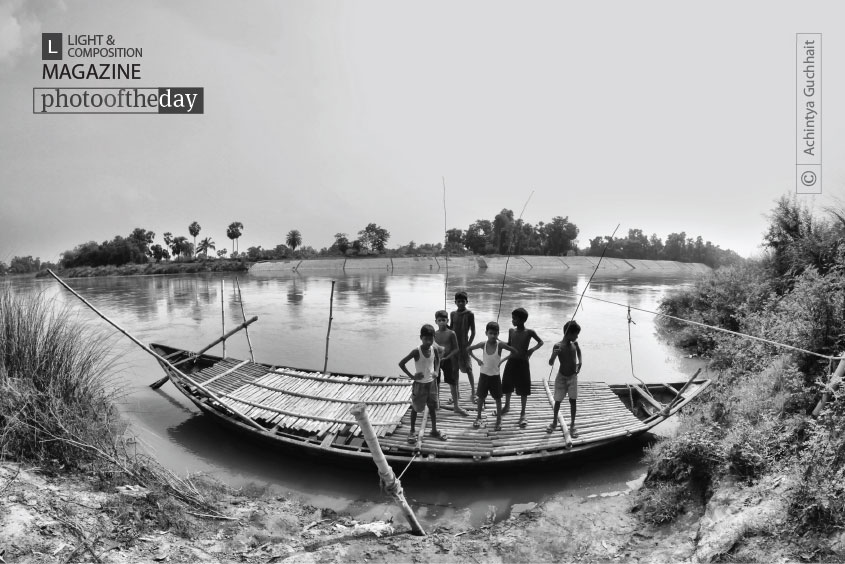
Fisherman Gang by Achintya Guchhait
Along the banks of the Damodar River in West Bengal, a group of young children gathers with fishing rods, testing their patience and skill in the flowing waters. The photographer captures this candid moment of childhood innocence and local tradition, highlighting the quiet determination of the youths against the backdrop of the river. This image is award-worthy for its authentic documentary approach, effectively freezing a fleeting, everyday scene that speaks to the coexistence of humanity and nature. The composition draws the viewer into the children's world, celebrating the simple, unscripted joys found in the commonest of places.
Achintya Guchhait
Based in Bangalore, India, Achintya Kumar Guchhait is a dedicated documentary photographer and traveler who captures the essence of human life in its most natural state. A techie by profession, he balances his career with a deep-seated passion for photography, constantly refining his craft by studying the works of others. His portfolio reflects a keen interest in the human experience, ranging from candid street scenes to wedding photography, and he continues to expand his creative horizons as a Getty contributor.
Resonance Score Breakdown
Transparency Note: The resonance score (11.9/20) is calculated based on social engagement metrics collected before the award announcement.
Expert Photography Reviews · 8
The Weight of the Line
I remember sitting on the edge of a canal in Amsterdam with a local named Bram, who spent his afternoons watching the water move. He told me that fishing wasn't really about the catch, but about the suspension of time.
Read the reflection →The Weight of the Line
To wait is to practice a kind of disappearance. You sit by the water, the surface shifting like hammered tin, and you become part of the bank. The rod is a bridge between your hand and the hidden life below.
Read the reflection →Reviews & Comments
Share your thoughts about this award-winning photograph. Your reviews contribute to the community engagement score.
The river’s surface holds the soft, diffused glow of a humid West Bengal afternoon. Achintya waited for the light to soften, letting the children become part of the silt and current. I’ve spent enough mornings by the water to recognize that stillness; it’s not just patience, it’s a surrender. Looking at their small, focused silhouettes, I feel a sudden, sharp ache for the simplicity of a line cast into the unknown. They aren’t waiting; they’re listening.
Before the eye identifies the fishing rods, a stillness settles in the chest. It’s the weight of the riverbank, that humid, suspended anticipation. I feel a sudden, sharp ache for the simplicity of their focus, the way they’ve tethered themselves to the water. When I return to this a year later, the children’s quiet patience doesn’t fade; it anchors me. It’s a rare, visceral reminder of a time when the world was only as wide as the current.
The riverbank hums. It’s a wide shot, the kind where the silence is heavy, pregnant with the anticipation of a bite. These kids aren’t just fishing; they’re holding a rhythm I haven’t felt in years. The frame doesn’t cut away, and it shouldn’t. It’s a long take of pure, unscripted patience. I’m actually holding my breath watching them. Guchhait knew exactly when to lock the shutter. It’s the frame the editor keeps, forever.
The frame’s geometry relies on the diagonal thrust of the fishing rods, which anchor the chaotic foreground. It’s a precarious balance. The negative space above the river provides a necessary, if thin, reprieve from the visual density below. I’m genuinely bothered by the horizon line’s slight tilt; it disrupts the structural integrity of the bank. Still, the spatial tension holds. The composition doesn’t collapse, though it’s a near thing. It’s rigorous enough to command attention.
The Canon’s sensor struggles with the high-contrast light reflecting off the Damodar, yet the lens resolves the children’s silhouettes with surprising acuity. At this focal length, the diffraction limit is barely pushed, keeping the textures of the riverbank crisp. I’m genuinely moved by how the subtle chromatic aberration around the fishing lines mimics the shimmering heat of West Bengal. It’s a raw, optical honesty that reminds me why I’ve spent my life obsessed with glass.
Most documentary work from the Damodar River fades into visual noise, but this holds. What separates it from the thousands of similar shots I’ve reviewed is the tension in those small, calloused hands gripping the rods. It’s not just a scene of play; it’s a study in focus. I’ve looked at this for years, and I still feel a quiet ache for that lost, singular concentration. It’s a rare, honest slice of time that actually endures.
One wonders how many mornings Guchhait spent on those riverbanks before the children stopped noticing the lens. It’s easy to snap a shutter, but harder to become part of the scenery. I’ve spent enough damp hours in the reeds to know that stillness is a tax one must pay. The composition is tidy, but the real craft is in the patience. It’s a quiet, earned moment. I find myself missing the smell of that river.
We look at these boys along the Damodar, and we hear the river’s low hum before we see their focus. They aren’t just fishing; they’re learning the rhythm of the water. I’m struck by how they’ve forgotten the camera entirely, lost in that quiet, shared patience. It’s a rare, honest stillness. When I see their hands gripping those rods, I feel a sudden, sharp ache for the simplicity of my own childhood. It’s a beautiful, breathing memory.