Our Shadows Belong to Us by Mohammad Saiful Islam
Captured at the historic gate of the Sultanahmet Mosque in Istanbul, this evocative image serves as a visual meditation on the inseparable nature of the self and one's shadow. The photographer utilized a wide-angle perspective to frame the interplay of light and form, emphasizing the philosophical connection between a person and their silhouette. By grounding the composition in such a culturally rich location, the image transcends a simple street capture, becoming a poignant reflection on human accountability and the paths we choose to follow. Its masterful balance of light and symbolic depth makes it a standout piece of black and white photography.
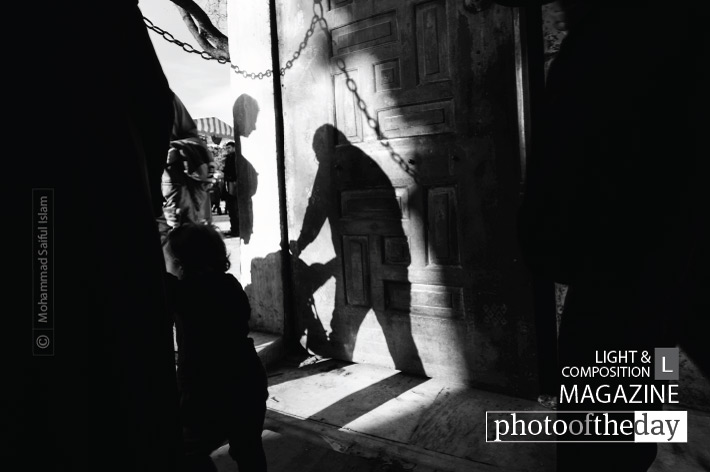
Exposure 1/80sec @ f/10 | ISO 200 | Focal Length 11mm
Mohammad Saiful Islam
Born in Bangladesh in 1984, Mohammad Saiful Islam is a dedicated photographer and military officer who began his artistic journey in 2011. His work focuses on the diversity of human life, street scenes, and nature, often exploring both monochrome and color palettes to capture global perspectives. Throughout his career, he has earned significant recognition, including finalist status in the CGAP Photo Contest and honorable mentions in national exhibitions, establishing himself as a compelling voice in contemporary photography.
Resonance Score Breakdown
Transparency Note: The resonance score (14.0/20) is calculated based on social engagement metrics collected before the award announcement.
Expert Photography Reviews · 7
The Weight of Following
In the physics of light, a shadow is merely an absence—a place where the sun is denied entry. Yet, in the geography of the human spirit, it feels like something far more substantial.
Read the reflection →The Weight of the Silhouette
If we were to shed our history, would our shadows remain attached to our heels? We often treat our past as a separate entity, something we can leave behind in the dust of a busy street or the silence of a room.
Read the reflection →Reviews & Comments
Share your thoughts about this award-winning photograph. Your reviews contribute to the community engagement score.
Stone walls. A sliver of light. The shadow stretches, tethered to the man. It’s a quiet tether. I’ve stood in Sultanahmet, and I recognize this stillness. The wide lens doesn’t shout; it breathes. It leaves room for the dust to settle. Nothing here is accidental. The empty corner is not empty. It’s a weight. I feel a sudden, sharp ache in my chest. To be this present, and yet, so beautifully absent.
At 11mm, the Nikon’s rectilinear distortion stretches the Sultanahmet’s geometry, pulling the shadows into a forced perspective that defies Euclidean intuition. Stopping down to f/10 pushes the diffraction limit, yet it’s necessary here to keep the focal plane deep enough to resolve the stone’s texture against the silhouette’s void. It’s a cold, calculated optical choice, but honestly? The way those shadows bleed across the uneven masonry makes my heart ache. It’s hauntingly precise.
Before the eye identifies the Sultanahmet gate, something in the chest tightens. It’s the weight of those elongated shadows stretching across the stone, tethering the figures to the earth. I feel a sudden, sharp loneliness looking at them. When I return to this a year later, the silence of the frame still pulls at my pulse. It’s not just light and form; it’s the quiet, heavy realization that we never truly walk alone.
In Sultanahmet, we watch a man walking, but it’s his shadow that holds our gaze. It stretches long against the ancient stone, a dark twin tethered to his heels. Did Mohammad listen to the silence of that gate before clicking the shutter? I feel a sudden, quiet ache in my chest seeing how he captures that inseparable weight. It’s a reminder that we never truly walk alone; we carry our history in every step we take.
1/80sec at f/10, 11mm. A wide-angle choice that forces the viewer into the frame. The f/10 aperture ensures the stone textures of Sultanahmet remain sharp, anchoring the silhouettes against the architecture. It’s a calculated, rigid geometry. I’ve seen enough soft-focus street work to last a lifetime, but this doesn’t hide behind blur. It’s technically sound. The shadows are crisp, the depth is absolute. It’s cold, precise, and frankly, I find the lack of compromise refreshing.
Sultanahmet’s stone doesn’t just frame these figures; it demands an accounting of their weight. Islam understands that light here is merely a thin, deceptive skin. It’s the encroaching darkness that truly defines the soul’s geography. When I look at how those silhouettes stretch against the ancient masonry, I feel a sudden, cold shiver of recognition. We aren’t just walking through Istanbul; we’re dragging our own histories behind us, tethered to the ground by our own inevitable absences.
Most street photography is ephemeral noise, but this frame hits differently. The 11mm distortion doesn’t just widen the Sultanahmet gate; it forces the shadows to stretch into an impossible, haunting reach. I’ve seen thousands of silhouettes, yet these feel like they’re actually tethered to the soul. It’s the tension between the stone architecture and that fleeting, dark projection that makes me stop. In thirty years, this won’t just be a record; it’ll be a haunting.