Frames within the Frame by Mohammad Saiful Islam
Captured during a train journey from Chittagong to Dhaka, this evocative image explores the concept of life as a series of nested perspectives. By framing the scene through the train's windows, the photographer highlights the layered reality of human existence, suggesting that every individual lives within numerous, overlapping frames. The composition is a thoughtful meditation on travel and observation, turning a mundane transit moment into a profound visual metaphor. Its ability to transform a simple commute into a philosophical reflection on the human condition makes this piece a standout example of insightful, narrative-driven street photography.
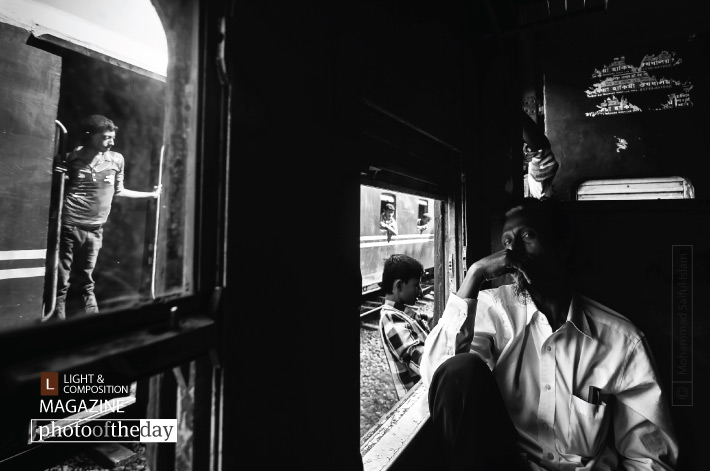
Exposure 1/250sec @ f/2.8 | ISO 200 | Focal Length 11mm
Ritesh Rath
Born in India Ritesh Rath lives in Cuttack, but he does not able to travel the whole world because of poor financial condition. He loves photography, images of wildlife, and want to be a photographer who would represent it in the whole world. Current Location Cuttack, INDIA Instagram https://www.instagram.com/_.natures._.photography._.hub_/ Best Achievements & Exhibitions None Award Winner Photo of the Day Camera Sony cyber shot 16.2 mp Lenses and Gears None
Resonance Score Breakdown
Transparency Note: The resonance score (12.2/20) is calculated based on social engagement metrics collected before the award announcement.
Expert Photography Reviews · 8
The Rhythm of Passing
The smell of damp iron and coal dust always brings me back to the rhythmic clatter of a long journey. It is a vibration that starts in the soles of your feet, traveling up through your shins until your entire skeleton hums with the movement of the earth beneath you.
Read the reflection →The Architecture of Passing Through
I remember sitting on a slow-moving train in the north of England, watching the countryside stutter past the glass. An elderly woman sat opposite me, her forehead pressed against the pane, tracing the movement of the hedgerows with her eyes.
Read the reflection →Reviews & Comments
Share your thoughts about this award-winning photograph. Your reviews contribute to the community engagement score.
Most commuters see a window as a barrier; Islam sees a geometry of patience. It’s a rare thing to find such deliberate layering in a fleeting transit shot. One suspects he didn’t just snap this while passing through Feni, but stood there, waiting for the light to align with the carriage’s rhythm. I’ve spent enough hours on trains to know how quickly these moments vanish. He earned this frame. It’s a quiet, disciplined bit of work.
Most street photography is just noise, but this caught me. Of the thousands I’ve reviewed, it’s the rare shot that earns its longevity. By using the train’s window frames to segment the landscape, Islam forces us to acknowledge our own voyeurism. It’s not just a commute; it’s a cage. I’ve seen countless window shots, but the way the geometry traps the subjects makes me feel genuinely claustrophobic. That’s why it’s still relevant a decade later.
The geometry of the train window dictates the viewer’s path. It’s a rigid architecture of nested rectangles that forces the eye toward the central aperture. The spatial tension between the dark interior frame and the exterior light creates a necessary fulcrum. It doesn’t rely on sentiment; it relies on the discipline of the edges. I’ve rarely seen such a brutal, effective use of the 11mm perspective. The frame holds. It’s a rare, cold perfection.
We look through these train windows and see more than just a commute; we see the quiet architecture of a life lived in transit. Mohammad Saiful Islam didn’t just point his lens; he waited for the rhythm of the journey to reveal itself. I’m struck by how the glass layers these faces, turning passengers into ghosts of their own stories. It’s a haunting, beautiful reminder that we’re all just passing through each other’s frames. I can’t look away.
Stripped of pigment, the monochrome palette here doesn’t feel like an absence, but rather a deliberate distillation into the silver-grey of a winter morning in Feni. It’s a haunting, charcoal-dusted meditation on distance, where the light clings to the window frames like the muted, dusty stillness of a Morandi still life. I’m truly breathless at how the tonal depth creates such a profound, aching silence; it’s as if the world’s colour has simply surrendered to memory.
The train rattles, but the frame stays deathly still. It’s a masterclass in blocking. By shooting at 11mm, Islam forces the viewer into the carriage, trapping us within those overlapping rectangles of glass and steel. I’ve spent hours staring at these windows; it’s haunting how he captures the rhythm of a commute turned into a film strip. The cut would have been a mistake. This is the frame the editor keeps. It’s pure, kinetic poetry.
Before the eye identifies the train carriage, a sudden stillness settles in the chest. It’s the claustrophobia of the frame that hits first, a rhythmic pulse of windows trapping the landscape. I feel a strange, hollow ache in my throat looking at those layered rectangles; it’s the loneliness of being a passenger in one’s own life. When I return to this a year later, the blur of the passing world feels like a memory I can’t quite touch.
The train’s rhythmic clatter fades when I look at this. It’s not just a window; it’s a threshold. He waited for the light to soften against the glass, catching the fleeting geometry of the Feni landscape. I feel a sudden, quiet ache for the stillness he found amidst such transit. It’s a rare grace to see the world layered like this, where the frame doesn’t capture the journey, but the soul of the traveler watching it pass.