Life and the Sea by Mohammad Saiful Islam
In this evocative capture, Mohammad Saiful Islam documents the innate human curiosity that draws young boys to the edge of the sea. Set against the coastal backdrop of Kuakata, the image highlights the intersection of survival, exploration, and the simple joys of youth. By utilizing a fast shutter speed, the photographer freezes the dynamic energy of the scene, emphasizing the subjects' engagement with their environment. The photograph is award-worthy for its poignant storytelling and its ability to transform a candid moment of discovery into a timeless reflection on the relationship between humanity and the vast, mysterious ocean.
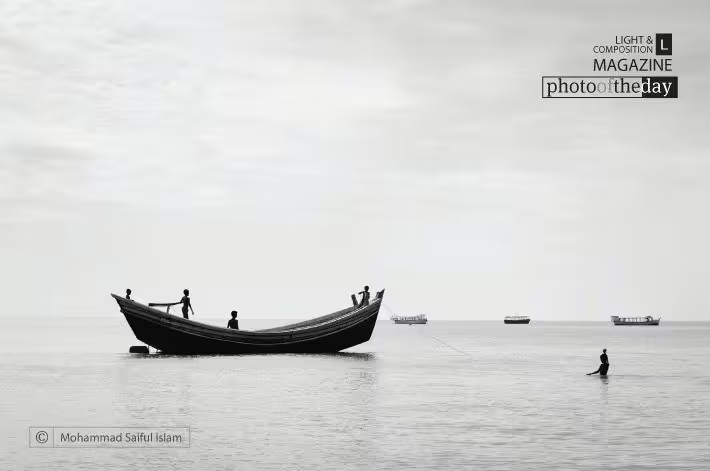
Exposure 1/2500sec @ f/4.5 | ISO 200 | Focal Length 35mm
Mohammad Saiful Islam
Born in Bangladesh in 1984, Mohammad Saiful Islam is a dedicated photographer and military officer whose work explores the diversity of human life across the globe. Since beginning his photographic journey in 2011, he has developed a keen eye for street photography, nature, and the human condition, working skillfully in both color and monochrome. His evocative imagery has earned him numerous accolades and international recognition, with his work frequently featured in exhibitions, national newspapers, and prestigious photography contests.
Resonance Score Breakdown
Transparency Note: The resonance score (12.7/20) is calculated based on social engagement metrics collected before the award announcement.
Expert Photography Reviews · 6
The Edge of Everything
In the early maps of the world, cartographers often drew monsters in the margins where the known land dissolved into the unknown deep. They were not merely warnings; they were acknowledgments of the human impulse to stand at the precipice.
Read the reflection →Salt on the Skin
The taste of the sea is not just salt; it is the sharp, metallic tang of cold water hitting warm skin. I remember the feeling of sand between my toes—not the soft, powdery kind, but the coarse, wet grit that clings to your ankles like a heavy secret.
Read the reflection →Reviews & Comments
Share your thoughts about this award-winning photograph. Your reviews contribute to the community engagement score.

The sea here isn’t just water; it’s a vast, breathing silence. Mohammad waited for the precise moment these boys became part of the horizon’s rhythm. I’ve stood on shores like Kuakata, feeling the salt air turn heavy, and I can almost feel the damp sand beneath his feet. It’s a quiet, fleeting grace. Watching them run against that infinite grey, I’m reminded that we don’t capture life—we simply wait for it to reveal itself.
We look at these boys in Kuakata and we hear the tide before we see the spray. Mohammad Saiful Islam didn’t just point his lens; he waited for the moment they stopped being subjects and became part of the sea itself. It’s a quiet, salt-crusted joy that catches in my throat. They’ve forgotten the camera entirely. That’s the mark of a listener. It’s a photograph that asks to be returned to, again and again.
The horizon line bisects the frame with clinical indifference, anchoring the chaotic movement of the surf. It’s a rigid geometry that forces the eye toward the subjects’ silhouettes. The negative space above the water creates a necessary vacuum, preventing the composition from collapsing into mere sentiment. I’ve grown weary of such subjects, yet the spatial tension here holds. The frame doesn’t just contain the sea; it disciplines the chaos into a singular, austere architectural statement.
Before the eye identifies the boys, something in the chest tightens. It’s the salt-heavy air I feel, that sudden, sharp activation of a forgotten childhood summer. The shutter speed doesn’t just freeze the water; it suspends the boys in a perpetual, breathless state of becoming. When I return to this, I’m struck by the ache of their smallness against that vast, indifferent horizon. It’s a quiet, rhythmic haunting that follows me home, long after the gallery lights dim.
The horizon line cuts the frame. It’s a clean break. Below, the boys run. Above, the sky holds its breath. I’ve spent minutes staring at that expanse of grey. It’s not just air. It’s weight. The silence here is heavy, almost cold. Nothing is accidental. The empty corner isn’t empty; it’s where the ocean waits. I feel small standing before it. It’s a rare, quiet mercy. The space between them and the sea is everything.
One suspects Islam didn’t just stumble upon these boys. That shutter speed suggests he’d been standing in the salt spray for hours, waiting for the exact moment the tide and the children’s curiosity aligned. It’s a rare thing to see such patience rewarded with genuine spontaneity. I’ve spent enough days shivering on a coastline to know when someone’s put in the work. He didn’t just take a photo; he earned the sea’s cooperation. Well played.
Mohammad’s picture poses such compassion and empathy, very beautiful.