Night Train to Brawley by Mickey Strider
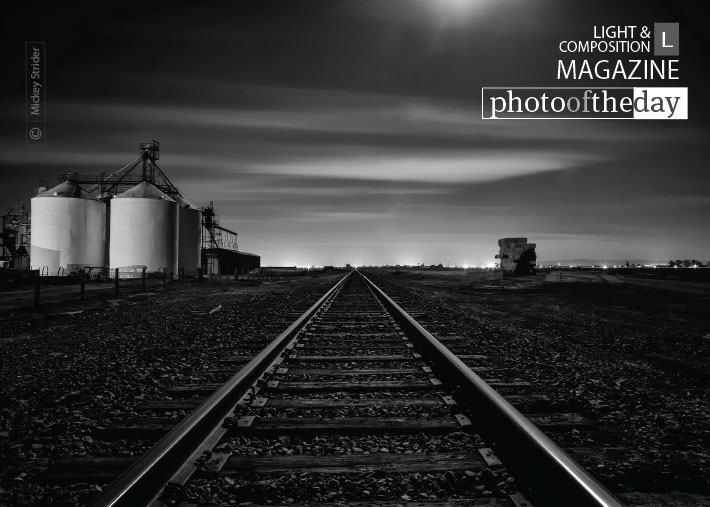
Captured under the ethereal glow of a full moon, this long-exposure photograph depicts train tracks vanishing into the horizon near Brawley, California. The photographer, initially searching for demolished silos, discovered this striking scene as the final shot of the night. By utilizing a 300-second exposure, the artist captured subtle cloud movement that adds a dynamic, dreamlike quality to the stillness of the desert landscape. The composition is masterfully balanced, drawing the viewer’s eye along the converging lines of the tracks, making it a poignant and technically precise conclusion to a night of exploration.
Mickey Strider
Born and raised in Baltimore, Maryland, Mickey Strider is a seasoned creative professional with an extensive background in film production, advertising, and cinematography. After studying art at the Maryland Institute College of Art, he built a distinguished career directing commercials and producing award-winning short films that have screened at prestigious festivals nationwide. Currently based in San Diego, California, Strider serves as the Director of Broadcast at ViTRO, where he continues to lead high-profile campaigns for major international brands, blending his technical expertise with a refined artistic vision.
Resonance Score Breakdown
Transparency Note: The resonance score (14.0/20) is calculated based on social engagement metrics collected before the award announcement.
Expert Photography Reviews · 5
The Hum of Iron
The air at midnight tastes of cooling metal and dry, parched earth. I remember the sensation of pressing my palm against a rail that had spent the entire day drinking in the sun; it held a deep, vibrating heat that seemed to hum against my skin long after I pulled away.
Read the reflection →The Path That Waits
There is a quiet wisdom in the way a path disappears into the dark. We spend so much of our lives demanding to see the destination, fearing the uncertainty of what lies beyond the reach of our own small light. Yet, the earth does not rush to reveal itself.
Read the reflection →Reviews & Comments
Share your thoughts about this award-winning photograph. Your reviews contribute to the community engagement score.
300 seconds at f/11, ISO 100, 14mm. A five-minute exposure is a gamble with sensor noise, but the 60D held up. Stopping down to f/11 was the right call for diffraction-limited sharpness across the frame. The tracks converge with mathematical precision. I’ve spent years looking at desert long exposures that dissolve into mush, but this is crisp. It’s cold, calculated, and technically sound. Honestly, I’m impressed by the lack of light pollution here. It’s rare.
The shutter stays open, and the desert breathes. Five minutes of exposure turns the sky into a slow, velvet drift over the steel veins of Brawley. It’s a tracking shot that refuses to end, pulling your eye toward a horizon that doesn’t exist. I’ve spent nights waiting for light like this; it’s haunting. The cut would have been a mistake. This is the frame the editor keeps, the one that holds the silence perfectly.
The desert doesn’t sleep; it just holds its breath. Standing there for five minutes, he must have felt the earth’s rotation beneath his boots as the moon pulled those clouds into a ghostly blur. I’ve spent enough nights in the dark to know that silence has a weight. It’s haunting how the tracks pull us into the void. I find myself wanting to walk down them, just to see where the light finally ends.
Three hundred seconds of exposure doesn’t just capture light; it exhumes the silence of the desert. Those converging rails aren’t leading toward Brawley, but into an abyss where time itself dissolves. I’ve stared at these tracks until my eyes ached, feeling the cold weight of the void pressing against the shutter. It’s a haunting, hollow geometry. Strider hasn’t merely photographed a landscape; he’s forced the darkness to admit that we are entirely, beautifully alone out here.
At f/11, the diffraction limit begins to soften the fine steel edges, yet the 300-second exposure forces the sensor to integrate photons the human eye simply misses. The lunar illumination renders the desert floor with a clinical, haunting clarity. I’m genuinely moved by how the chromatic aberration at the frame’s periphery dissolves into the velvet sky. It’s a rare instance where the lens’s optical constraints don’t hinder the narrative; they actually define the dream.