Screen Printing by Jabbar Jamil
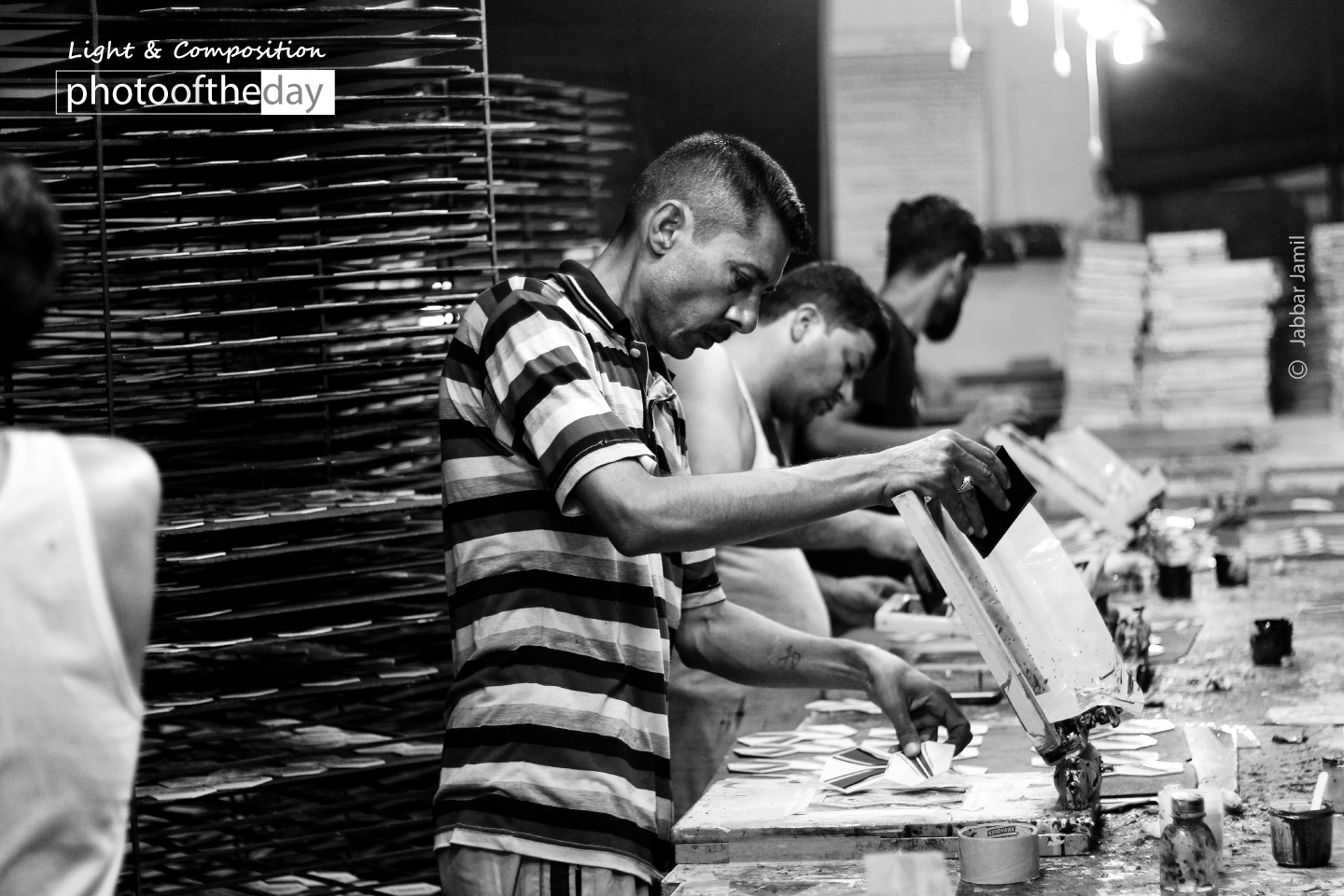
In the bustling industrial heart of Sialkot, Pakistan, Jabbar Jamil captures the rhythmic intensity of a football manufacturing factory. The photograph focuses on a screen-printing station where a team of laborers works in synchronized motion to apply logos and text to sports equipment. By documenting the division of labor and the repetitive, high-speed nature of the assembly line, Jamil highlights the human element behind mass production. The image is award-worthy for its candid portrayal of industrial life, utilizing a sharp compositional eye to transform a mundane workspace into a compelling narrative of human effort and collective productivity.
Jabbar Jamil
Based in Sialkot, Pakistan, Jabbar Jamil is a dedicated street photographer who views his craft as a vital bridge between his personal comfort zone and the wider world. His work serves as both a creative outlet and a meditative practice, allowing him to document the raw, often unvarnished realities of his environment. Through his lens, Jamil seeks to forge human connections, capturing the authentic moments of daily life that define his community and his perspective as a visual storyteller.
Resonance Score Breakdown
Transparency Note: The resonance score (11.0/20) is calculated based on social engagement metrics collected before the award announcement.
Expert Photography Reviews · 8
The Rhythm of the Hands
We are all woven from the same thread of repetition, a steady heartbeat that marks the passage of our days. There is a quiet sanctity in the work that demands our full attention, where the palm meets the surface and the mind settles into the groove of a task.
Read the reflection →The Rhythm of the Dust
There is a particular quality to the light in a room where work is constant, a thick, suspended clarity that seems to hold the weight of every movement made within it.
Read the reflection →Reviews & Comments
Share your thoughts about this award-winning photograph. Your reviews contribute to the community engagement score.
You’ve caught the rhythm of that factory floor perfectly. I can almost hear the slap of the screens and the heavy breathing of the men. It’s not just the labor; it’s the way their hands move in that blur of repetition. I’ve stood in rooms like that, and the heat usually chokes the life out of a frame. You didn’t let that happen. There’s something honest happening here. You waited. I can feel it.
Watching these laborers, I’m struck by the same frantic, repetitive tension I see in a nesting bird harassed by a lens. It’s a high-speed assembly line, yet there’s a cold, extractive quality to the framing. Did Jamil earn this proximity, or did he simply intrude? I find the lack of human connection unsettling. It’s technically sharp, sure, but it feels like a hunt where the subject’s dignity was sacrificed for the sake of the shot.
The rhythm here is electric. Jamil caught the exact millisecond the squeegee hit the frame, freezing the blur of labor into a perfect, kinetic geometry. It’s industrial poetry. I’ve spent years chasing this kind of syncopation; one tenth of a second later and the tension collapses, the human connection lost to the machine. My heart actually raced looking at this. It’s not just a factory floor; it’s a heartbeat caught in ink. That’s the decisive moment, pure and simple.
The rhythm here is relentless. It’s a blur of ink and muscle, a high-speed assembly line caught in a perfect, shutter-locked freeze. I’m struck by the blur of the squeegee—it’s the kinetic heartbeat of the factory. Jamil didn’t just document a process; he captured the exact frame where the labor becomes a dance. The cut would’ve been a mistake. It’s a visceral, sweaty, beautiful sequence that refuses to move, and honestly, it makes me hold my breath.
The screen-printing frame dictates the rhythm here. It’s a rigid geometry of repetitive labor. The alignment of the squeegees creates a sharp, diagonal tension that pulls the eye across the picture plane with clinical efficiency. I’m genuinely unsettled by how perfectly the laborers’ limbs mirror the industrial apparatus. It’s cold, precise, and entirely devoid of sentimentality. The composition doesn’t just hold; it traps the viewer within the factory’s relentless, mechanical architecture. It’s a brutal, necessary structure.
In Sialkot, the ink doesn’t just stain the fabric; it marks the rhythm of a life. We watch these hands move in a blur of synchronized labor, and we feel the weight of their repetition. I’m struck by the quiet focus in their eyes, a gaze that suggests they’ve listened to the machine’s hum long before they touched the screen. It’s a haunting, beautiful dance of human effort. This is a photograph that asks to be returned to.
Watching these laborers in Sialkot, I’m struck by how they move with the same fluid, rhythmic precision I’ve seen in schooling baitfish. There’s no backscatter here, no light-stealing water column to fight, just the raw, dry clarity of human industry. It’s a relief to see such sharp, vibrant color without worrying about the refractive index or red-light absorption. I find myself mesmerized by their synchronized pace; it’s a beautiful, chaotic dance that feels strangely, wonderfully alien.
The ink-stained surfaces and rhythmic geometry of the drying racks create a claustrophobic, industrial choreography that defines these men. I’m struck by how the harsh, directional light catches the wet pigment, turning the workspace into a visceral, tactile landscape. It’s not just a factory; it’s a theater of repetition. The environment doesn’t merely frame the laborers; it dictates their posture and pace. I find the sheer weight of that mechanical atmosphere deeply moving, almost suffocatingly beautiful.
strikes me the most is how workers carefully do there art work.