Fun after School by Shahnaz Parvin
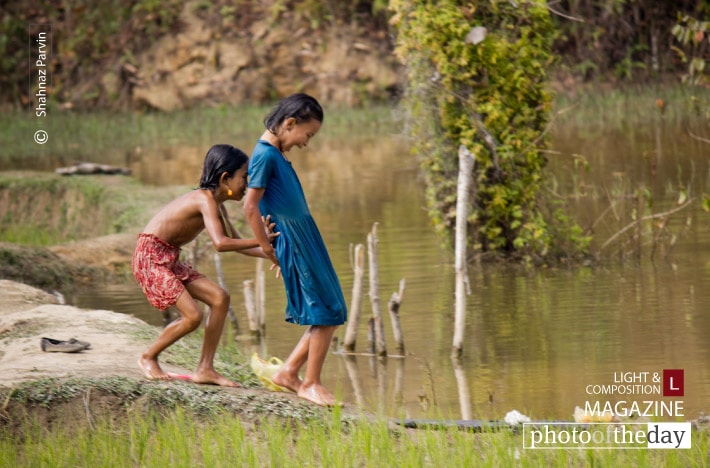
Captured in the scenic hills of Bandarban, this photograph documents a spontaneous moment of childhood joy. As children from the Tanchangya community finished their school day, they gathered at a local pond to bathe and play, their natural exuberance providing a candid glimpse into village life. The photographer, drawn to the authenticity of the scene, utilized a long focal length to observe the interaction from a distance, ensuring the subjects remained undisturbed. The image is award-worthy for its ability to transform a simple, fleeting moment of play into a poignant cultural narrative, highlighting the vibrant spirit of youth against a serene, rural backdrop.
Shahnaz Parvin
Based in Dhaka, Bangladesh, Shahnaz Parvin was a highly acclaimed photojournalist celebrated for her profound documentary work. Recognized as one of the world's top photographers during her career, she dedicated her lens to capturing the diverse culture, people, and landscapes of her homeland. As a prolific contributor to Light and Composition, she earned numerous accolades for her evocative storytelling, leaving behind a significant legacy that continues to represent the heart and soul of South Asian photography.
Resonance Score Breakdown
Transparency Note: The resonance score (12.7/20) is calculated based on social engagement metrics collected before the award announcement.
Expert Photography Reviews · 7
The Weight of Water
We forget how to be light. As children, the body is not a vessel for labor or a map of scars; it is simply a way to move through the world. We run toward the water not because we are thirsty, but because the water is there, offering a mirror that does not judge.
Read the reflection →The Weight of Water
In the physics of childhood, time does not move in a straight line. It pools. It gathers in the hollows of the day, much like rainwater caught in a stone basin, waiting for a disturbance to ripple its surface.
Read the reflection →Reviews & Comments
Share your thoughts about this award-winning photograph. Your reviews contribute to the community engagement score.
Most travel photography relies on the exotic to mask a lack of substance, but this frame earns its place by resisting that trap. Using a 194mm lens, Parvin keeps her distance, letting the Tanchangya children’s chaotic splash define the scene rather than the photographer’s ego. It’s a rare, honest glimpse of pure, unposed joy. I’ll admit, seeing their unfiltered laughter makes me miss the simplicity of my own childhood. It’s a keeper for the archives.
At 194mm, the compression of the focal plane renders the Bandarban hills into a soft, painterly bokeh, a function of the f/5.6 aperture that isolates the children beautifully. I’m struck by how the lens resolves the water’s surface tension; it’s a delicate interplay of light refraction that the human eye simply misses. The diffraction limit hasn’t compromised the sharpness of their laughter. It’s a rare, crystalline capture of joy that I’ve found genuinely moving.
The pond holds them. A ripple breaks the surface. It’s a quiet geometry of play. I’ve spent minutes watching the water, not the children. The distance creates a stillness that feels heavy. It’s rare to see such restraint in a scene so full of motion. Nothing here is accidental. The empty corner is not empty. It’s a breath. I feel a sudden, sharp ache for that silence. It’s enough. It’s everything.
The 194mm compression flattens the spatial depth, forcing the figures into a rigid, rhythmic sequence against the water. It’s a calculated geometry. The negative space surrounding the splashing children provides the necessary fulcrum to balance the frame’s internal weight. I’ve grown weary of sentimental travel snapshots, but the discipline here holds. The composition doesn’t collapse under the weight of its own narrative. It’s a rare, structural success that keeps the eye locked within the frame.
1/60sec at f/5.6, 194mm. It’s a precarious choice. At this focal length, 1/60sec is begging for motion blur, yet the shutter speed holds. The compression of the 194mm lens flattens the pond, forcing the subjects into a tight, coherent plane. I’ve seen enough shaky telephoto shots to know this took discipline. It’s technically sound, though I’d prefer a faster shutter to freeze the splash. It’s a sharp, calculated capture. I actually respect the restraint here.
Before the eye identifies the children, a sudden lightness enters the chest. It’s the kinetic energy of the splash, the way the water catches the light, that triggers a visceral, almost forgotten memory of unburdened play. I’ve returned to this pond three times today, and each time, the stillness of the hills deepens my own breathing. It’s a rare, quiet joy that follows me home, lingering like the cool spray of a distant, sun-drenched afternoon.
The light here isn’t just illumination; it’s a soft, humid breath settling over the Bandarban hills. Shahnaz waited, holding her breath, letting the distance between her and the pond dissolve. I’ve felt that same stillness, where the shutter release feels like an intrusion on a sacred ritual. Watching these children splash in the cooling hour, I’m struck by a sudden, sharp ache for my own lost simplicity. It’s a quiet, holy grace captured in motion.