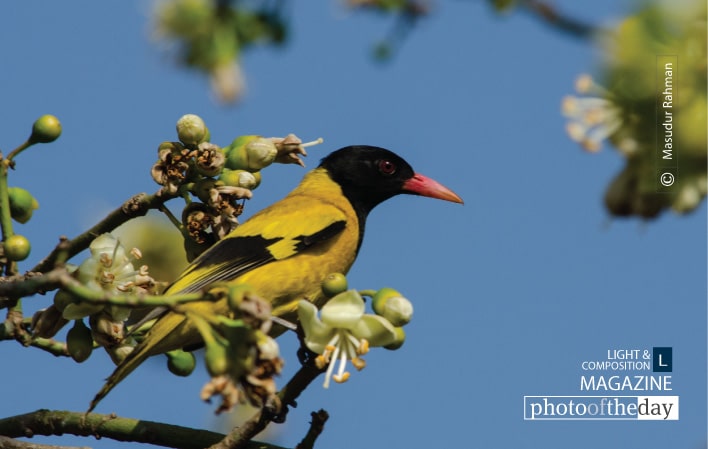
Black-hooded Oriole by Masudur Rahman
Captured on a crisp winter morning near the Karnaphuli River in Mohora, this striking portrait of a Black-hooded Oriole highlights the bird's vibrant yellow and black plumage. The photographer expertly utilized a 400mm focal length to isolate the subject against its natural habitat, showcasing the intricate details of this species, locally known as 'Hulud Pakhi.' The image is award-worthy for its clean composition and the precise technical execution required to document such a fleeting wildlife moment, effectively celebrating the natural beauty of Bangladesh’s avian life.
Masudur Rahman
Born in 1967, Masudur Rahman Mamoon is a dedicated wildlife photographer based in Chittagong, Bangladesh. After beginning his journey with portraiture in 1998, he transitioned his focus to bird photography in 2007, eventually becoming an active member of the Chittagong Bird Club. A graduate of Chittagong University, Mamoon balances his professional life with a deep commitment to documenting nature, frequently sharing his avian photography and insights through local media to foster a greater appreciation for wildlife conservation.
Resonance Score Breakdown
Transparency Note: The resonance score (13.8/20) is calculated based on social engagement metrics collected before the award announcement.
Expert Photography Reviews · 5
The Weight of Yellow
In the quiet hours before the world fully wakes, there is a particular shade of yellow that seems to hold more gravity than the rest. It is not the aggressive gold of high noon, nor the pale, sickly tint of old parchment. It is a vibrant, startling declaration of presence.
Read the reflection →A Flash of Brightness
I was walking through the park this morning, feeling a bit gray. The sky was heavy, and I had a long list of chores weighing down my pockets. I was looking at the pavement, counting my steps, when a sudden burst of color caught my eye from the branches above.
Read the reflection →Reviews & Comments
Share your thoughts about this award-winning photograph. Your reviews contribute to the community engagement score.
Before the eye identifies the bird, something in the chest tightens. That sudden, electric yellow against the muted, blurred greens of Mohora triggers an immediate physiological alertness. It’s a sharp, singular focus that demands I hold my breath. When I return to this, I’m struck by the isolation of the subject; it feels like a secret kept from the river. I’ve found myself craving that specific, vibrant clarity on gray mornings. It’s a quiet, piercing joy.
Of the thousands of wildlife shots I’ve reviewed, most are just pretty records. This Oriole survives because of that sharp, aggressive focus on the eye; it’s a tiny, piercing anchor in a sea of soft green. I’ll admit, the vibrant yellow plumage actually made me smile. It’s not just a technical capture; it’s a moment of pure, unadulterated life. In thirty years, this clarity will still feel like a genuine encounter, not a digital artifact.
One suspects the light cooperated on the first attempt. It often does, for the patient. Yet, there’s a stillness here that suggests Rahman didn’t just stumble upon this Oriole. He’s clearly spent hours in the damp heat of the Karnaphuli, waiting for that precise, sharp turn of the head. I’ve spent enough mornings shivering in a blind to respect the discipline required for such clarity. It’s a quiet, earned victory. Well played, sir.
1/800sec at f/9, 400mm, ISO 400. Rahman chose a narrow aperture to ensure the entire bird remained sharp, sacrificing background bokeh for absolute focus. It’s a calculated, rigid trade-off. At 400mm, the D7000’s sensor handles the light well enough, but f/9 feels overly cautious. I’ve spent years chasing focus on erratic subjects; I’ll admit, the precision here is irritatingly perfect. He didn’t gamble, and frankly, the result doesn’t leave room for me to complain. It works.
At f/9, the Nikkor’s focal plane is razor-thin, yet it’s captured the Oriole’s plumage with startling micro-contrast. The diffraction limit hasn’t softened the primary feathers, allowing the sensor to resolve textures the human eye would simply blur into yellow noise. It’s a clinical triumph of optics. I’m genuinely moved by how the bokeh, a function of that long 400mm compression, renders the background into a soft, painterly wash. It’s a rare, precise intersection of glass and biology.