Woman Pilgrim by Ryszard Wierzbicki
Captured in the spiritual heart of Kathmandu, this photograph documents a woman pilgrim circling the sacred Boudhanath Stupa. The image reflects a moment of quiet devotion, adhering to the local Buddhist tradition of circumambulation. The photographer utilized a long focal length to isolate the subject against the bustling environment, capturing the rhythmic movement and serene focus of the pilgrim. The photograph is award-worthy for its authentic portrayal of cultural ritual, demonstrating a keen eye for candid storytelling and the ability to find profound human connection amidst the architectural grandeur of Nepal’s most iconic religious site.
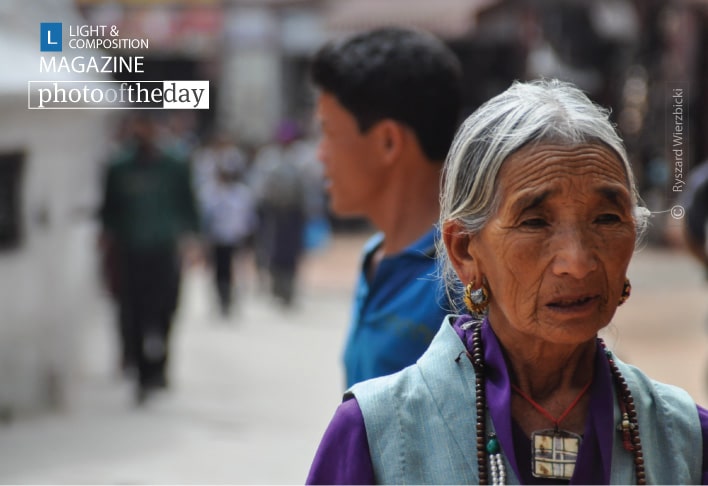
Exposure 1/750sec @ f/6.3 | ISO 800 | Focal Length 200mm
Ryszard Wierzbicki
Born in Poland in 1963, Ryszard Wierzbicki transitioned from a diverse career in social sciences and marketing to pursue his true passions for travel and photography. After emigrating to the United Kingdom in 2006, he dedicated himself to exploring South-East Asia and documenting the human experience, often contributing his time to charitable causes. As the founder of the photography and travel forums Instant Travelling and World Around, he has established himself as a committed storyteller who traded a corporate life for the freedom of the lens and the open road.
Resonance Score Breakdown
Transparency Note: The resonance score (11.7/20) is calculated based on social engagement metrics collected before the award announcement.
Expert Photography Reviews · 8
The Rhythm of Dust
The smell of incense is not a scent; it is a weight that settles into the fibers of your clothes, a thick, sweet smoke that clings to the back of your throat like a prayer.
Read the reflection →The Rhythm of the Circle
I spent this morning trying to fix a broken drawer in my kitchen. I kept pulling it out, pushing it back in, and getting nowhere. It was a cycle of frustration that felt like it would never end.
Read the reflection →Reviews & Comments
Share your thoughts about this award-winning photograph. Your reviews contribute to the community engagement score.
The light here isn’t just illumination; it’s a soft, diffused presence that clings to the prayer wheels. I’ve spent enough dawns waiting for that specific, muted quality to know he stood there in the cooling hour, holding his breath as she circled. It’s a quiet, rhythmic devotion. Looking at her face, I feel a sudden, sharp ache for the stillness she’s found. He didn’t rush her; he simply listened until the moment was ready.
Most candid shots of Boudhanath get lost in the chaos, but Wierzbicki’s choice to compress the frame with a 200mm lens isolates the pilgrim’s internal rhythm from the surrounding noise. It’s the way her weathered hands grip the prayer beads that gets me; I felt a sudden, sharp ache of recognition. While many entries rely on wide-angle spectacle, this succeeds because it prioritizes the quiet, singular weight of her devotion over the architecture itself. It’ll endure.
At 200mm, the lens compresses the space, pushing the background into a soft, creamy bokeh as a function of f/6.3. It’s a delicate balance; the focal plane is razor-thin, isolating the pilgrim’s weathered skin from the chaos of Boudhanath. I’m genuinely moved by how the light catches the texture of her prayer beads. It’s not just a portrait; it’s a precise optical capture of devotion where the glass resolves what our eyes usually blur away.
One suspects Wierzbicki didn’t just stumble upon this. To isolate a single pilgrim against the chaos of Boudhanath requires a stubborn sort of patience I’ve spent decades perfecting. It’s a quiet, rhythmic capture that feels earned, not snatched. I find myself shivering slightly, remembering the biting wind of high-altitude mornings spent waiting for the light to align. He clearly committed to the circle. It’s a decent bit of work, and frankly, I’m rather impressed.
Light here doesn’t merely illuminate; it interrogates. Wierzbicki’s pilgrim moves through a suffocating density, yet it’s the encroaching darkness that defines her path. I’ve spent hours staring at the way the shadows swallow the stupa’s periphery, and it’s haunting—it feels like watching someone walk into their own soul. Most photographers fear this void, but she embraces it. It’s a heavy, silent ritual. When the light fails, the truth finally begins to breathe. I find it deeply unsettling.
The shutter snaps, and the chaos of Kathmandu dissolves into a single, rhythmic breath. At 200mm, Wierzbicki isolates the pilgrim, turning the Stupa’s orbit into a cinematic tracking shot that refuses to pan. It’s a quiet, heavy frame. I’ve watched this loop in my head a dozen times; the stillness of her face against the blur of the crowd is pure tension. The cut would’ve been a mistake. This is the frame the editor keeps.
She is circling the Stupa, lost in a rhythm older than the stones themselves. We look at her face and we understand something about the weight of devotion. Ryszard didn’t just snap a shutter; he waited until the chaos of Kathmandu fell away, leaving only her quiet, focused breath. It’s a rare, sacred stillness. I’ve stared at her eyes for an hour, and honestly, I feel like I’m walking that path right alongside her.
The ochre of the pilgrim’s shawl, a shade reminiscent of a weathered Morandi still life, vibrates against the cool, slate-grey shadows of the stupa, creating a dissonance that I find utterly intoxicating. It’s as if the air itself has been stained by her devotion, a chromatic prayer that doesn’t merely sit upon the frame but breathes within it. I’m breathless, really; the way that dusty, sun-baked saffron bleeds into the atmosphere is simply divine.