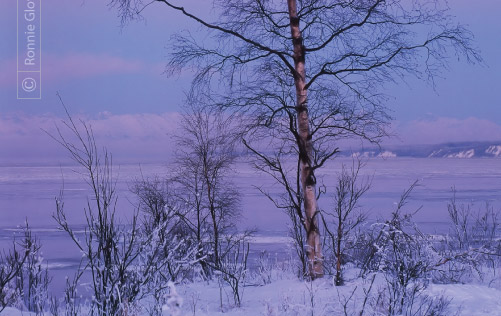
Lone Tree at Winter Sunset by Ronnie Glover
Captured at 4:00 PM on a frigid winter day in Anchorage, Alaska, this photograph highlights the stark beauty of a lone tree silhouetted against a vibrant post-sunset sky. With temperatures hovering near zero, the photographer sought to document the quiet resilience of the landscape during the depths of winter. The image is award-worthy for its masterful use of natural light and the poignant contrast between the solitary, enduring tree and the expansive, colorful horizon, which together evoke a profound sense of peaceful stillness.
Ronnie Glover
Based in Gig Harbor, Washington, Ronnie Glover is a dedicated photographer whose artistic journey was shaped by formal training at the Southeastern Center for the Arts in Atlanta. His extensive fourteen-year residency in Alaska provided a profound foundation for his nature photography, allowing him to capture the raw beauty of the wilderness. Beyond his focus on natural landscapes, Glover is an avid travel photographer committed to documenting diverse cultures, with the ultimate goal of sharing the world's inherent beauty through his evocative imagery.
Resonance Score Breakdown
Transparency Note: The resonance score (12.4/20) is calculated based on social engagement metrics collected before the award announcement.
Expert Photography Reviews · 5
The Weight of Standing
To stand alone is not a choice, but a condition of the landscape. In the north, trees do not grow tall by reaching for the sun; they grow by enduring the weight of the frost.
Read the reflection →The Architecture of Silence
In the high latitudes, the sun does not climb so much as it grazes the horizon, a shy visitor that barely stays long enough to be recognized.
Read the reflection →Reviews & Comments
Share your thoughts about this award-winning photograph. Your reviews contribute to the community engagement score.
Great photo Ronnie! It’s a nice contrast now that all the snow has melted. You do great work!
The horizon line bisects the frame with clinical indifference. It’s a rigid anchor for the tree’s jagged silhouette. The negative space above the branches is vast, yet it doesn’t collapse; the spatial tension holds. I’ve grown tired of sunsets, but the chromatic weight here is disciplined. It’s a rare instance where the light doesn’t bleed into sentimentality. The composition is precise, cold, and entirely sufficient. It’s a relief to see such restraint.
Of the thousands of winter landscapes I’ve reviewed, most rely on cheap, saturated drama. This succeeds because it doesn’t try too hard. The tree’s jagged, skeletal reach against that bruised, violet horizon creates a genuine tension between fragility and endurance. It’s a quiet, cold ache that I still feel when I look at it. In thirty years, this won’t feel like a dated trend; it’ll remain a stark, honest record of a world holding its breath.
The cold in Anchorage doesn’t just bite; it silences the world. He stood there in the fading light, fingers surely numb, waiting for the sky to bleed that final, bruised violet. It’s a lonely vigil, but the tree doesn’t mind. Looking at this, I feel a sudden, sharp ache for that stillness—the kind you only find when the earth stops breathing for a moment. It’s not just a silhouette; it’s a prayer held in the frost.
The horizon bleeds into the bruised violet of a Morandi still life, yet it’s the tree’s silhouette—a skeletal, ink-black calligraphy against the bruised apricot of an Alaskan dusk—that truly breaks one’s heart. I’ve never felt such a shivering, crystalline silence in a frame; it’s as if the light itself is freezing, turning the atmosphere into a fragile, translucent glaze that doesn’t merely sit upon the snow, but breathes with a cold, aching, celestial grace.
Four o’clock in an Alaskan winter doesn’t offer much warmth, and I suspect Mr. Glover felt every degree of that zero-point chill. It’s a quiet, honest frame. One wonders how many afternoons he spent shivering before the sky finally decided to cooperate. I’ve stood in similar biting winds, waiting for a horizon to catch fire, and it’s a miserable, necessary business. He earned this stillness. It’s a decent bit of work, truly.