Moroccan Heads by Abdellah Azizi
Captured in the aftermath of a refreshing rain shower in Ouarzazate, this image documents the vibrant communal spirit of Morocco as residents emerge to embrace the returning sun. The photographer was drawn to the unique intersection of European-influenced architecture and the deeply conservative, traditional culture of the region's southern inhabitants. By choosing a narrow aperture to maintain depth in the public square, the photographer highlights the interplay between the environment and the local figures. This work is award-worthy for its authentic cultural storytelling, capturing a fleeting, candid moment that bridges the gap between modern urban life and timeless Moroccan tradition.
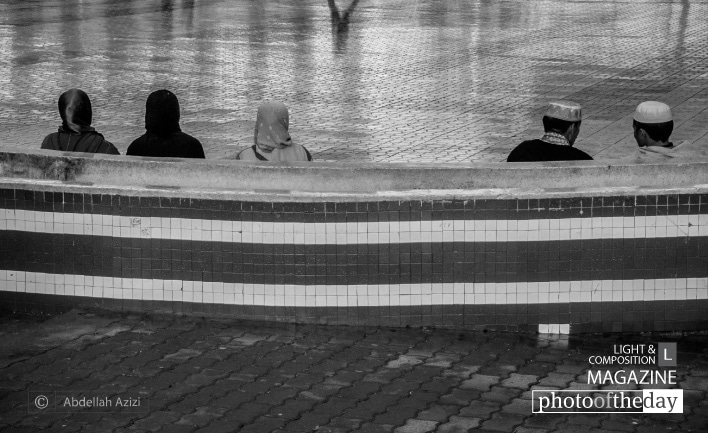
Exposure 1/40sec @ f/22 | ISO 640 | Focal Length 48mm
Abdellah Azizi
Born in Ouarzazate in 1987, Abdellah Azizi is a Moroccan photographer dedicated to capturing the landscapes, folkloric traditions, and daily life of North Africa. After formal training in lighting, grip techniques, and audio-visual post-production, he transitioned from a career in film and videography to professional photography. Driven by the creative freedom the medium provides, Azizi now focuses on documenting the rich cultural tapestry of his homeland, leveraging his technical background in lighting to produce evocative and authentic imagery.
Resonance Score Breakdown
Transparency Note: The resonance score (12.9/20) is calculated based on social engagement metrics collected before the award announcement.
Expert Photography Reviews · 7
The Architecture of Belonging
In the high desert, the air carries a particular weight after the rain, a scent of damp earth rising to meet a sun that has been waiting for its turn to reclaim the sky.
Read the reflection →The Weight of Shadows
We walk through the streets of our own making, yet we are rarely present in them. There is a distance between the stone beneath our feet and the thoughts that pull us elsewhere. We pass one another like ghosts, heads bowed, anchored by the gravity of things unsaid.
Read the reflection →Reviews & Comments
Share your thoughts about this award-winning photograph. Your reviews contribute to the community engagement score.
The rain has just retreated, leaving the Ouarzazate stone heavy with damp memory. I feel the chill of that wet earth in my own bones. Azizi didn’t rush; he waited for the light to soften against those ochre walls, listening to the square breathe again. It’s a quiet, humble geometry. He’s captured the exact moment when the land stops mourning the clouds and begins to welcome the sun. It’s a rare, patient grace I deeply admire.
Before the eye identifies the Ouarzazate square, something in the chest tightens. It’s the rain-washed stillness, that held-breath moment before the sun reclaims the stone. I feel a strange, cool dampness on my own skin looking at those shadowed figures. When I return to this a year later, the architecture feels less like a backdrop and more like a cage for time itself. It doesn’t just document a place; it haunts the quiet corners of my memory.
Rain has washed the dust from Ouarzazate. The light hits the stone. It’s sharp. I’m drawn to the wall, not the crowd. The figures are small, incidental. They don’t demand the eye. I find myself breathing with the architecture. The space between the heads is where the story lives. It’s quiet. Nothing here is accidental. The empty corner is not empty. It’s a pause. I’ve never felt such stillness in a public square.
Shooting at f/22 on a D90 sensor inevitably invites diffraction, softening the fine textures of the Ouarzazate architecture. While the focal plane spans the square, the Airy disk expansion here obscures the micro-contrast I crave. It’s a technical compromise, yet there’s a haunting, tactile quality to the light hitting those damp surfaces. I’m genuinely moved by how the haze softens the figures; it’s as if the physics of the lens itself captured the desert’s humid, fleeting breath.
1/40sec at f/22, ISO 640, 48mm. Diffraction is the enemy here. Stopping down to f/22 on a D90 sensor introduces significant softness; it’s a technical failure that undermines the sharpness required for street documentation. The shutter speed is dangerously slow for handheld work, leading to motion blur that ruins the figures. I’ve spent years staring at these charts, and it’s frustrating to see such poor light management. The optics simply weren’t respected here.
F/22 on a D90? That’s a bold gamble with diffraction, though it keeps the Ouarzazate square sharp enough. One wonders if Azizi stood there until his boots grew roots, or if he simply got lucky with the rain. I’ve spent enough miserable afternoons waiting for light to know that the best shots aren’t found; they’re endured. It’s a decent bit of patience, even if the composition feels a touch hurried. Still, I’d have stayed longer.
Most street photography from 2013 feels dated, but this holds up. The choice of f/22 forces the viewer to reconcile the sharp, textured stone of Ouarzazate with the blurred, rhythmic movement of the figures. It’s the tension between that static architecture and the fleeting human presence that makes me stop. I’ve seen thousands of square-life shots, but the way the light hits those wet surfaces makes me feel the cooling air. It’s a keeper.
Very nice photograph :)