Makeshift Boat by Nirupam Roy
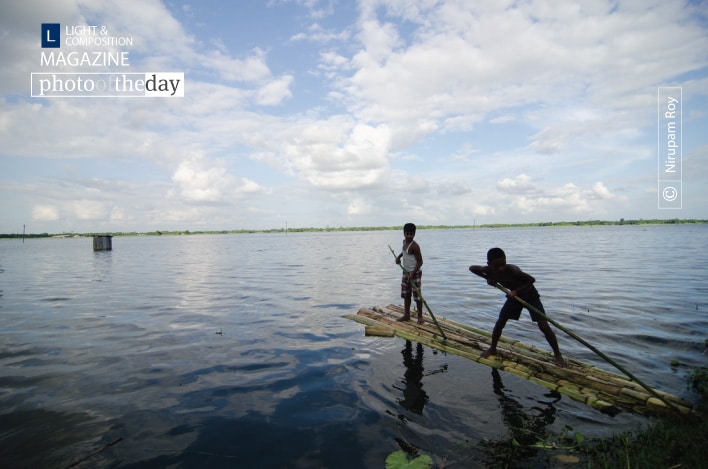
Captured during the monsoon season in rural West Bengal, this image documents a fleeting moment of childhood ingenuity. As the landscape transforms with rising waters, two young boys navigate a makeshift vessel crafted from banana tree trunks—a traditional and resourceful solution to the flooded terrain. The photographer skillfully utilizes a wide-angle lens to immerse the viewer in the scene, emphasizing the scale of the water against the boys' determined expressions. This photograph is award-worthy for its authentic portrayal of rural life, capturing a blend of cultural tradition and the resilient, playful spirit of youth amidst the seasonal elements.
Nirupam Roy
Hailing from the town of Tufanganj in West Bengal, India, Nirupam Roy balances a career as a school teacher with a profound dedication to documentary photography. His transition into the visual arts was sparked by a desire to capture the scenic beauty of his travels and the intimate moments of family life, eventually evolving into a deep-seated passion for exploring societal phenomena. Through his lens, Roy seeks to transform common, everyday aspects of life into meaningful narratives, finding both creative fulfillment and personal peace in his ongoing pursuit of photographic excellence.
Resonance Score Breakdown
Transparency Note: The resonance score (12.8/20) is calculated based on social engagement metrics collected before the award announcement.
Expert Photography Reviews · 5
The Weight of Paper Boats
I spent this morning watching my neighbor’s toddler try to sail a folded piece of notebook paper in a rain puddle. It didn't last long, of course. The paper grew heavy, turned to mush, and sank into the grit of the driveway.
Read the reflection →The Architecture of Drift
In the quiet hum of a kitchen, I often watch how water behaves when it meets an obstacle. It does not argue; it simply finds the path of least resistance, folding itself around stones and roots with a liquid, persistent grace.
Read the reflection →Reviews & Comments
Share your thoughts about this award-winning photograph. Your reviews contribute to the community engagement score.
The wide-angle distortion pushes the horizon, creating a precarious spatial tension. The banana-trunk vessel acts as a fulcrum, anchoring the boys against the encroaching water. It’s a rigid geometry that barely contains the chaos of the flood. I’m genuinely unsettled by how the frame forces the subjects into such a tight, sinking corner. The composition holds, but only just. It’s a fragile architecture that doesn’t permit a single wasted pixel in this watery expanse.
1/1250sec at f/4, 12mm. A wide-angle gamble. At 12mm, the Tokina demands proximity, yet the shutter speed is overkill for a drifting raft. It’s a clinical freeze of motion that didn’t need that much velocity. I’m annoyed by the wasted potential of the depth of field here. It’s sharp, sure, but the lack of separation makes the background bleed into the boys. It’s technically competent, but it’s a cold, distant way to document a flood.
The water stretches. It’s a vast, grey silence swallowing the horizon. Two boys drift on banana trunks. They aren’t fighting the flood; they’re part of it. I feel a sudden, sharp ache in my chest watching them. The frame is mostly sky and silt. Nothing here is accidental. The empty corner isn’t empty. It’s the weight of the monsoon. They’ve found a way to exist in the void. It’s quiet. It’s enough.
Most documentary work from this region fades into a blur of predictable poverty porn. What separates this from the pack is the boys’ posture; they aren’t victims, they’re captains. Using that 12mm lens forces us into their fragile banana-trunk boat, making me feel genuinely anxious about the water’s depth. It’s a rare, honest snapshot of childhood resilience. In thirty years, we won’t remember the monsoon, but we’ll remember their defiance against the rising tide.
Before the eye identifies the banana trunks, a sudden stillness settles in the chest. It’s the weight of the monsoon, that heavy, humid air pressing against the skin. I feel a strange, sharp ache in my throat watching them navigate that vast, indifferent water. When I return to this a year later, the boys’ focus remains, a quiet defiance against the flood. It’s a fragile, held-breath moment that follows me into the dark of sleep.