A Colorful Start by Zahraa Al Hassani
Zahraa Al Hassani captures a vibrant morning ritual, transforming simple, colorful buttons and a small blue spoon into a compelling visual narrative. Set against a moody, dark gray background, the composition emphasizes the striking contrast between the playful, bright objects and the somber environment. This deliberate arrangement reflects the photographer's background in graphic design, showcasing a keen eye for color theory and balance. The image is award-worthy for its ability to elevate an ordinary, domestic scene into a sophisticated study of color and form, demonstrating how meticulous styling can turn everyday items into a source of inspiration.
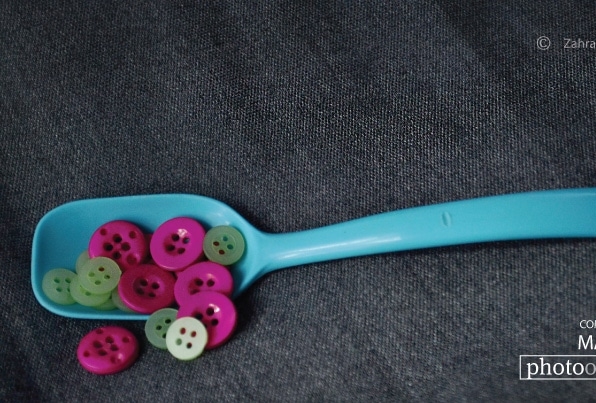
Exposure 1/100sec @ f/5.3 | ISO 800 | Focal Length 46mm
Zara Otaifah
Based in Baghdad, Iraq, Zahraa Al Hassani is a dedicated photographer and senior graphic designer at Zain Telecommunications. A graduate of the University of Technology in Baghdad, she leverages her extensive design expertise to refine her photographic perspective and visual storytelling. Her work is deeply influenced by her professional background in marketing and communications, where she focuses on creating elegant, impactful imagery. Balancing a career in telecommunications with her artistic pursuits, she remains committed to exploring the nuances of purist photography and expanding her creative horizons.
Resonance Score Breakdown
Transparency Note: The resonance score (12.1/20) is calculated based on social engagement metrics collected before the award announcement.
Expert Photography Reviews · 7
The Architecture of Small Things
We spend our lives waiting for the grand architecture of fate, forgetting that the universe often speaks in the language of the miniature. A handful of buttons, a stray spoon, the debris of a morning routine—these are the seeds of our days.
Read the reflection →The Weight of Small Things
In the quiet hours of the morning, before the world demands our attention, we often find ourselves surrounded by the debris of our own existence. A stray button, a discarded spoon, the remnants of a meal—these are not merely objects.
Read the reflection →Reviews & Comments

Share your thoughts about this award-winning photograph. Your reviews contribute to the community engagement score.
1/100sec at f/5.3, ISO 800, 46mm. It’s a messy technical compromise. ISO 800 on a D3100 introduces noise that muddies the color contrast. Why f/5.3? It’s an arbitrary aperture that lacks the sharpness needed for macro-style detail. I’ve spent years staring at sensors, and the grain here just irritates me. The composition is fine, but the technical execution is lazy. You’ve got a graphic designer’s eye, but you’re fighting your own gear. It’s a missed opportunity.
Before the eye identifies the buttons, something in the chest tightens. It’s the sudden, sharp contrast against that charcoal void. I find myself holding my breath, waiting for the blue spoon to move. It’s a quiet, domestic ache—the kind that follows you into sleep. When I return to it a year later, the colors feel less like objects and more like a fragile, held-together memory of a morning that shouldn’t feel this heavy.
At f/5.3, the focal plane is razor-thin, yet the Nikon’s optics resolve the buttons’ textures with surprising clarity. The diffraction of light across the blue spoon’s concave surface is, in the strictest physical sense, extraordinary. It’s a delicate dance of photons against that moody gray void. I’m genuinely moved by how the lens captures such vibrant chromatic saturation at ISO 800. It’s not just a domestic scene; it’s a precise, beautiful collision of optics and color.
Against a charcoal void reminiscent of a Morandi still life, these buttons erupt like confetti, their saturated hues—the sharp yellow of a lemon rind, the deep crimson of a crushed petal—singing against the melancholy grey. It’s a delicious, tactile dissonance that makes my heart ache for the simple joy of pigment. That solitary blue spoon, cooling the composition like a shadow on a Vermeer wall, creates a chromatic tension that’s truly, breathlessly exquisite to behold.
Most still lifes I review are cluttered, but this works because of the restraint. The blue spoon acts as an anchor, preventing the scattered buttons from feeling chaotic. It’s a quiet, domestic geometry that feels remarkably fresh a decade later. I’ll admit, the simplicity makes me smile—it’s a rare, honest moment of playfulness in a city often defined by its weight. It survives because it doesn’t try to be anything more than it is.
Darkness swallows the edges. A blue spoon rests. Buttons scatter like fallen petals. It’s a quiet morning, yet the weight of the gray feels heavy. I’ve spent minutes watching the space between the plastic and the void. It’s unsettling. Nothing here is accidental. The empty corner is not empty. It’s a breath held in a room that’s forgotten how to be still. I find myself wanting to reach out and disturb the silence.
Buttons scattered like discarded memories against a void. It’s a quiet, suffocating theater. Al Hassani forces these plastic trinkets to endure the gravity of that dark gray expanse, and I’m struck by a sudden, cold ache for the domestic stillness she’s captured. The blue spoon doesn’t just sit there; it anchors the frame against the encroaching silence. It’s not playfulness we see, but a desperate, vibrant resistance against the inevitable weight of the dark.