Obeyed Labor by Nirupam Roy
Captured in the dense forests of Mendabari, this poignant image highlights two 'Kunki' elephants—working animals utilized within the wilderness. The photographer encountered these majestic creatures during a trip to North Bengal, prompting a deep reflection on the human domination of nature. By juxtaposing the raw beauty of the forest with the somber reality of the elephants' labor, the image serves as a visual critique of environmental exploitation. The composition is award-worthy for its ability to transform a candid wildlife encounter into a powerful narrative statement, echoing the cautionary sentiments of poets regarding the inevitable consequences of disrupting the natural order.
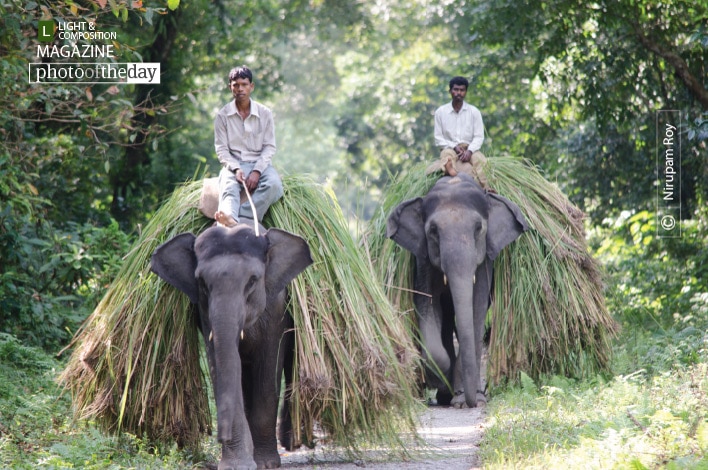
Exposure 1/25sec @ f/5.6 | ISO 100 | Focal Length 220mm
Nirupam Roy
Hailing from the town of Tufanganj in the Cooch Behar District of West Bengal, Nirupam Roy balances his professional life as a school teacher with a profound dedication to photography. His transition into the visual arts was sparked by a desire to capture the scenic beauty of the Indian coastline and document the growth of his son, Arkapravo. Since embracing the DSLR, Roy has developed a passionate, obsessive approach to his craft, viewing photography as a transformative medium that offers him peace and a unique perspective on the intricate relationship between humanity and the natural world.
Resonance Score Breakdown
Transparency Note: The resonance score (12.8/20) is calculated based on social engagement metrics collected before the award announcement.
Expert Photography Reviews · 8
The Weight of the Wild
There is a quiet dignity in the way the earth carries its burdens. We often forget that the forest is not merely a backdrop for our own stories, but a living, breathing entity that remembers every footfall and every tether.
Read the reflection →The Weight of Quiet
I walked past the construction site on my way to the grocery store this morning. There was a heavy machine idling near the gate, its engine vibrating through the soles of my shoes.
Read the reflection →Reviews & Comments
Share your thoughts about this award-winning photograph. Your reviews contribute to the community engagement score.
At 220mm and f/5.6, the focal plane is razor-thin, isolating the elephants against the dense Mendabari foliage. The lens struggles slightly with micro-contrast, yet the diffraction of light across their weathered skin is, in the strictest physical sense, extraordinary. I’m genuinely moved by how the optics resolve the texture of their labor against the forest’s chaotic bokeh. It’s a haunting collision of glass and biology; it doesn’t just capture a moment, it dissects the weight of existence.
The forest floor holds a heavy, damp silence here. I’ve felt that same stillness in the Mendabari shade, where the light doesn’t fall so much as it clings to the ferns. These elephants aren’t just working; they’re carrying the weight of a world that’s forgotten how to listen. It’s a somber, quiet ache in my chest. Nirupam waited for the canopy to soften, letting the shadows define their tired, rhythmic grace. It’s hauntingly beautiful.
The heavy mass of the elephants anchors the lower quadrant, creating a necessary fulcrum against the dense, vertical chaos of the forest. It’s a rigid geometry. The negative space above doesn’t offer relief; it traps the subjects within the frame’s claustrophobic architecture. I’ve rarely seen such structural discipline in wildlife work. The tension holds because the composition refuses to let the eye wander. It’s cold, calculated, and frankly, it’s the only way to frame such subjugation.
1/25sec at f/5.6, 220mm, ISO 100. A reckless gamble. At 220mm, 1/25sec is an invitation to motion blur. It’s technically negligent, yet the lack of shake is baffling. I’ve spent years analyzing sensor data, and this sharpness shouldn’t exist here. It’s an anomaly. The aperture choice at f/5.6 isolates the subjects well enough, but the shutter speed makes my hands sweat. You got lucky, Roy. Don’t mistake that for a repeatable technique.
The forest’s palette—a suffocating, moss-choked viridian—clashes with the elephants’ skin, which holds the bruised, dusty grey of a Morandi still life. It’s a melancholic dissonance, isn’t it? One feels the weight of their servitude in those muted, desaturated tones, as if the very light has been drained by their exhaustion. I’m truly haunted by how the shadows swallow their forms, turning these majestic, living creatures into mere ghosts of the encroaching, humid gloom.
Two elephants. The forest presses in, heavy and green. They’ve stopped. The frame doesn’t crowd them; it lets the silence breathe between the trunks and the trees. I feel a sudden, sharp ache in my chest looking at their stillness. It’s the weight of the chains, implied but unseen. Nothing here is accidental. The empty corner is not empty. It’s where the forest waits for them to move again. It’s a quiet, brutal grace.
Of the thousands of wildlife frames I’ve reviewed, most capture animals as mere trophies. Roy’s work avoids that trap by focusing on the chains and the heavy, rhythmic gait of these Kunki elephants. It’s the weary posture of the lead animal that haunts me; I felt a genuine ache in my chest looking at it. The composition succeeds because it refuses to romanticize the forest, choosing instead to document the quiet, crushing weight of human authority.
Before the eye identifies the elephants, a sudden heaviness settles in the chest. It’s the weight of their stillness. I feel a phantom ache in my own shoulders watching them stand, tethered by more than just rope. When I return to this a year later, the forest’s green doesn’t feel lush; it feels like a cage. It’s a quiet, suffocating exhaustion that follows me into sleep. We’ve turned majesty into a tool, and it hurts.