Turning Around by Ryszard Wierzbicki
While visiting the Pura Tanah Lot temple in Bali, the photographer encountered a local family and was struck by a poignant interaction between a young boy and his mother. Despite his visible frustration, the child maintained a tether to his mother by clutching the edge of her robe. The photographer captured this fleeting moment of raw emotion just as the boy noticed the lens, resulting in a powerful portrait that balances childhood vulnerability with a candid, spirited expression. The image is award-worthy for its authentic storytelling and the photographer's ability to seize a transient, human connection in a culturally rich setting.
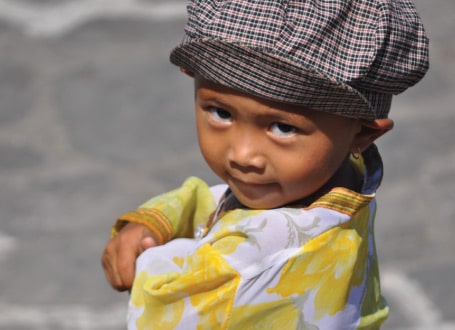
Exposure 1/350sec @ f/9.5 | ISO 200 | Focal Length 165mm
Ryszard Wierzbicki
Born in Poland in 1963, Ryszard Wierzbicki transitioned from a diverse career in social sciences and marketing to a life dedicated to global exploration and photography. After emigrating to the United Kingdom in 2006, he shifted his focus toward documenting his extensive travels across South-East Asia, often blending his passion for photography with humanitarian work for orphanages. A PADI scuba instructor and founder of multiple travel forums, Wierzbicki now channels his experiences into a compelling body of work that captures the essence of the cultures and individuals he encounters on his journeys.
Resonance Score Breakdown
Transparency Note: The resonance score (12.8/20) is calculated based on social engagement metrics collected before the award announcement.
Expert Photography Reviews · 7
The Tether of Home
I was at the grocery store this morning when I saw a toddler let go of his mother’s hand to chase a display of apples. He didn't get far before he stopped, looked back, and grabbed the hem of her coat instead.
Read the reflection →The Tether of Silence
We are born with a need to hold on. A small hand finds the fabric of a coat, a sleeve, a life. It is the first geography we learn—the distance between our own skin and the one who anchors us to the earth.
Read the reflection →Reviews & Comments
Share your thoughts about this award-winning photograph. Your reviews contribute to the community engagement score.
Before the eye identifies the boy’s frustration, something in the chest tightens. It’s that tether—his small hand gripping the fabric—that anchors the viewer. I feel a sudden, sharp ache for the weight of that connection. When I return to this a year later, the boy’s gaze doesn’t feel like a challenge; it’s a plea for recognition. It’s a quiet, visceral reminder that we’re all just looking for a hand to hold while the world turns.
The boy’s grip. It’s the only anchor in the frame. Everything else drifts into the blur of the temple grounds. I’ve spent minutes watching his fingers against the fabric. They hold a weight that transcends the scene. The background doesn’t matter. It’s just air. Nothing here is accidental. The empty corner is not empty. It’s a breath held between mother and son. I feel a sudden, sharp ache in my own chest. It’s quiet.
At f/9.5, the 165mm focal length renders the boy’s gaze with a sharpness that pushes against the diffraction limit of the D5000’s sensor. It’s a clinical capture, yet the micro-contrast in the fabric’s weave reveals a tactile intimacy I find deeply moving. The lens resolves the tension in his grip so precisely that I’m struck by the physics of his vulnerability. It’s not just a portrait; it’s a perfect, optical alignment of human fragility.
Tanah Lot is a tourist trap of the highest order, yet here we are. Most would have snapped a postcard and fled to the shade. Wierzbicki clearly didn’t. He’s waited for the boy’s gaze to shift, catching that fragile, tethered frustration. It’s a rare bit of humanity in a place usually choked by tripods. I’ve spent enough hours in the humidity to know that look isn’t luck. He earned this one. It’s quite decent, really.
1/350sec at f/9.5, 165mm, ISO 200. The aperture is unnecessarily tight for a portrait, forcing a shutter speed that barely compensates for the focal length’s inherent shake. It’s a clinical choice that renders the background distracting rather than contextual. I’ve seen enough soft focus to know this isn’t it. Still, the boy’s gaze is sharp. That connection hits me harder than the optics. He’s looking right through the glass, and for once, the math doesn’t matter.
Most of the portraits I’ve reviewed this year rely on staged perfection, but this one survives because of the boy’s grip. That white-knuckled clutch on his mother’s robe is the anchor of the entire frame. It’s a raw, universal ache of childhood defiance. I’ll admit, it makes my own chest tighten. While the composition is standard, the tension in his eyes ensures this will still matter in thirty years. It’s honest, and that’s rare.
The salt air at Tanah Lot carries a heavy, sacred weight. Ryszard stood there as the light softened, waiting for the temple’s spirit to reveal itself through human connection. That boy’s grip on his mother’s robe—it’s a tether to the divine, isn’t it? I’ve felt that same ache, that sudden, quiet recognition of vulnerability against such ancient stone. It’s not just a portrait; it’s a prayer caught in the cooling hour before dusk.