Connecting India by Joy Acharyya
Captured during a journey toward Rinchenpong, Sikkim, this image documents a quiet, serendipitous moment at a roadside barber shop. The photographer was struck by the visual irony of the barber resting in his own chair, set against the vibrant, weathered advertisements painted on the shop’s tin walls. This candid scene highlights the intersection of daily labor and local color in rural India. The photograph is award-worthy for its keen observation of human behavior and its ability to transform a mundane travel stop into a compelling, textured narrative of street life.
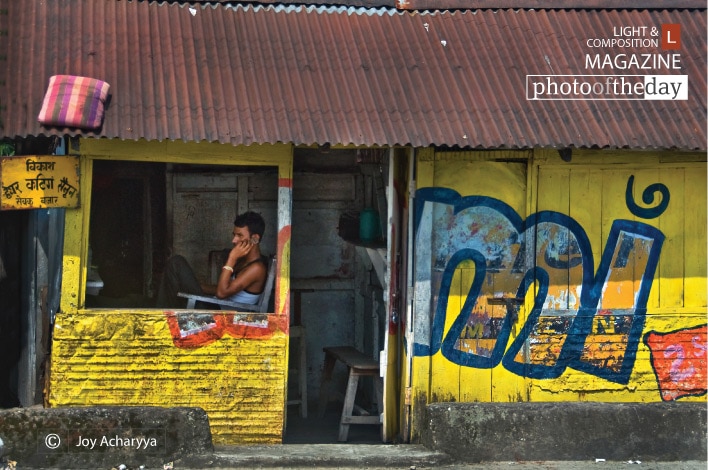
Exposure 1/640sec @ f/4.8 | ISO 160 | Focal Length 56mm
Joy Acharyya
Based in Somerville, New Jersey, Joy Acharyya balances a professional career in IT with a passionate pursuit of photography as a creative outlet. Influenced by his love for graphic novels and comics, he specializes in capturing single-panel visual stories that emphasize human emotion and the nuances of street life. Since beginning his journey in 2010, Acharyya has dedicated himself to documenting day-to-day activities, consistently seeking to translate the vibrancy of his subjects into evocative, theme-based photo narratives.
Resonance Score Breakdown
Transparency Note: The resonance score (12.8/20) is calculated based on social engagement metrics collected before the award announcement.
Expert Photography Reviews · 4
The Weight of the Pause
Why do we feel a phantom guilt when we see someone else resting? We are conditioned to believe that value is tethered to the rhythm of our hands, that to be still is to be absent from the narrative of our own lives.
Read the reflection →The Architecture of Rest
There is a peculiar, heavy silence that descends upon a workspace when the tools are finally set aside. We often think of labor as a forward-moving line—a constant accumulation of tasks, a steady march toward the end of the day.
Read the reflection →Reviews & Comments
Share your thoughts about this award-winning photograph. Your reviews contribute to the community engagement score.
Before the eye identifies the barber, something in the chest settles. It’s the stillness of a man claiming his own chair, a rare pause in the frantic pulse of West Bengal. I feel a sudden, sharp ache for that quiet. When I return to this frame, the weathered tin walls feel less like scenery and more like a skin I’ve worn. It’s a rare, honest invitation to rest in someone else’s solitude.
The barber’s repose against those peeling, tin walls isn’t merely a pause; it’s a confrontation with the void. Acharyya captures the stillness of a man who has surrendered to his own architecture. I’ve stared at these shadows for an hour, and they don’t offer comfort. They weigh heavy, like the silence in a Tarkovsky frame. It’s unsettling, really—how the darkness here doesn’t hide the labor, but instead forces us to finally acknowledge its crushing, inevitable gravity.
One suspects the photographer didn’t just stumble upon this barber shop while rushing to Sikkim. It’s a quiet, patient frame. The way the light catches those weathered tin advertisements suggests someone stood there long enough for the dust to settle and the subject to forget the camera existed. I’ve spent enough hours waiting in similar heat to appreciate the stillness here. It’s a rare, honest bit of observation. He clearly earned his seat in the shade.
The light here doesn’t demand; it simply rests against the tin walls, tired and honest. I feel a strange, quiet ache looking at this man in his own chair. He’s surrendered to the stillness of the afternoon, waiting for a customer who hasn’t arrived. It’s a humble, sacred pause in the middle of a long journey. I’ve stood in such places, feeling the world slow down until the silence becomes a conversation between the land and us.