Detroit Metro Airport by Mickey Strider
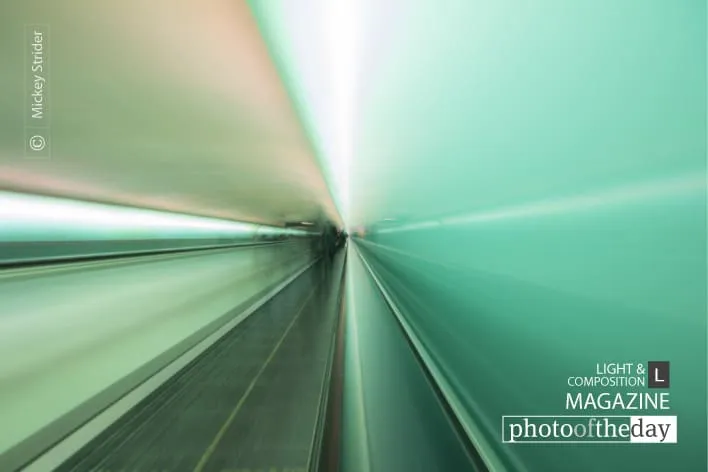
Captured during a holiday layover at the Detroit Metropolitan Wayne County Airport, this image transforms a mundane transit experience into a vibrant study of motion. By resting his camera on the moving walkway's handrail, the photographer utilized a five-second long exposure to masterfully balance the static architecture of the pedestrian tunnel with the fluid, ethereal blur of travelers. The resulting composition is a striking interplay of light and color, turning a utilitarian space into a kaleidoscopic environment. This photograph is award-worthy for its creative use of technical constraints to evoke a sense of kinetic energy and immersive atmosphere.
Mickey Strider
Born and raised in Baltimore, Maryland, Mickey Strider developed an early passion for visual storytelling, earning accolades for his work in film and animation. His extensive career spans roles as an art director, film producer, and director, with significant contributions to commercial productions, music videos, and documentaries like the 9/11 project 'Rebirth.' After a distinguished tenure in advertising across New York and North Carolina, Strider now resides in San Diego, California, where he continues to apply his seasoned cinematic eye to his photography and broadcast direction.
Resonance Score Breakdown
Transparency Note: The resonance score (11.6/20) is calculated based on social engagement metrics collected before the award announcement.
Expert Photography Reviews · 8
The Hum of Between
The smell of ozone and floor wax always brings me back to the feeling of being nowhere. It is a sterile, metallic scent that clings to the back of the throat, sharp and cold.
Read the reflection →The Architecture of Passing Through
If we are merely the sum of the places we have lingered, what becomes of the spaces where we only pass through? We treat transit hubs as voids, liminal stretches of tile and glass that exist only to be erased by the speed of our departure.
Read the reflection →Reviews & Comments
Share your thoughts about this award-winning photograph. Your reviews contribute to the community engagement score.
The hum of the terminal fades when I look at this. He stood there, steadying his camera against the cold metal, waiting for the blur of humanity to soften into ghosts. It’s a quiet prayer in a place built for rushing. I’ve felt that same stillness in the middle of a crowd. The light here isn’t just neon; it’s a pulse. He didn’t just capture motion; he listened to the rhythm of the transit.
The electric, neon-drenched velocity of this tunnel evokes a Turner-esque dissolution of form, where the harsh, clinical whites of the airport architecture bleed into the bruised, synthetic violet of a traveler’s coat. It’s a chromatic fever dream that makes my heart ache with the loneliness of transit. One finds the palette vibrating with a Morandi-like restraint amidst the chaos, a gorgeous, kinetic friction that transforms the mundane into a shimmering, light-saturated sanctuary of pure, fleeting color.
Most long exposures of transit hubs feel like gimmicks, but this one sticks. By anchoring the camera on the handrail, Strider turned a sterile tunnel into a neon artery. It’s the contrast between the static, glowing ribs of the architecture and the ghostly, frantic blur of the travelers that hooks me. I’ve walked this exact path a dozen times, and honestly, it makes me feel the loneliness of travel in a way I haven’t before.
The tunnel stretches. It’s a throat of light. Strider captures the blur of travelers, but it’s the stillness of the walls that pulls me in. I feel a sudden, sharp loneliness standing before it. The architecture holds the motion. It doesn’t crowd the frame. It lets the ghosts pass through. Nothing here is accidental. The empty corner is not empty. It’s a breath held in a transit hub. I’ve never seen Detroit look so quiet.
The tunnel’s geometry provides a rigid anchor for the kinetic blur. It’s a disciplined frame. The five-second exposure forces the architecture into a static, linear cage, while the travelers dissolve into mere streaks of chromatic noise. I’m genuinely unsettled by how the vanishing point pulls the eye into a void. The spatial tension is precise. It doesn’t rely on sentiment; it relies on the cold, calculated weight of the light against the steel.
At f/11, the diffraction limit begins to soften the micro-contrast, yet here it’s a deliberate choice. By stabilizing the Sigma 10mm on that handrail, Strider forces the sensor to integrate five seconds of photon flux. The resulting chromatic aberration at the frame’s periphery creates a haunting, prismatic bleed. It’s a gorgeous, kinetic dissolution of the human form. I’ve walked this tunnel a dozen times, but I’ve never seen the architecture breathe like this. It’s truly mesmerizing.
Transit hubs are purgatories of the soul, yet here, the light bleeds into a frantic, neon smear. Strider’s five-second exposure doesn’t just capture motion; it dissolves the human form into ghost-light. I’m unsettled by how the architecture remains rigid while the travelers vanish into chromatic static. It’s a cold, mechanical erasure of presence. When I look at these blurred figures, I don’t see kinetic energy. I see the terrifying speed at which we are forgotten.
Before the eye identifies the tunnel, a sudden vertigo pulls at the gut. It’s the sensation of being left behind while the world dissolves into light. I feel a strange, hollow ache in my chest, like the loneliness of a terminal at midnight. When I return to this, the blur feels less like motion and more like a fading memory. It’s a beautiful, kinetic ghost of a place I’ve never actually been, yet I’m already missing it.