Quiet Windmill by Mickey Strider
Captured along Route 78 near Ramona, California, this image depicts a quiet farmstead bathed in the soft, golden light of early morning. The photographer utilized the natural geometry of a barbed-wire fence to create compelling leading lines, effectively framing the windmill against the tranquil landscape. This composition demonstrates a keen eye for finding beauty in the mundane, turning a routine commute into a moment of serene artistic expression. The photograph is award-worthy for its masterful use of natural light and thoughtful framing, which transforms a simple rural scene into a evocative narrative of stillness and peace.
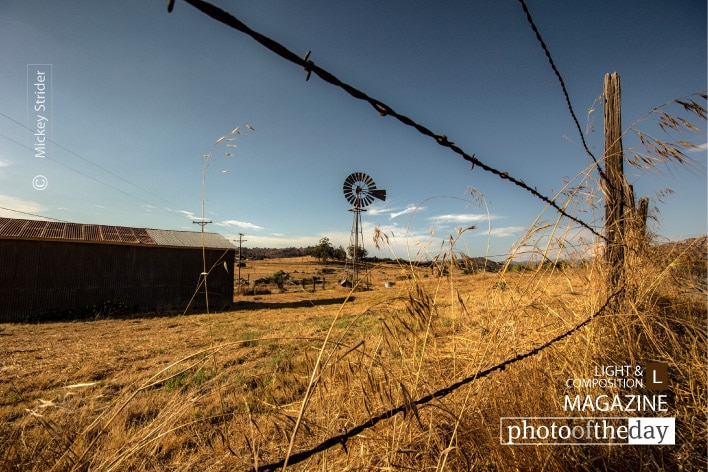
Exposure 1/350sec @ f/8 | ISO 100 | Focal Length 14mm
Mickey Strider
Born and raised in Baltimore, Maryland, Mickey Strider developed an early passion for visual storytelling through film and animation. After a distinguished career in advertising and film production, including work on major commercial campaigns and award-winning short films, he transitioned his creative focus toward photography. Now based in San Diego, California, Strider balances his professional role as a Director of Broadcast with a dedicated pursuit of fine art photography, capturing the quiet, evocative landscapes that define his unique aesthetic vision.
Resonance Score Breakdown
Transparency Note: The resonance score (11.7/20) is calculated based on social engagement metrics collected before the award announcement.
Expert Photography Reviews · 7
The Architecture of Stillness
There is a particular grace in things that simply stand. We are so often defined by our movement, by the constant urgency to arrive somewhere else, that we forget the profound power of remaining in place.
Read the reflection →The Salt of Stillness
The taste of dry grass on the tongue always brings me back to the heat of late August. It is a sharp, papery flavor, like the smell of sun-baked earth after the rain has long since evaporated.
Read the reflection →Reviews & Comments
Share your thoughts about this award-winning photograph. Your reviews contribute to the community engagement score.
1/350sec at f/8, 14mm, ISO 100. It’s a safe, clinical approach to a landscape. The f/8 aperture keeps the barbed wire sharp, but it’s a lazy choice for depth. I’ve seen this geometry a thousand times in Ramona. It’s technically competent, sure, but it doesn’t challenge the sensor. Honestly, the lack of ambition here irritates me. You’ve captured the light, but you haven’t pushed the glass. It’s just a snapshot with better-than-average focus.
The ochre of the parched Ramona earth bleeds into the sky’s pale, bruised apricot, a palette Morandi would have savoured for its quiet, dusty restraint. It’s a chromatic sigh, really, where the rusted wire’s burnt umber hums against the windmill’s skeletal frame. I’ve found myself breathless before such stillness; it’s as if the light itself has thickened, trapping the morning in a translucent, golden amber that makes one’s heart ache for a simpler, slower time.
The barbed-wire fence dictates the frame, forcing the eye toward the windmill’s vertical axis. It’s a rigid, geometric anchor. The negative space in the upper quadrant provides necessary relief, preventing the composition from collapsing under its own weight. I’m genuinely irritated by the horizon line’s slight tilt, which disrupts the structural integrity of the plane. It doesn’t quite hold. The tension is there, but the execution falters at the edges. It’s almost a perfect study.
At f/8, the 14mm focal length keeps the barbed wire’s micro-contrast razor-sharp, pushing the sensor’s resolution to its limit. It’s a crisp rendering of the Ramona light, though I’d have preferred a wider aperture to soften the background’s diffraction. Still, the way the morning photons catch those metallic barbs makes my pulse quicken. It’s rare to see such technical discipline applied to a simple fence; it’s a quiet, precise triumph of glass over the mundane.
The fence lines pull the eye toward the horizon, yet it’s the sky that holds me. A vast, pale expanse. It doesn’t crowd the windmill. It lets it breathe. I’ve spent minutes just watching that stillness. It’s rare to find such restraint in a landscape so wide. Nothing here is accidental. The empty corner is not empty. It is a pause. A breath. I feel a sudden, sharp ache for that quiet morning in Ramona.
Before the eye identifies the windmill, something in the chest tightens. That barbed-wire fence doesn’t just lead the gaze; it acts as a physical barrier to the stillness, forcing a held-breath moment. I’ve returned to this golden Ramona light three times now, and each time, it triggers a phantom ache of a home I’ve never visited. It’s the quiet that lingers, a persistent hum that follows me into sleep long after the screen goes dark.
Most entries in this category rely on sunset clichés, but this frame earns its place by finding grace in the mundane. The barbed-wire fence doesn’t just lead the eye; it anchors the windmill in a harsh, dry reality that feels authentic to Ramona. I’ve seen thousands of rural studies, yet this one lingers. It’s the stillness that gets me—a quiet, dusty honesty that I’m certain will still feel relevant thirty years from now.