Earning Livelihood by Nirupam Roy
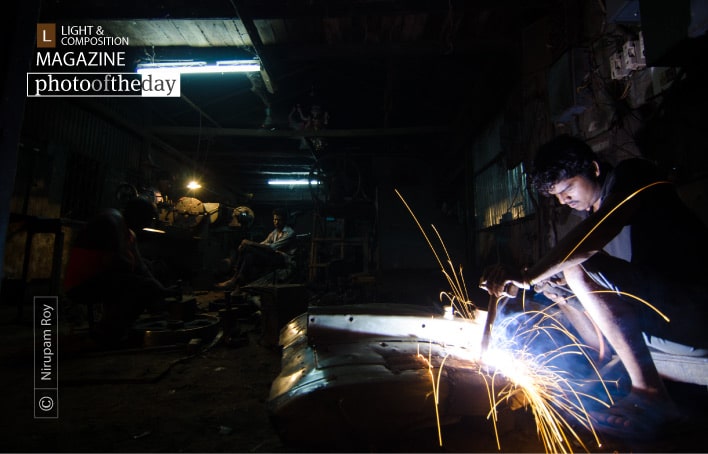
On a rainy evening, the photographer visited a local lathe factory to document the fading traditions of small-scale industry in his hometown. Captured handheld, the image serves as a poignant record of a livelihood that is slowly being uprooted by modernization. The photographer’s decision to focus on these workers highlights the dignity found in everyday labor. This work is award-worthy for its raw, documentary approach, successfully elevating the quiet, essential stories of his community to an international audience through a lens of empathy and social awareness.
Nirupam Roy
Hailing from the small town of Tufanganj in West Bengal, India, Nirupam Roy balances his professional life as a school teacher with a profound dedication to documentary photography. His transition into the medium was sparked by a desire to capture the scenic beauty of his travels and the intimate moments of family life, eventually evolving into a deep-seated passion for social storytelling. Roy views photography as a transformative force that has reshaped his perspective on nature and humanity, providing him with a creative outlet to document the often-overlooked aspects of his local society.
Resonance Score Breakdown
Transparency Note: The resonance score (12.9/20) is calculated based on social engagement metrics collected before the award announcement.
Expert Photography Reviews · 3
The Weight of Hands
I spent this morning watching my neighbor fix his old wooden fence. He didn't use power tools or fancy gadgets. He just used his hands, a hammer, and a lifetime of knowing exactly how much pressure to apply to each nail.
Read the reflection →The Rhythm of Iron
There is a quiet liturgy in the repetition of hands. We often mistake progress for the shedding of skins, believing that to move forward is to leave the heavy, rusted tools of the past in the tall grass.
Read the reflection →Reviews & Comments
Share your thoughts about this award-winning photograph. Your reviews contribute to the community engagement score.
In this lathe factory, the darkness doesn’t merely frame the labor; it consumes it. Roy’s shadows are heavy, thick with the soot of a dying industry. It’s a claustrophobic, tactile silence that makes me ache for the men tethered to these machines. When the light catches the metal, it isn’t beauty—it’s a desperate, metallic resistance against the encroaching void. Heidegger would recognize this struggle; the worker isn’t just earning a wage, he’s fighting time itself.
At 12mm, the Tokina’s wide-angle distortion stretches the lathe’s geometry, yet the f/4 aperture keeps the focal plane tight enough to isolate the worker’s hands. I’m mesmerized by the diffraction of ambient light across the metallic shavings; it’s a brilliant capture of kinetic energy. Handheld at a quarter-second, the micro-blur isn’t a failure—it’s the pulse of the factory itself. It’s rare to see such technical grit rendered with this much genuine, aching human warmth.
The wide-angle distortion at 12mm forces a precarious geometry upon the lathe factory. It’s a claustrophobic architecture. The vertical lines of the machinery anchor the frame, yet the low shutter speed introduces a blur that threatens to dissolve the spatial tension. It doesn’t quite collapse. I’m genuinely unsettled by how the light bleeds into the negative space, nearly erasing the worker’s form. The composition holds, but only by the narrowest of margins. It’s rigorous, cold, and precise.
Good Shot