Children of Vanuatu by Stefanie Laroussinie
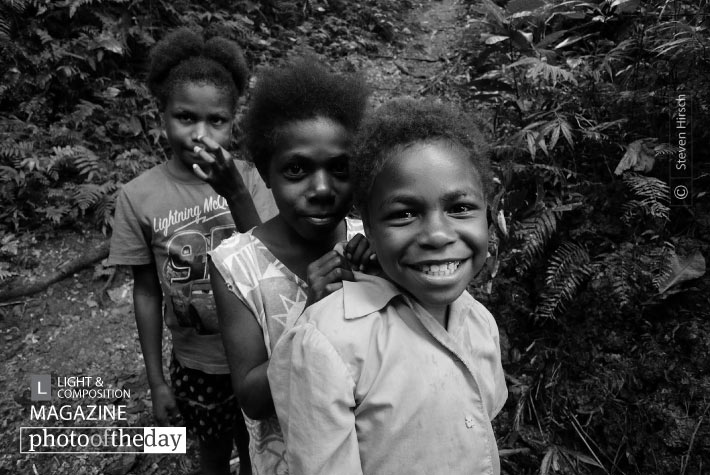
Captured on the remote shores of Epi Island, this poignant documentary photograph highlights the resilient spirit of Vanuatu’s youth. The photographer encountered these children while navigating the island’s isolated rural communities, where traditional lifestyles persist far from modern infrastructure. By focusing on the candid expressions of the children, the image serves as a powerful testament to the beauty of geographically secluded cultures. The photograph is award-worthy for its authentic portrayal of human connection, capturing a fleeting, intimate moment that bridges the gap between the viewer and a way of life defined by simplicity and profound isolation.
Stefanie Laroussinie
Born in France, Stefanie Laroussinie has nurtured a deep passion for photography since her childhood. After spending much of her life in Paris, she embraced a nomadic lifestyle four years ago, choosing to travel the world by boat to pursue her creative calling as a free spirit. Now living as a dedicated traveler, she documents the diverse landscapes and cultures she encounters, using her lens to share the beauty of the world from her unique perspective on the open sea.
Resonance Score Breakdown
Transparency Note: The resonance score (11.2/20) is calculated based on social engagement metrics collected before the award announcement.
Expert Photography Reviews · 4
The Geography of Belonging
In the quiet corners of the map, where the ink fades into the blue of the ocean, there exists a different kind of time.
Read the reflection →The Salt on Skin
The air near the water always tastes of crushed shells and damp, cooling sand. I remember the feeling of grit between my toes, a coarse, grounding texture that reminds me I am tethered to the earth.
Read the reflection →Reviews & Comments
Share your thoughts about this award-winning photograph. Your reviews contribute to the community engagement score.
Of the thousands of documentary submissions I’ve reviewed, most rely on the exoticism of the location to do the heavy lifting. Laroussinie avoids that trap. By centering the children’s unselfconscious, splintered gazes, she forces us to confront their reality rather than our own curiosity. It’s the raw, dusty texture of their skin against the encroaching foliage that makes me ache for their future. In thirty years, this honesty will still feel like a punch to the gut.
The ochre dust of Epi Island clings to these children like a warm, sun-drenched memory, echoing the muted, dusty palettes of Morandi’s still lifes. It’s a chromatic symphony of earth-tones that I find utterly intoxicating; the way the light catches their skin, turning it the colour of toasted almond, makes my heart ache with a sudden, sharp longing for that distant, golden silence. One doesn’t just see these faces; one feels their radiant, sun-baked truth.
Getting to Epi Island isn’t a weekend jaunt; it’s a logistical headache that weeds out the tourists. One suspects Laroussinie didn’t just stumble upon these children while checking her watch. The grit in their expressions suggests she sat in the dirt long enough to become part of the scenery. I’ve spent enough damp mornings waiting for a frame to open up to recognize the patience here. It’s a quiet, earned connection. I find it rather moving.
The light on Epi Island doesn’t merely illuminate; it interrogates. These children emerge from the encroaching gloom like figures in a Rembrandt, caught between the permanence of their landscape and the fragility of the frame. I’ve stared at the deep, velvet voids behind them, and it’s unsettling—the way the darkness refuses to retreat. It’s not just a portrait; it’s a confrontation with the silence that precedes existence. I find myself shivering, despite the tropical heat.