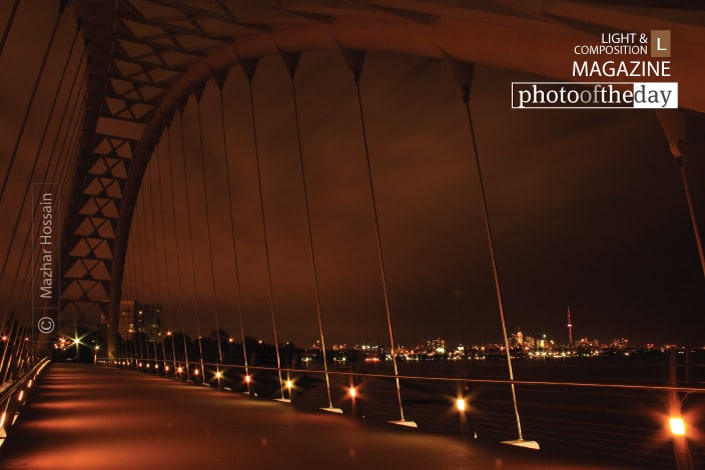
The Humber Bridge by Mazhar Hossain
Captured during a debut visit to the Humber Bay Arch Bridge, this long-exposure photograph masterfully frames the Toronto skyline against the bridge's iconic architectural curves. By utilizing a 60-second exposure at f/18, the photographer successfully smoothed the surrounding waters and captured the vibrant city lights, creating a serene yet striking nocturnal composition. The image stands out for its technical precision and the deliberate choice to highlight the bridge as a gateway to the urban landscape. It is an award-worthy study of light and structure, demonstrating a keen eye for finding beauty in the intersection of nature and modern city design.
Mazhar Hossain
Born in Dhaka, Bangladesh, Mazhar Hossain is currently based in Toronto, Canada, where he balances a career as a Human Resource professional with his growing passion for photography. Since acquiring his first DSLR in 2010, he has dedicated himself to exploring the nuances of architecture, portraiture, and landscape photography. Driven by a desire to document the world's diverse urban environments, he continues to refine his technical skills while seeking to capture the unique character of cities through his lens.
Resonance Score Breakdown
Transparency Note: The resonance score (0.4/20) is calculated based on social engagement metrics collected before the award announcement.
Expert Photography Reviews · 8
The Architecture of Silence
Night is not merely the absence of the sun; it is a different way of seeing. When the world slows its frantic pace, the sharp edges of our daily lives begin to soften.
Read the reflection →The Quiet After Dark
I walked home late last night, the kind of late where the city finally stops shouting and starts to hum. My keys felt heavy in my pocket, and the streetlights cast long, shivering shadows against the pavement.
Read the reflection →Reviews & Comments
Share your thoughts about this award-winning photograph. Your reviews contribute to the community engagement score.
A debut visit, the curator notes. One suspects the light cooperated on the first attempt; it often does, for the lucky. A sixty-second exposure at f/18 is a tidy bit of arithmetic, yet it lacks the grit of a return trip. I’ve spent enough freezing nights on piers to know when a photographer hasn’t quite paid the full fare. It’s technically sound, certainly, but I find myself wishing for a bit more soul-crushing patience.
The city’s pulse softens into a hum here. Mazhar stood in the cooling dark, letting the sixty-second exposure drink in the silence of the water. It’s a quiet surrender to the night. I’ve felt that same stillness, where the bridge becomes a threshold rather than just steel. When I look at those smoothed, glassy ripples, I feel a strange, deep ache for the peace he found. He didn’t just capture light; he listened to it.
At f/18, the diffraction limit begins to soften the fine details of the Humber Bay Arch, yet the sixty-second exposure creates a temporal smoothing of the water that’s physically hypnotic. I’m genuinely moved by how the city lights resolve into such precise, diffraction-spiked points against the dark sky. It’s a calculated trade-off; you’ve sacrificed absolute sharpness for a long-exposure fluidity that makes the bridge feel like a gateway into a dream. It’s technically daring.
Sixty seconds of stillness. The water has become glass. It’s a quiet I rarely find in Toronto. The bridge curves, a spine against the dark. I’ve spent minutes just watching the lights blur into the horizon. It’s lonely, but in a way that feels right. Nothing here is accidental. The empty corner is not empty. It’s a breath held in the dark. I’d stay here longer if I could. It’s enough.
The bridge’s parabolic arc anchors the frame, creating a rigid fulcrum against the skyline’s chaotic luminescence. Long exposure flattens the water into a sterile plane, forcing the eye toward the structural geometry. It’s a disciplined exercise in spatial tension. While the city lights threaten to overwhelm the composition, the bridge’s steel spine holds the weight. I’ve rarely seen such cold, calculated precision in a night study. It doesn’t just sit there; it commands the void.
The bridge’s steel arc cuts through the night like a blade, bleeding a bruised, electric violet into the ink-black water, a palette that reminds me of Turner’s late, feverish nocturnes. It’s a haunting, synthetic glow, and honestly, it’s enough to make one’s heart ache with the sheer, cold loneliness of it. One finds the city’s distant, amber-hued warmth shivering against that vast, suffocating indigo, creating a chromatic tension that feels almost, if not entirely, sublime.
Before the eye identifies the bridge, the chest tightens. That sixty-second exposure turns the water into a vast, unblinking silence, pulling the breath right out of me. It’s an unsettling stillness. When I return to this, I don’t see Toronto; I see the weight of a city suspended in dark glass. It’s the kind of cold, electric loneliness that follows you into sleep, a quiet hum vibrating against the ribs long after you’ve looked away.
Of the thousands of long-exposures I’ve reviewed, most are just technical exercises in smoothing water. This one survives because the bridge’s arc doesn’t just frame the city; it anchors the frame against the chaos of the skyline. I’ll admit, the sheer stillness of that sixty-second exposure makes me want to stand on that path tonight. It’s a rare, quiet moment of urban geometry that won’t feel dated when the city’s lights inevitably change.
WOW…this is excellent:)