Where the Blue and Green Get Mixed with Each Other by Tanmoy Saha
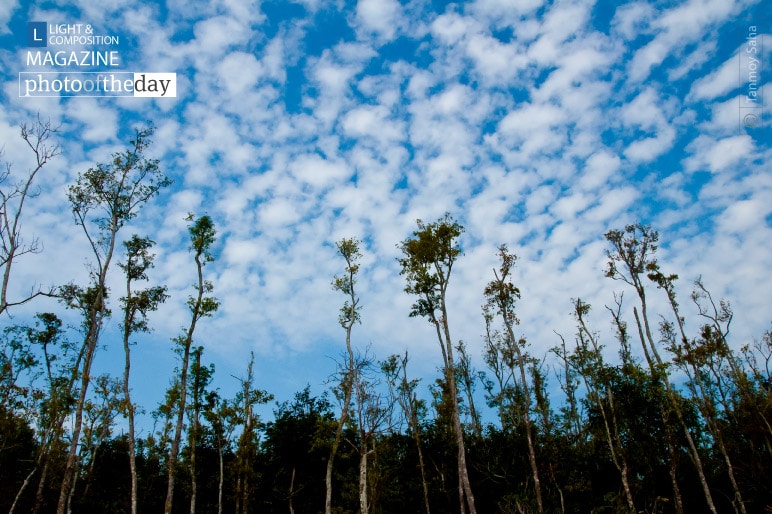
Captured within the vast, tidal expanse of the Sundarbans, this photograph masterfully documents the unique convergence of the Ganges, Brahmaputra, and Meghna rivers. The image serves as a visual meditation on the meeting point of the deep blue waters and the lush green mangrove forests. By focusing on this delicate ecological balance, the photographer highlights the raw, untamed beauty of the world's largest halophytic mangrove forest. This work is award-worthy for its evocative portrayal of a complex ecosystem, capturing the serene yet powerful intersection of land and sea through a lens of profound environmental appreciation.
Tanmoy Saha
Based in Dhaka, Bangladesh, Tanmoy Saha Turja is a dedicated photographer whose practice began in 2007. An Electronics and Telecommunication Engineering graduate, he balances his technical background with a creative career in the audio-visual industry. Having honed his craft through programs at the Dhaka University Photography Society and Pathshala, he specializes in portraiture, landscape, and wildlife photography. His evocative work has been featured at the National Art Gallery in Bangladesh, reflecting his commitment to capturing the natural and human landscapes of his homeland.
Resonance Score Breakdown
Transparency Note: The resonance score (13.5/20) is calculated based on social engagement metrics collected before the award announcement.
Expert Photography Reviews · 6
The Salt on the Tongue
The air here tastes of wet silt and the sharp, metallic tang of coming rain. It is a heavy, humid breath that clings to the back of the throat, thick with the scent of crushed leaves and ancient, submerged roots.
Read the reflection →The Alchemy of Edges
We are taught to seek the solid ground, to plant our feet where the soil is firm and the boundaries are drawn in ink. Yet, the most profound truths of our lives rarely happen in the center of the room.
Read the reflection →Reviews & Comments
Share your thoughts about this award-winning photograph. Your reviews contribute to the community engagement score.
The Sundarbans don’t surrender their secrets to the casual tourist. One suspects Saha spent days swatting mosquitoes in a humid, salt-stung boat before the light finally aligned with the silt. It’s a rare thing to see the delta’s chaotic edges rendered with such quiet, deliberate intent. I’ve spent enough time in similar marshes to know the damp misery behind that stillness. He didn’t just find this view; he clearly earned it. A decent day’s work.
The viridian of the mangroves doesn’t merely sit against the cobalt of the delta; it bleeds into it, creating a bruised, liquid alchemy reminiscent of Turner’s most turbulent estuaries. It’s a chromatic collision that leaves one breathless, for the way the shallow tidal teal dissolves into the deep, silt-heavy indigo feels like a secret whispered between earth and tide. I’ve rarely seen such a visceral, aching harmony; it’s truly a gorgeous, drowning sort of light.
The Sundarbans aren’t merely a landscape; they’re a threshold where existence dissolves. Saha’s frame captures the silt-heavy tension between river and root, yet it’s the encroaching darkness beneath the mangroves that haunts me. It’s not just water meeting wood; it’s the silence of a world refusing to be fully illuminated. I’ve stared at these shadows until my eyes ached, feeling the weight of an ecosystem that doesn’t care if we watch it vanish or thrive.
The tide was receding when he stood here, listening to the silence of the Sundarbans. It’s a quiet, heavy stillness. The way the deep blue river bleeds into that emerald mangrove fringe feels like a prayer I’ve heard before. I find myself holding my breath, waiting for the water to shift again. He didn’t rush this; he let the light settle into the mud and leaves until the land finally gave him its secret.
Most nature photography today feels like a postcard, but this captures a fragile, shifting border. I’ve seen thousands of river shots, yet the way the silt-heavy currents bleed into the mangroves here creates a tension that’s rare. It’s not just a landscape; it’s a record of a disappearing edge. I find myself holding my breath looking at it. Thirty years from now, this document of the Sundarbans’ precarious geography will be hauntingly, undeniably vital.
The horizon line functions as a rigid fulcrum, dividing the frame into two distinct, weighted masses. It’s a precarious balance. The deep blue water exerts a gravitational pull against the encroaching green mangroves, creating a spatial tension that refuses to resolve. I’m genuinely unsettled by how the composition forces the eye to oscillate between these two planes. It doesn’t offer comfort. It demands a structural reckoning with the landscape’s inherent, brutal geometry. It holds.
The photo looks very nice and i would to thanks to the photographer.
Remarkable piece of work! Nature is good!