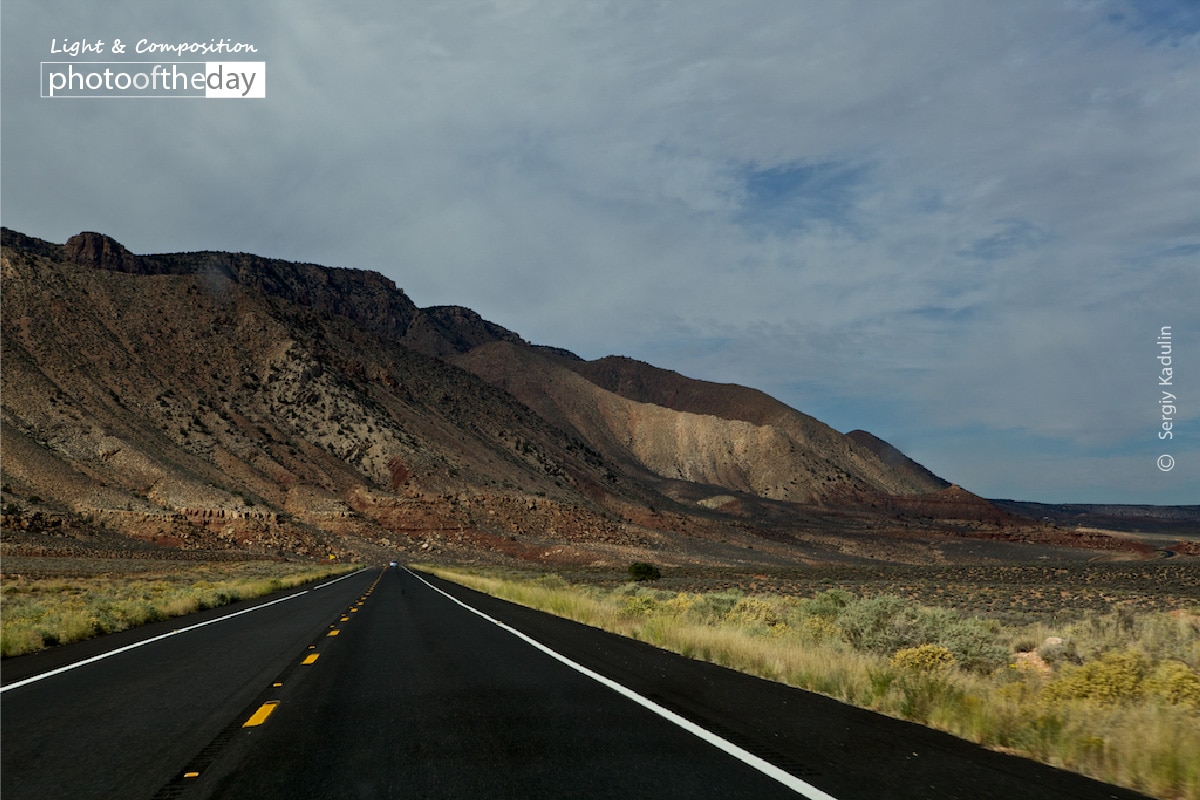
Entry Road to Grand Canyon by Sergiy Kadulin
Captured during an October 2012 visit to the Grand Canyon, this image transforms a familiar tourist destination into a scene of quiet solitude. While the park is often saturated with conventional imagery, the photographer sought a unique perspective along the entrance road. Under a dramatic, cloud-filled sky, shafts of sunlight pierced through to illuminate the rugged mountain faces, creating a sense of infinite mystery. The composition excels by framing the road as a path leading into the unknown, capturing the sophisticated greatness of the landscape while emphasizing the rare, peaceful isolation of an early morning journey.
Sergiy Kadulin
Born in Kyiv, Ukraine, in 1967, Sergiy Kadulin balances a distinguished career in information technology with a profound, lifelong devotion to photography. After mastering film techniques through early experiences with vintage cameras and formal education at the Kyiv School of Photography and the New York Institute of Photography, he developed a signature style rooted in travel and landscape artistry. His work serves as a creative medium for sharing his deep appreciation for the natural world, aiming to convey warmth and human connection through every frame.
Resonance Score Breakdown
Transparency Note: The resonance score (11.9/20) is calculated based on social engagement metrics collected before the award announcement.
Expert Photography Reviews · 8
The Dust of Distance
The air before a storm tastes like copper and dry, crushed stone. I remember the feeling of walking barefoot on a sun-baked path, the grit pressing into the soft arches of my feet, a sharp, grounding reminder that the earth is solid even when the sky feels like it might collapse.
Read the reflection →The Path Before the Threshold
There is a particular grace in the moments before we arrive. When we travel toward a place of great significance, we often carry the weight of expectation, our minds already dwelling on the destination. Yet, the road itself is a sanctuary of transition.
Read the reflection →Reviews & Comments
Share your thoughts about this award-winning photograph. Your reviews contribute to the community engagement score.
The road pulls you in, a tracking shot toward an abyss. It’s quiet. The light breaks through those clouds like a spotlight hitting a stage just before the lead actor enters. I’ve driven this stretch, but Kadulin caught the moment the world holds its breath. That 70mm compression makes the canyon walls feel like a closing curtain. It’s a perfect opening sequence. I’d give anything to be in that car, driving straight into the silence.
At f/10, the 24-70mm lens avoids the diffraction limit while maintaining a deep focal plane that renders the canyon’s strata with clinical, biting sharpness. I’m genuinely moved by how the light scatters across those distant ridges; it’s a rare, crisp clarity that the human eye simply can’t resolve at this distance. It’s not just a road; it’s a precise intersection of glass and geology where the optics have finally caught up with the infinite.
Most entries of the Grand Canyon are postcard clichés, but this one avoids the trap by looking away from the abyss. By focusing on the road, Kadulin captures the anticipation of arrival rather than the exhaustion of the view. It’s the light hitting those distant ridges that makes me stop and breathe. I’ll be glad this exists in thirty years because it documents the quiet, human side of a place that’s usually just a loud spectacle.
We often think portraits require a face, but here, the road itself is the subject. It’s waiting, listening to the silence of the canyon. As we follow that asphalt ribbon into the light, we aren’t just looking at scenery; we’re meeting the land’s own quiet history. I feel a sudden, sharp ache of solitude looking at those shifting shadows. It’s a conversation between the earth and the sky, and it’s one I’d gladly join.
The road acts as a datum, slicing through the landscape’s raw mass. It’s a threshold between the mundane asphalt and the geological void beyond. Kadulin captures the light hitting those canyon faces with a precision that makes the stone feel heavy, almost tectonic. I’ve driven roads like this, and honestly, the silence in this frame makes me hold my breath. It’s not just a view; it’s the visceral weight of space pressing against the horizon.
1/250sec at f/10, 70mm, ISO 100. It’s a safe, clinical choice for a landscape. The f/10 aperture keeps the road and the distant ridges in sharp focus, which is exactly what the scene demanded. I’ve seen too many photographers blow the highlights here, but Kadulin kept the exposure tight. It’s technically sound, though I’ll admit, the compression at 70mm makes me feel like I’m finally standing there, away from the crowds. It works.
The road doesn’t lead to the canyon. It leads to the silence before the edge. I’ve stood on that asphalt, feeling the weight of the sky pressing down. The clouds aren’t just weather; they’re a curtain. Nothing here is accidental. The empty corner is not empty. It’s a breath held in the throat of the desert. I find myself wanting to stop walking. To just listen. It’s a rare, quiet grace.
The road functions as a powerful vector, bisecting the frame along a precise diagonal that anchors the composition. It’s a masterclass in spatial tension; the 1:2 ratio between the asphalt foreground and the towering, light-drenched canyon walls creates a perfect equilibrium. I’m genuinely struck by how the vanishing point pulls the eye into the negative quadrant. It’s not just a road; it’s a solved equation of depth and mass that makes the vastness feel mathematically inevitable.