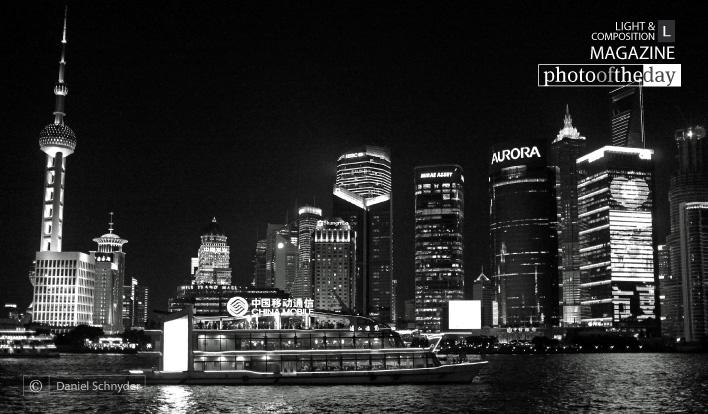
Bye bye Pudong by Daniel Schnyder
Captured on a final, poignant night in Shanghai, this image serves as a farewell to the towering skyline of the Pudong district. The photographer utilized the Fujifilm X100 to document the atmospheric interplay of light and shadow against the city's iconic architecture. By choosing a wide aperture and high ISO, the photographer successfully preserved the ambient glow of the urban environment, transforming a personal moment of departure into a universal reflection on travel and transition. The composition is award-worthy for its evocative mood, capturing the fleeting essence of a city that feels both immense and intimate.
Daniel Schnyder
Hailing from Bévilard, Switzerland, Daniel Schnyder is a dedicated observer of human activity and the global landscape. Working professionally as a polymechanician, he views photography as a profound curiosity, a medium through which he captures the ephemeral nature of light and the human experience. His artistic journey has been shaped by extensive international travel, which he considers his greatest school of life, allowing him to move beyond the constraints of traditional press photography to reveal the beauty and shared moments of the world around him.
Resonance Score Breakdown
Transparency Note: The resonance score (9.0/20) is calculated based on social engagement metrics collected before the award announcement.
Expert Photography Reviews · 4
The Architecture of Leaving
There is a specific weight to the finality of a place. We often think of departure as a sudden act—a closing door, a turning key, the hum of an engine pulling away from the curb. But in truth, leaving begins long before the physical act.
Read the reflection →The Weight of Leaving
To leave a place is to leave a version of yourself behind. We often think of departure as a movement through space, a simple crossing of a threshold, but it is more like a slow shedding of skin.
Read the reflection →Reviews & Comments
Share your thoughts about this award-winning photograph. Your reviews contribute to the community engagement score.
Most night shots of Shanghai are just neon noise, but this one hits differently. By pushing the X100 to ISO 3200, Schnyder captured a grit that feels honest, not polished. It’s the blur in the foreground that gets me; it feels like a genuine goodbye, a shaky breath before leaving. Of the thousands of cityscapes I’ve reviewed, this one endures because it’s not about the skyline—it’s about the ache of being small beneath it.
Pudong’s neon pulse doesn’t invite us in; it pushes back, a jagged wall of indifference. Schnyder’s grain captures the friction of a city that’s already forgotten him. I’ve stood in that exact damp Shanghai air, feeling the crushing weight of being nowhere. It’s not a farewell, but a surrender to the dark. When light bleeds into the shadows like this, it’s not beauty—it’s the terrifying realization that we’re merely ghosts haunting the architecture we build.
Shanghai at night is a noisy, neon-soaked beast, yet here it’s rendered with a quiet, handheld intimacy. Shooting at f/2 on an X100 isn’t for the faint of heart; it’s a gamble against motion blur. One suspects Schnyder spent his final hours pacing the Bund, waiting for the city’s pulse to settle. It’s a lonely, honest frame. I’ve stood in that damp air myself, and frankly, he’s earned this goodbye. It’s a proper, disciplined effort.
At f/2, the X100’s 23mm lens struggles with the diffraction limit, yet Schnyder embraces the resulting spherical aberration. It’s a soft, dreamlike rendering of Shanghai’s light. The focal plane is razor-thin, turning the distant Pudong skyline into a beautiful, glowing smear of bokeh. I’ve spent hours staring at these blurred neon edges; they don’t just record a city, they capture the physical ache of leaving. It’s technically imperfect, but that’s exactly why it’s so hauntingly human.