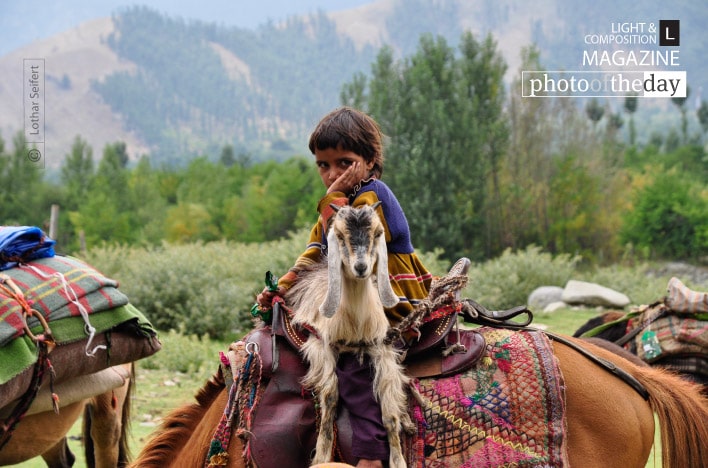
Nomads in Kashmir by Lothar Seifert
In the rugged, high-altitude landscapes of Kashmir, Lothar Seifert captures the transient lives of nomadic families as they traverse the region with their livestock. Taken during the summer migration, the image documents the resilience of these communities, including young children, as they navigate the challenging terrain before retreating to the warmer climates of Jammu for winter. Seifert’s choice of a swift shutter speed freezes the movement of the nomads against the vast, unforgiving backdrop of the Himalayas. The photograph is award-worthy for its poignant storytelling, offering an intimate glimpse into a traditional, seasonal lifestyle that remains largely untouched by the modern world.
Lothar Seifert
Born in 1955, Lothar Seifert resides in a small village in Upper Lusatia, Germany, where he balances his professional career as a design engineer with a deep passion for photography. His extensive travels through Nepal, Kashmir, and Ladakh have shaped his focus on portrait and road photography, often highlighting the solidarity he feels for marginalized communities. Beyond his artistic pursuits, Seifert is dedicated to humanitarian efforts, including supporting schooling for children in Nepal and environmental conservation, using his lens to foster a deeper global understanding of both nature and humanity.
Resonance Score Breakdown
Transparency Note: The resonance score (11.3/20) is calculated based on social engagement metrics collected before the award announcement.
Expert Photography Reviews · 7
The Weight of the Road
I spent this morning trying to organize my closet, pulling out boxes I hadn't touched in years. I found a pair of worn-out boots from a trip I took when I was twenty, still caked in a bit of dried mud from a trail I can barely name anymore.
Read the reflection →The Weight of the Horizon
There is a specific kind of silence that belongs only to those who carry their homes upon their backs. We often mistake stillness for a lack of movement, yet the most profound journeys are those that never truly settle.
Read the reflection →Reviews & Comments
Share your thoughts about this award-winning photograph. Your reviews contribute to the community engagement score.
Before the eye identifies the nomads, something in my chest tightens. It’s the vast, indifferent scale of the Himalayas that triggers a sudden, sharp loneliness. I feel the thin air in my own lungs. When I return to this, I don’t see travel; I see the weight of their migration pressing against the frame. It’s haunting how they’ve carved a path through such silence. I’ve never felt so small, yet so tethered to their journey.
The mountain doesn’t care. It looms, vast and indifferent. The nomads are small, mere ink strokes against the stone. I find myself holding my breath, waiting for them to move. They don’t. They’re suspended in the climb. It’s a quiet ache in my chest. Nothing here is accidental. The empty corner is not empty. It’s the weight of the altitude. It’s the silence they carry. They’ve left everything unnecessary behind. I’m grateful for the space.
1/800sec at f/7.1, ISO 640. The shutter speed is overkill for a walking pace, but it’s a necessary insurance policy against motion blur in high-altitude wind. Stopping down to f/7.1 was the right call; it renders the Himalayan backdrop with the clinical sharpness this terrain demands. I’ve spent enough time in these mountains to know the light is deceptive. Seifert didn’t waste it. The technical discipline here is cold, precise, and entirely correct. It works.
The ochre dust of the Kashmiri pass, a shade reminiscent of Morandi’s muted earth pigments, clings to the nomads’ garments, creating a chromatic dissonance against the bruised, slate-grey sky that I find utterly heart-wrenching. It’s a palette of survival, where the cold, thin light of the Himalayas bleeds into the fabric, turning their migration into a slow, tonal symphony of endurance that doesn’t just sit on the frame; it breathes with a melancholic, ancient weight.
Most travel photography relies on the exotic to mask a lack of substance. Of the thousands I’ve reviewed, this succeeds because Seifert doesn’t just document a migration; he anchors the nomads against the crushing scale of the Himalayas. That 1/800 shutter speed freezes their exhaustion, not just their movement. It’s the grit in their faces that gets me every time. Thirty years from now, we’ll still be looking at this, wondering how they endured such silence.
The frame’s architecture relies on the diagonal thrust of the mountain slope, which anchors the nomadic figures against the vast negative space above. It’s a precarious balance. The weight of the livestock pulls the eye downward, yet the horizon line holds the composition in check. I’ve rarely seen such stark spatial tension. It doesn’t rely on the narrative of migration; it succeeds because the geometry of the terrain forces the subjects into a rigid, inevitable alignment.
The air here is thin, biting at the lungs. I feel a sudden, sharp ache in my own chest looking at these children crossing the scree. Seifert didn’t just capture a migration; he listened to the silence of the Himalayas. That 1/800th shutter speed caught the dust mid-air, freezing a moment of profound vulnerability. He stood in the cooling hour, waiting for the light to reveal their resilience against the vast, indifferent stone. It’s haunting.
Very,very nice picture.
Thank you for selecting my photos as picture of the day. I am very happy about this.
Best regards from Germany