Standing Tall by Shirren Lim
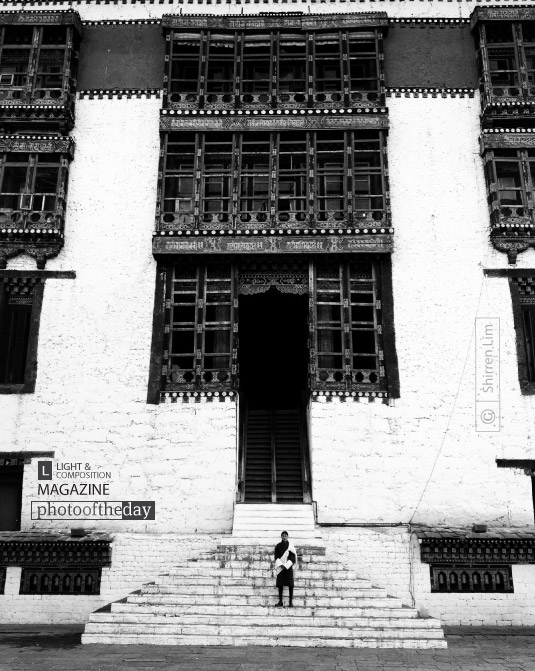
Captured at the majestic Trashichho Dzong in Thimphu, Bhutan, this photograph emphasizes the profound scale of traditional architecture against the human form. The photographer, struck by the immense proportions of the government secretariat, strategically positioned a travel guide on the steps to provide a sense of perspective. This deliberate choice highlights the interplay between monumental structure and individual presence. The image is award-worthy for its clean composition and its ability to convey the overwhelming grandeur of the site, turning a simple architectural study into a compelling narrative about human scale within a vast, historic environment.
Shirren Lim
Born on Penang Island, Malaysia, in 1970, Shirren Lim is a Jakarta-based photographer who discovered her true passion for the craft in 2009. Specializing in portraiture, she seeks to capture the sincerity and raw humanity of her subjects through an intense, earthy aesthetic. Heavily influenced by the iconic work of Steve McCurry, Lim strives to produce images that resonate with the same emotional depth and global impact as the photography that inspired her youth. Her work has been featured in various international print and web publications.
Resonance Score Breakdown
Transparency Note: The resonance score (12.3/20) is calculated based on social engagement metrics collected before the award announcement.
Expert Photography Reviews · 8
The Weight of Silence
We often mistake size for importance, believing that the towering walls we build are meant to dwarf the spirit. Yet, when we stand before something that has outlived generations, we are not diminished by its scale; we are invited to become quiet.
Read the reflection →Small Against the Stone
I spent an hour this morning trying to fix a loose shelf in my kitchen. I kept looking at the wall, feeling frustrated by how crooked the brackets were and how small my tools looked against the expanse of the plaster.
Read the reflection →Reviews & Comments
Share your thoughts about this award-winning photograph. Your reviews contribute to the community engagement score.
You waited for that guide to stand perfectly still against the weight of the Dzong, and I can feel the silence in that moment. It’s a quiet, heavy kind of scale. Most people would just snap the building, but you made it about the person. I’ve stood in places like that, feeling small, and you caught that exact ache. It’s honest work. You didn’t just document architecture; you captured how it feels to be human.
The scale hits you first. It’s a wide shot that refuses to blink, pinning that solitary guide against the crushing weight of the Dzong. I love how the iPhone 4S sensor renders the stone; it’s raw, honest, and lacks the digital polish that ruins modern frames. The cut would have been a mistake. Lim understood that the silence between the human and the architecture is where the story lives. It’s a perfect, held breath.
We look at this lone figure on the steps of Trashichho Dzong and we feel the weight of history pressing down. It’s a quiet, humble conversation between a person and the stone giants of Thimphu. I’m moved by how small the guide seems against those massive, ornate walls. It’s a reminder that we are merely passing through these ancient spaces. This is a photograph that asks to be returned to, again and again.
Trashichho Dzong’s scale is undeniable, but why must we reduce a Bhutanese guide to a mere prop for perspective? It’s a tired trope that treats local bodies as architectural scale bars. I’ve seen this gaze too often in travel photography. Does the history of this site vanish when we turn a person into a measurement? It makes me deeply uncomfortable. We shouldn’t mistake a clean composition for a profound encounter with another culture.
1/60sec at f/2.4, 4.3mm. The iPhone 4S sensor is a bottleneck, yet Lim’s choice of a fixed wide aperture forces a shallow plane that isolates the guide against the Dzong’s rigid geometry. It’s a calculated risk. The low ISO keeps the noise floor manageable, preserving the stone’s texture. I’ve seen countless architectural shots ruined by over-processing, but this remains honest. It’s technically sparse, yet the math holds up. I actually respect the restraint shown here.
The stone of Trashichho Dzong holds a silence that only the mountains truly understand. Shirren waited for the light to soften, letting the architecture breathe against the vast, thin air of Thimphu. I’ve stood in such places, feeling my own insignificance against those towering walls. By placing a guide on the steps, she didn’t just add scale; she invited us into the quiet. It’s a humble, patient observation of how small we are beneath the heavens.
The verticality of the Trashichho Dzong demands total submission from the viewer. The architecture’s rigid geometry creates a crushing spatial tension. By placing the figure at the base, the frame establishes a necessary fulcrum. It’s a brutal lesson in scale. I’ve rarely seen such a cold, calculated use of negative space. The iPhone’s limited sensor doesn’t soften the impact; it’s sharp, clinical, and precise. It’s a rare moment where the structure actually holds.
Most architectural shots fail because they’re cold, but this one breathes. By placing that lone figure on the massive stone steps, Lim forces us to confront our own insignificance against the Dzong’s weight. I’ve seen thousands of travel photos, yet this one sticks. It’s the iPhone 4S grain that grounds it, making the scene feel like a memory rather than a postcard. It’s a quiet, honest reminder of our place in history. I’d keep this forever.