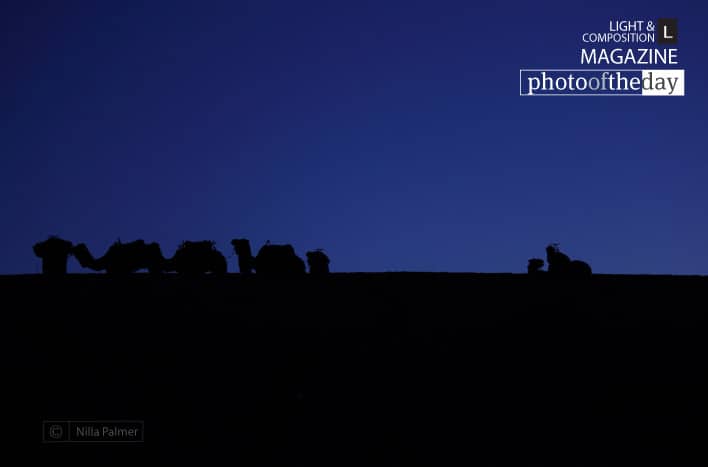
Saharan Silhouette by Nilla Palmer
After a grueling two-hour camel trek across the undulating dunes of the Western Sahara, the photographer found herself in Merzouga amidst an unexpected desert downpour. As dawn broke, the harsh conditions gave way to a moment of sublime clarity, revealing a striking silhouette defined by the stark contrast between deep black shadows and the rich indigo of the morning sky. This image is award-worthy for its masterful use of minimalism and color theory, transforming a challenging travel experience into a timeless, evocative study of light and form that captures the quiet, enduring spirit of the desert.
Nilla Palmer
Based in Brisbane, Australia, Nilla Palmer has cultivated a deep passion for global exploration and photography over the past 27 years. Her artistic journey evolved from early experiences with 110mm and 35mm film to a sophisticated mastery of modern digital techniques. Dedicated to capturing moments that resonate deeply with viewers, Palmer strives to tell compelling visual stories that inspire audiences to discover the beauty of far-off lands.
Resonance Score Breakdown
Transparency Note: The resonance score (11.8/20) is calculated based on social engagement metrics collected before the award announcement.
Expert Photography Reviews · 6
The Weight of Silence
There is a particular kind of stillness that only arrives after the storm has passed. We often fear the upheaval, the sudden shift in the weather of our lives, yet it is in the aftermath that the world truly reveals its bones.
Read the reflection →The Quiet After the Storm
I spent this morning trying to scrub a stubborn mud stain off my kitchen floor. It rained so hard last night that the garden overflowed, and I must have tracked half the yard inside without realizing it.
Read the reflection →Reviews & Comments
Share your thoughts about this award-winning photograph. Your reviews contribute to the community engagement score.
We look at this silhouette against the indigo dawn and we don’t just see a shape; we hear the desert’s silence. Nilla didn’t just capture a trek; she listened to the dunes until they whispered their secrets. It’s a portrait of endurance, where the human form becomes one with the horizon. I feel a profound ache in my chest looking at it. It’s a photograph that asks to be returned to, again and again.
The shutter clicks and the world stops breathing. That indigo sky isn’t just color; it’s the silence between two scenes. I’ve spent hours in editing suites chasing this exact tension. The silhouette holds the frame, refusing to let the horizon swallow it whole. It’s a perfect, frozen cut. I felt my own pulse slow down just looking at it. It’s the kind of shot an editor keeps because it’s the only one that tells the truth.
The desert doesn’t yield its secrets to the hurried. Nilla stood here in the cooling hour, waiting for the indigo sky to settle against the dunes. It’s a rare, quiet clarity. I’ve felt that same stillness after a storm, when the air holds its breath. The silhouette isn’t just a shape; it’s a prayer of shadow. It makes me ache for that silence, for the moment when the land finally decides it’s time to be seen.
Shadow isn’t merely the absence of sun here; it’s the desert’s own conscience. Palmer’s silhouette doesn’t just occupy the frame; it interrogates the indigo void. I’ve spent hours staring at these dunes, and honestly, the crushing silence of that black edge makes my chest ache. It’s a brutal, necessary erasure. When the light finally yields to such absolute darkness, we aren’t looking at a landscape anymore. We’re watching the world decide what it refuses to reveal.
The indigo sky feels almost too perfect, doesn’t it? I’m unsettled by how the desert’s harsh reality dissolves into this aestheticized void. Why does the silhouette remain anonymous? Is this figure a person or merely a prop for our consumption of the exotic? It’s technically sharp, but it strips the landscape of its history to serve a travel fantasy. I find myself craving the grit of the trek, not this polished, silent erasure of the Sahara.
1/100sec at f/4.5, ISO 400. It’s a lazy exposure. At f/4.5, the depth of field is too shallow for a landscape, yet the shutter speed is too slow to freeze any real motion. I’ve spent years in the field; I know the light in Merzouga demands more precision than this. It’s technically sloppy. Still, the indigo saturation is correct. It’s the only reason this shot doesn’t collapse under its own lack of rigor.