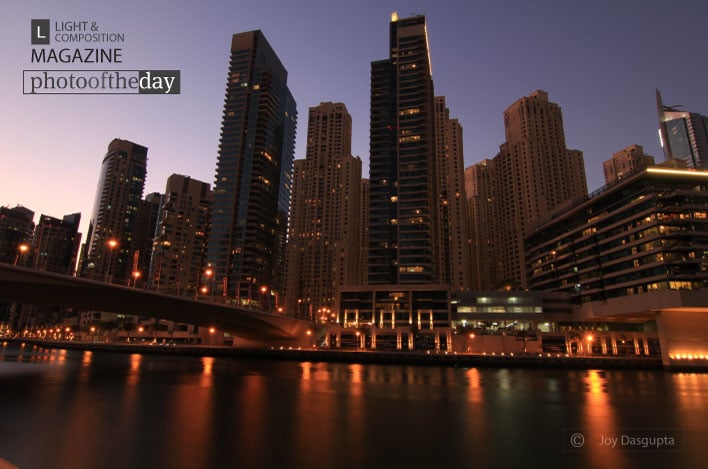
Man-made Marina by Joy Dasgupta
Captured at night, this long-exposure photograph showcases the architectural grandeur of Dubai Marina, a massive man-made waterfront development. By utilizing a 30-second exposure, the photographer transformed the Persian Gulf waters into a smooth, reflective surface, perfectly mirroring the illuminated skyscrapers that define the city's skyline. The composition emphasizes the scale of the 8 km public walkways and the intricate urban planning of the site. This image is award-worthy for its technical precision in low-light conditions and its ability to capture the serene, futuristic atmosphere of one of the world’s most ambitious engineering feats.
Joy Dasgupta
Born in India in 1977 and a graduate of Calcutta University, Joy Dasgupta has resided in the United Arab Emirates for the past seven years. An active member of both the Emirates Photography Club and the Kolkata Photographers Club, he views photography as a profound source of personal fulfillment and a means to engage with the world through a creative lens. Inspired by the masters of the craft, he continuously challenges himself to refine his technical skills and artistic vision with every photograph he captures.
Resonance Score Breakdown
Transparency Note: The resonance score (14.3/20) is calculated based on social engagement metrics collected before the award announcement.
Expert Photography Reviews · 7
The Architecture of Echoes
We build our monuments to reach the stars, yet we are always tethered to the ground by the weight of our own shadows.
Read the reflection →The Architecture of Silence
We often speak of cities as if they were living, breathing organisms, prone to the same chaotic pulses that govern our own veins. We describe the roar of traffic, the frantic pace of the sidewalk, and the relentless hum of electricity that keeps the darkness at bay.
Read the reflection →Reviews & Comments
Share your thoughts about this award-winning photograph. Your reviews contribute to the community engagement score.
30 seconds at f/14, ISO 100, 12mm. A calculated risk. Stopping down to f/14 forces diffraction, yet it’s the only way to achieve that specific starburst pattern on the marina lights. It’s a cold, clinical trade-off. I’ve spent enough time in Dubai to know the humidity ruins long exposures, but the sensor stayed clean here. It’s technically sound. I’m actually impressed the 550D didn’t introduce more noise in the shadows. A precise, logical execution.
Thirty seconds of stillness. Joy let the shutter breathe while the city’s electric pulse settled into the glass-like surface of the marina. It’s a quiet, synthetic silence. I find myself shivering slightly, feeling the cool, damp air of that midnight hour. He didn’t just capture architecture; he listened to the hum of the steel giants until they finally stopped trembling. It’s a rare, meditative peace found in the heart of such a frantic, man-made world.
At f/14, the Tokina’s diffraction limit begins to soften the micro-contrast, yet it’s exactly what this scene demands. The thirty-second exposure integrates the photon flux into a perfect, glassy stillness. I’m genuinely moved by how the sensor resolves the light trails against the dark water; it’s a clinical, beautiful silence. The lens has captured a geometry the human eye simply can’t process in real-time. It’s a rare, cold, and precise triumph of optics.
The electric cyan of these towers bleeds into the water like a spilled inkwell of synthetic sapphire, creating a nocturnal hum that reminds me of Morandi’s quietest, most melancholic palettes. It’s a cold, crystalline rapture; I’m breathless before this artificial stillness. One finds the deep, bruised violet of the horizon line particularly haunting, as if the desert’s ancient heat has finally surrendered to the relentless, neon-drenched precision of a future that doesn’t know how to sleep.
Thirty seconds of stillness. The water doesn’t move. It’s a mirror for the steel giants. I find myself holding my breath, waiting for a ripple that never comes. The frame is heavy with light, yet it feels hollow. It’s a strange, cold peace. Nothing here is accidental. The empty corner is not empty. It’s a void that demands I look closer. I’ve never felt so small in a city that’s so loud.
Dubai Marina isn’t a city; it’s a neon tomb for the sun. By smoothing the water into a glassy, indifferent void, the long exposure strips away the pulse of the tide. It’s technically precise, sure, but it’s terrified of the dark. I find the clinical perfection here deeply unsettling. Where is the grit? Where is the human cost of this glass ambition? It’s a beautiful, hollow shell, and frankly, it makes me feel cold.
Before the eye identifies the architecture, something in the chest tightens. The stillness of the water creates a vacuum, a silence so heavy it forces a shallow breath. I’ve stared at these glass towers for years, and they still trigger a strange, cold vertigo. It’s the loneliness of the infinite reflection that haunts me. When I return to this frame, I don’t see engineering; I see a mirror waiting for a ghost that never arrives.
BRILLIANT night …
This is realllyyyy excellent…