Chimpanzees Our Closest Relatives by Kirsten Bruening
Captured at the Cologne Zoo, this striking portrait highlights the profound genetic and emotional connection between humans and chimpanzees. By focusing on the subject's expressive facial features, the photographer invites viewers to contemplate the thin line between ape and man. The image was taken with a 70mm focal length at a fast shutter speed of 1/800s, freezing the subtle nuances of the animal's expression. This photograph is award-worthy for its intimate composition and the photographer's ability to bridge the gap between wildlife and portraiture, capturing a moment of quiet, human-like introspection that challenges our understanding of intelligence and kinship.
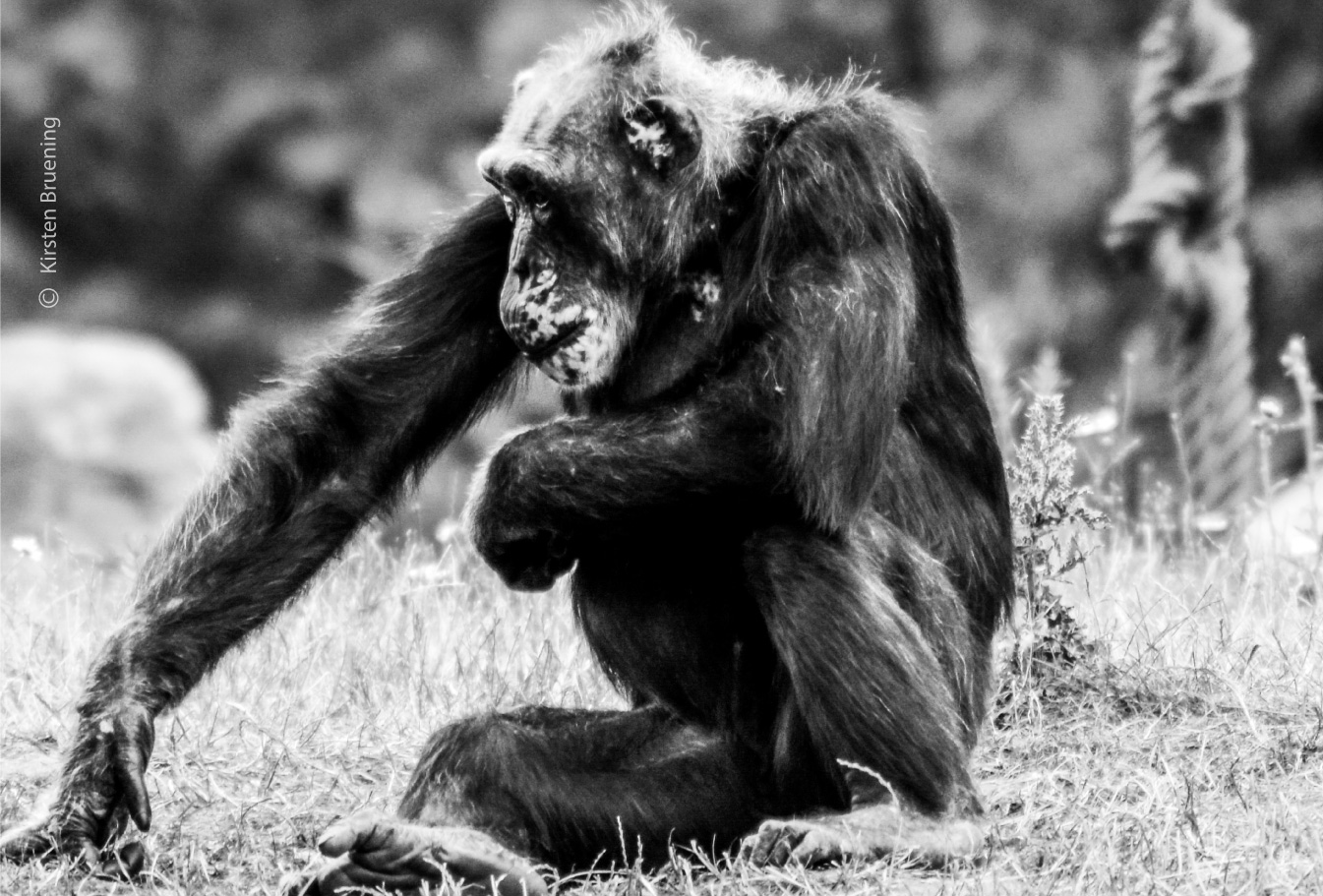
Exposure 1/800sec @ f/5.6 | ISO 800 | Focal Length 70mm
Kirsten Bruening
Based near Cologne, Germany, Kirsten Bruening is a dedicated photographer whose lifelong passion for the craft began in childhood. After a fifteen-year hiatus, she returned to the medium with a renewed focus on black and white wildlife, nature, and portraiture. Bruening is particularly drawn to the interplay of light and shadow, which she believes best conveys the depth of human and animal emotion. Currently pursuing further academic study in photography, she continues to refine her technical skills and artistic vision.
Resonance Score Breakdown
Transparency Note: The resonance score (10.4/20) is calculated based on social engagement metrics collected before the award announcement.
Expert Photography Reviews · 8
The Mirror in the Eyes
I remember sitting in a quiet corner of a local library, watching an elderly man read a newspaper. He wasn't just scanning the headlines; he was tracing the words with a trembling finger, his brow furrowed in a way that felt deeply, achingly familiar.
Read the reflection →The Mirror in the Dark
It is 3:15 am. The house is quiet enough to hear the hum of the refrigerator, a sound that feels like a heartbeat in an empty chest. I find myself staring at the wall, wondering about the things we keep locked away behind our eyes.
Read the reflection →Reviews & Comments
Share your thoughts about this award-winning photograph. Your reviews contribute to the community engagement score.
It’s a striking portrait, yet I find myself craving the chaotic, fluid physics of the deep. Here, the air is forgiving; light doesn’t vanish into the blue, and there’s no backscatter to ruin the clarity of those soulful eyes. I’m genuinely moved by the chimpanzee’s gaze, but I can’t help but miss the struggle against water’s refractive index. It’s a beautiful, dry stillness, but it lacks the hard-won, vibrant triumph of a deep-sea encounter.
Freezing a primate at 1/800s feels like a missed opportunity for intimacy. Why resolve every hair when the subject’s internal life is what matters? It’s technically sharp, sure, but it’s stiflingly literal. I’d have preferred a slower shutter to let the movement blur the boundaries between our species. This approach is closer to a clinical specimen than Hiroshi Sugimoto’s long-exposure theatres. It’s technically proficient, but honestly? It leaves me feeling cold and uninspired.
That gaze hits hard. It’s not just a zoo shot; it’s a mirror. Bruening caught that flicker of introspection right before the chimp looked away. If she’d waited a tenth of a second, that connection would’ve dissolved into just another animal portrait. I’ve spent years hunting that exact look on the subway. It’s raw, it’s honest, and it’s fleeting. She nailed the timing. Honestly, looking at those eyes, I feel like I’m the one being watched.
The enclosure’s concrete datum creates a brutal, artificial threshold, stripping away the chimpanzee’s natural context. While the portrait’s intimacy is undeniable, I’m struck by the cold, grey void behind those eyes. It’s a cage, not a habitat. The light doesn’t dance here; it just hits the skin, highlighting the tragic geometry of confinement. I find it deeply unsettling. We’ve built a structure that captures the subject, but it’s failed to honor the space they deserve.
A zoo enclosure is hardly the wilderness, yet one can’t deny the weight in those eyes. It’s a sharp capture, certainly, but I find myself wondering if the photographer spent a week by the glass or merely an afternoon. Did they wait for the crowd to thin, or just snap and leave? It’s technically sound, but I’ve seen enough to know that true intimacy usually demands more than a quick shutter click at the Cologne Zoo.
Most wildlife shots are just taxidermy with a pulse, but this one actually unsettled me. By keeping the 70mm focal length tight, Bruening avoids the zoo’s clutter, forcing us to confront that weary, heavy-lidded gaze. It’s the eyes that do the work; they hold a weary intelligence that makes me look away. In thirty years, we’ll still be debating our kinship with these creatures, and this portrait will remain the definitive, uncomfortable evidence why.
The light here isn’t the wild, untamed sun I usually chase, but it’s still listening. Kirsten caught a stillness that feels heavy, like the air before a storm. Looking into those eyes, I’m struck by a sudden, quiet ache—it’s like seeing a reflection of my own solitude. She didn’t rush the shutter. She waited until the ape’s gaze turned inward, finding that fragile, shared silence that exists between us and the earth. It’s deeply moving.
Captivity isn’t a neutral backdrop. When we frame a chimpanzee behind Cologne Zoo glass, are we documenting kinship or merely our own dominion? I find the subject’s gaze deeply unsettling, yet I wonder if we’re projecting human melancholy onto a creature trapped for our amusement. Does the 70mm lens bridge the gap, or does it just sanitize the cage? It’s a sharp portrait, sure, but whose humanity are we actually celebrating here? I’m left feeling quite cold.