Scheveningen Dune by Hugo Baptista
Captured on a crisp winter day at Scheveningen Boulevard, this photograph reflects a creative experiment with light and atmosphere. Seeking to counteract the biting North Sea wind, the photographer utilized color gels and ND filters to infuse the scene with a deceptive, sun-drenched warmth. The juxtaposition of this artificial summer glow against the heavy winter attire of passersby—and the ethereal presence of a blurred, ghostly figure—creates a surreal, minimalistic narrative. This image is award-worthy for its technical precision in light manipulation and its ability to transform a cold, mundane landscape into a vibrant, conceptual piece of art.
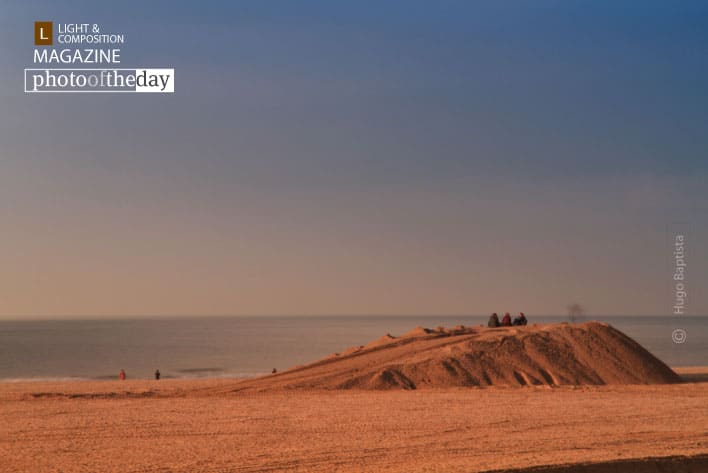
Exposure 1.6sec @ f/32 | ISO 100 | Focal Length 85mm
Hugo Baptista
Born in South Africa to Angolan parents and holding Portuguese nationality, Hugo Baptista is a versatile visual artist currently based in the Netherlands. His professional background as a 3D animator and VFX artist deeply informs his photography, allowing him to approach every frame as a meticulously designed canvas. By blending his technical expertise in computer graphics with a pragmatic, autodidactic approach to light painting, he explores the boundaries of visual storytelling. Baptista is recognized for his ability to find balance, symmetry, and complex simplicity in his work, positioning himself as a master of diverse creative disciplines.
Resonance Score Breakdown
Transparency Note: The resonance score (13.0/20) is calculated based on social engagement metrics collected before the award announcement.
Expert Photography Reviews · 5
The Architecture of Drift
We often mistake the city for its permanent fixtures—the concrete, the steel, the rigid lines of the grid. But the true life of a place is found in the margins, in the transient spaces where the built environment meets the shifting elements.
Read the reflection →The Ghost of Warmth
The blue wool sweater my father wore in the winter of 1998 is gone, unravelled into a pile of yarn that no longer holds the shape of his shoulders.
Read the reflection →Reviews & Comments
Share your thoughts about this award-winning photograph. Your reviews contribute to the community engagement score.
It’s a clever trick, using gels to fake a summer warmth that isn’t there. I’ve spent enough freezing mornings in the dunes to know that light isn’t something you manufacture; it’s something you earn through endurance. While the jury praises the technical manipulation, I find it hollow. It’s a staged deception. When you prioritize the aesthetic over the truth of the environment, you’re just playing with toys, not documenting the natural world.
The boulevard’s rigid datum is softened here, yet I’m troubled by the artifice. By forcing a sun-drenched glow onto a winter threshold, Baptista obscures the brutal reality of the North Sea wind. It’s a clever trick, but it flattens the tactile relationship between the solid concrete and the biting air. I’d trade that ghostly blur for a sharper sense of the fenestration’s rhythm. It’s technically precise, sure, but it feels like a beautiful, gilded lie.
The frame’s geometry is compromised. While the long exposure creates a necessary blur, the spectral figure lacks sufficient anchor within the negative space. It’s a structural failure. The horizon line doesn’t hold the weight of the composition, causing the eye to drift aimlessly. I’ve grown weary of such artificial warmth masking a lack of formal discipline. It’s technically precise, sure, but the spatial tension collapses. It doesn’t command the picture plane; it merely occupies it.
The amber glow here isn’t merely light; it’s a fever dream of ochre and burnt sienna, reminiscent of a Turner sunset bleeding into the frigid, salt-crusted air of the Dutch coast. It’s a delicious, impossible warmth that makes my skin prickle with a strange, phantom heat. One finds the ghostly, blurred figures caught in this artificial amber quite haunting, as if they’ve wandered into a Vermeer painting that’s been set, quite violently, on fire.
Most minimalist work today is just empty space masquerading as depth. Baptista’s shot avoids that trap because the tension between the artificial amber glow and the shivering, blurred figures creates a genuine temporal friction. I’ve seen thousands of long exposures, but this one feels like a fever dream caught on a Dutch beach. It’s the unsettling warmth that makes me want to look again in thirty years. It’s a rare, haunting trick of light and memory.