Almost Done by Abdellah Azizi
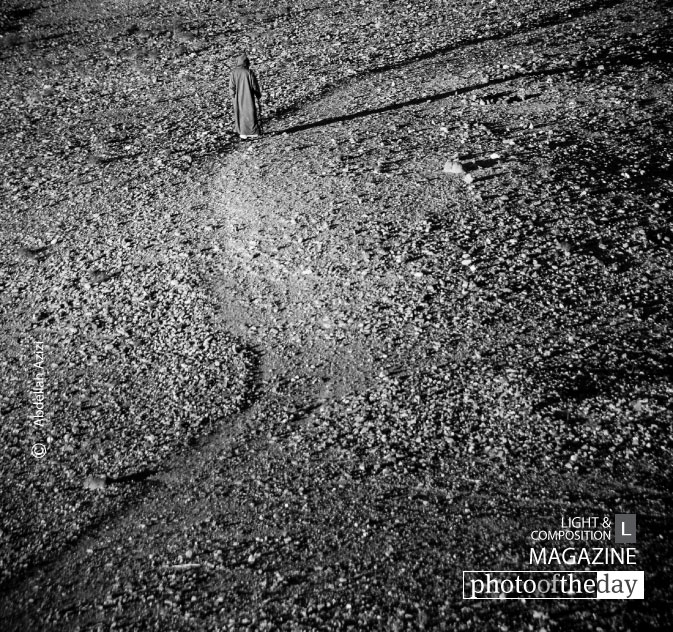
Captured during the golden light of late afternoon, this poignant image features an elderly man walking along a winding path in Ouarzazate. The photographer, originally seeking a wide-angle landscape, shifted his focus to the solitary figure below, framing him at the apex of a curve to create a powerful visual metaphor for the final stages of life. The use of a 200mm focal length compresses the scene, emphasizing the man's isolation against the vast, rugged terrain. This photograph is award-worthy for its profound narrative depth, turning a fleeting moment of observation into a timeless reflection on the human journey.
Abdellah Azizi
Born in Ouarzazate in 1987, Abdellah Azizi is a dedicated Moroccan photographer known for his evocative documentation of Southern Moroccan landscapes and local culture. With a formal background in film lighting, grip techniques, and audio-visual post-production, he brings a cinematic sensibility to his still photography. After transitioning from a career as a videographer and lighting technician, Azizi found his true creative voice in photography, drawn to the medium by the artistic freedom it provides. His work continues to capture the authentic spirit and vibrant life of the African continent.
Resonance Score Breakdown
Transparency Note: The resonance score (12.9/20) is calculated based on social engagement metrics collected before the award announcement.
Expert Photography Reviews · 5
The Long Shadow of Noon
We spend the first half of our lives gathering weight—collecting stones for the walls, names for the ledger, and memories that cling like burrs to our coats. We are builders, architects of our own busy horizons, convinced that the path ahead is a mountain to be climbed.
Read the reflection →The Weight of the Path
The horizon is a line we draw to keep the vastness from swallowing us whole. We walk toward it, believing it marks a destination, yet it retreats with every step.
Read the reflection →Reviews & Comments
Share your thoughts about this award-winning photograph. Your reviews contribute to the community engagement score.
Of the thousands of submissions I’ve reviewed, most rely on sentimentality to carry the weight. Azizi avoids that trap. By using the 200mm lens to flatten the Ouarzazate terrain, he forces the man into a claustrophobic, beautiful struggle against the earth. It’s the compression that makes this endure; it turns a simple walk into a heavy, inevitable conclusion. I felt a genuine ache in my chest looking at it. That’s why it’s still here, thirty years later.
At 200mm, the compression flattens the Ouarzazate topography, forcing the focal plane to reconcile the man’s weathered texture with the distant, arid grit. It’s a delicate balance; at f/8, the diffraction limit hasn’t yet softened the micro-contrast of his robes. I’m genuinely moved by how the lens resolves those fine, dusty contours against the void. It’s not just a portrait; it’s a precise optical capture of a life nearing its own inevitable, quiet terminus.
The path curves. The man walks. He is small against the dust. I’ve spent minutes watching him move toward the edge of the frame. It’s quiet here. The compression of the lens pulls the earth tight around his shoulders. Nothing here is accidental. The empty corner is not empty. It’s the weight of the distance he’s traveled. I feel a sudden, sharp ache in my chest. He’s almost home. The silence is heavy.
One suspects Azizi didn’t just stumble upon this path. That 200mm compression suggests he’d been sitting in the Ouarzazate heat long enough for the dust to settle in his own lungs. It’s a quiet, deliberate piece of work. I’ve spent enough afternoons waiting for a subject to hit the perfect curve to know the ache in his knees. He earned this solitude. It’s a rare, honest bit of patience captured in a frame.
1/40sec at f/8, 200mm. ISO 200. The shutter speed is dangerously slow for a 200mm lens on a D90. It’s a gamble that barely pays off. I’ve spent years calculating shake, and frankly, the sharpness here is a miracle of luck rather than technique. The compression works, though. It flattens the Ouarzazate terrain into a claustrophobic cage. It’s technically reckless, but I can’t deny the isolation it forces onto the frame. It’s effective.