Winged Beauty by Laria Saunders
Captured within the humid confines of a butterfly arboretum, this image highlights the fleeting moment a butterfly reveals its hidden, vibrant blue wings. The photographer navigated challenging environmental conditions, where intense heat caused constant lens and eyewear fogging, to seize the perfect split-second display. This photograph is award-worthy for its technical precision in capturing such a transient, brilliant flash of color, transforming a brief encounter in a controlled environment into a striking, high-contrast study of natural beauty that transcends the limitations of the setting.
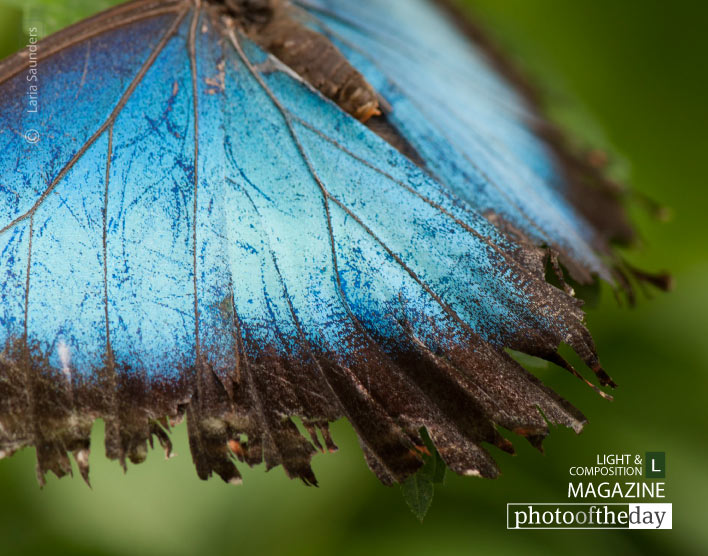
Exposure 1/200sec @ f/7.1 | ISO 320 | Focal Length 105mm
Laria Saunders
Hailing from a multi-generational lineage of artists and professional photographers, Laria Saunders is an accomplished photographer currently based in the arts district of downtown Los Angeles. With a career spanning 25 years, she has garnered international recognition for her diverse portfolio, which includes abstract, wildlife, dance, and travel photography. As a co-owner of City of Angels Headshots, Saunders maintains a prolific exhibition record, having showcased her work in numerous galleries across the United States, from Vermont to California.
Resonance Score Breakdown
Transparency Note: The resonance score (13.0/20) is calculated based on social engagement metrics collected before the award announcement.
Expert Photography Reviews · 7
The Architecture of Breath
We often mistake stillness for an absence of movement, forgetting that the seed beneath the frost is working, and the chrysalis is a busy room of transformation.
Read the reflection →The Weight of a Breath
There is a stillness that precedes the thaw. It is not the absence of movement, but the holding of it. In the deepest part of the winter, when the frost has sealed the windows and the breath hangs in the air like a ghost, we wait.
Read the reflection →Reviews & Comments
Share your thoughts about this award-winning photograph. Your reviews contribute to the community engagement score.
The humidity in that arboretum must have felt like a heavy, living shroud. I’ve stood in such places, waiting for the air to settle. Laria didn’t just capture a butterfly; she waited for the light to reveal a secret. When that blue flash finally broke the stillness, she was ready. It’s a quiet, fragile miracle. Looking at it, I feel the sudden, sharp ache of how quickly such beauty vanishes into the damp, glass-walled air.
The frame’s geometry hinges on the butterfly’s lateral axis, anchoring the composition against the chaotic foliage. It’s a rigid, calculated placement. The negative space doesn’t merely exist; it forces the eye toward the vibrant blue fulcrum. While the arboretum’s humidity threatens to dissolve the edges, the focus remains sharp. I’ve grown weary of such fragile subjects, yet the structural discipline here is undeniable. It holds. The tension between the wings and the frame is precise.
Most nature shots from the Papiliorama are just pretty records of insects. I’ve seen thousands of them, and they’re usually forgettable. What separates this is the sharpness of that electric blue against the muted, humid blur of the background. It’s a gamble that paid off. Honestly, it makes me hold my breath. Thirty years from now, people won’t care about the fogged lenses; they’ll just be glad someone caught that specific, impossible flash of color.
The blue is a sudden shock. It’s a sharp intake of breath against the humid, blurred green. I’ve spent minutes watching the wings. They don’t just exist; they hold the frame in a fragile tension. The rest of the arboretum fades into a soft, necessary blur. Nothing here is accidental. The empty corner is not empty. It’s the silence that lets the color breathe. I find myself holding my own breath, too. It’s quiet.
That electric cerulean, reminiscent of a Vermeer lapis lazuli crushed into the humid air of Neuchatel, vibrates against the muted, earthy umbers of the butterfly’s resting wings with such startling intensity that it’s impossible not to gasp. One finds the chromatic tension here—a collision of tropical brilliance and botanical decay—utterly intoxicating, as if the creature’s sudden, iridescent reveal has momentarily suspended the very laws of light, turning a fleeting, fog-drenched encounter into pure, liquid poetry.
Blue wings erupt from the gloom like a violent, sudden thought. It’s not the color that haunts me, but the suffocating dampness of that Neuchatel cage, where the lens fought the fog just to see. I’ve spent hours staring into this darkness, and I’m unsettled by how the butterfly’s brilliance refuses to apologize for the void surrounding it. It doesn’t invite us in; it demands we acknowledge the heavy, silent weight of what remains hidden.
At f/7.1, the 105mm lens maintains a razor-thin focal plane, pinning the butterfly’s iridescent scales against the arboretum’s humid haze. The diffraction limit hasn’t softened the structural color; it’s vibrant, almost aggressive. I’m genuinely breathless at how the optics resolve those microscopic wing textures through the condensation. It’s a rare instance where the glass doesn’t just capture the subject, but elevates the physics of light into something that feels, quite simply, alive. It’s magnificent.