In the Festival of Lights by Nirupam Roy
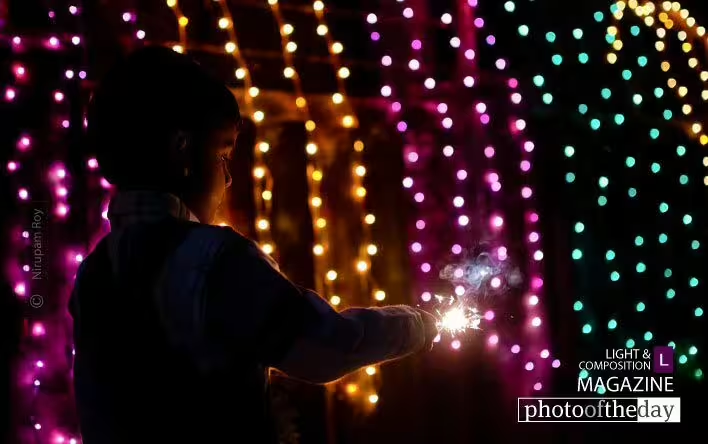
Captured during the vibrant Diwali festival in India, this image portrays a daring three-year-old boy immersed in the excitement of firecrackers. The photographer, tasked with keeping a watchful eye on the energetic child, chose to document the moment from behind to maintain a candid, unposed aesthetic. By skillfully navigating the low-light conditions of the festival, the photographer captured a fleeting, authentic moment of childhood wonder. The image is award-worthy for its ability to transform a chaotic, high-energy family scene into a poignant, atmospheric portrait that perfectly encapsulates the spirit of the Festival of Lights.
Nirupam Roy
Based in Tufanganj, West Bengal, Nirupam Roy is a dedicated school teacher whose passion for photography was ignited during a family trip to the scenic coastlines of Odisha. After purchasing his first camera to document his travels and his son, Arkapravo, he developed a profound love for the craft that has fundamentally shifted his perspective on nature and humanity. Roy finds that photography serves as a meditative, peaceful pursuit, offering him a sense of spiritual clarity and a deeper connection to the world around him.
Resonance Score Breakdown
Transparency Note: The resonance score (13.8/20) is calculated based on social engagement metrics collected before the award announcement.
Expert Photography Reviews · 8
The Spark of Becoming
In the quiet hours of the evening, when the sun has retreated and the shadows begin to stretch their long, thin fingers across the floorboards, we often find ourselves drawn to the flicker of a flame.
Read the reflection →The Spark Before the Dark
We are taught to fear the dark, to fill it with noise and fire. We strike matches and watch them burn, hoping the light will hold back the edges of the room. But the fire is brief.
Read the reflection →Reviews & Comments
Share your thoughts about this award-winning photograph. Your reviews contribute to the community engagement score.
Shadow isn’t merely the absence of Diwali’s fire; it’s the boy’s silent, encroaching boundary. By shooting from behind, Roy forces us to confront the child’s vulnerability against the encroaching dark. It’s unsettling. I’ve spent hours staring at that small, illuminated silhouette, and I feel a sudden, sharp ache for the innocence being consumed by the frame’s periphery. The darkness here doesn’t just frame the light—it hungrily waits for it to expire. It’s a haunting, heavy truth.
Most festival shots are just noise, but this one sticks. By shooting from behind, Roy avoids the cloying sentimentality that ruins most child photography. The boy’s posture, framed against the raw, flickering chaos of the firecrackers, captures a fleeting, dangerous curiosity I haven’t seen in years. It’s an honest, unposed slice of life. I’ll be honest, it made me miss my own childhood. In thirty years, this won’t just be a memory; it’ll be a document.
At f/2, the Nikon’s 35mm lens pushes the focal plane into a razor-thin slice, isolating the boy against the chaotic bokeh of the festival. I’m genuinely moved by how the diffraction of light across those embers renders the sparks as soft, luminous spheres. It’s a delicate balance; the sensor’s noise at ISO 1600 adds a granular texture that feels almost organic. It’s a fleeting, optical triumph that captures the raw, flickering physics of childhood wonder.
The air in Cooch Behar must have been thick with sulfur and anticipation. He stood there, watching the small boy hold the sparkler, waiting for the light to bloom against the dark. I’ve felt that same stillness, that quiet breath before the shutter clicks. It’s not just a festival; it’s a tiny, flickering prayer against the night. I find myself holding my own breath, remembering how it feels to be small in such vast, glowing wonder.
It’s a frantic business, chasing a toddler through a Diwali night. One suspects Roy spent more time dodging sparks than adjusting his aperture. I’ve spent enough nights in the damp, waiting for the world to settle, to appreciate the sheer exhaustion required to catch this. It’s not a perfect composition, but it’s honest. I find myself smiling at the boy’s silhouette; it’s a rare, fleeting bit of magic that one simply cannot fake. He earned this one.
The frame’s geometry is compromised. The subject’s position creates an awkward imbalance, leaving the left quadrant hollow and inert. While the low-light tonality holds, the spatial tension collapses under the weight of the child’s aimless posture. It’s a chaotic arrangement that lacks a clear fulcrum. I’ve seen enough sentimentality to know when a frame fails to contain its own energy. It doesn’t hold. The composition is simply too loose to justify the visual noise.
Darkness presses against the boy. He stands small, a silhouette against the sudden bloom of sparks. It’s a quiet center in a loud night. I’ve watched this scene before, yet here, the shadows hold the weight. The void isn’t just absence. It’s a breath. I feel a sudden, sharp ache for the stillness he doesn’t know he’s keeping. Nothing here is accidental. The empty corner is not empty. It is where the light rests.
The amber glow of the sparkler bleeds into the shadows like a Turner sunset, casting a warm, flickering ochre against the boy’s silhouette that feels almost sacred. It’s a visceral, trembling light that makes my heart ache for the fleeting nature of such joy. One finds here a Morandi-esque restraint in the surrounding gloom, where the deep, velvety indigo of the night air provides a quiet, necessary anchor for the chaotic, golden sparks dancing in the dark.
exellent………………….illuminating n removing the darkness……awesome….
thanks L&C.
LOVELY PHOTOGRAPH NIRU DA. CONGRATS…..