Curse of Reckoning by Sammam Junaid
Captured in the remote village of Tushkhali, this poignant documentary photograph depicts a laborer caught in a moment of profound emotional distress. The photographer observed the man working under grueling conditions, his tears serving as a powerful testament to the systemic hardships faced by those who sustain society through their labor. By documenting this raw intersection of physical exhaustion and mental anguish, the image serves as a stark commentary on the lack of dignity afforded to the working class. It is an award-worthy piece for its ability to transform a fleeting, painful moment into a universal narrative regarding the curse of reckoning.
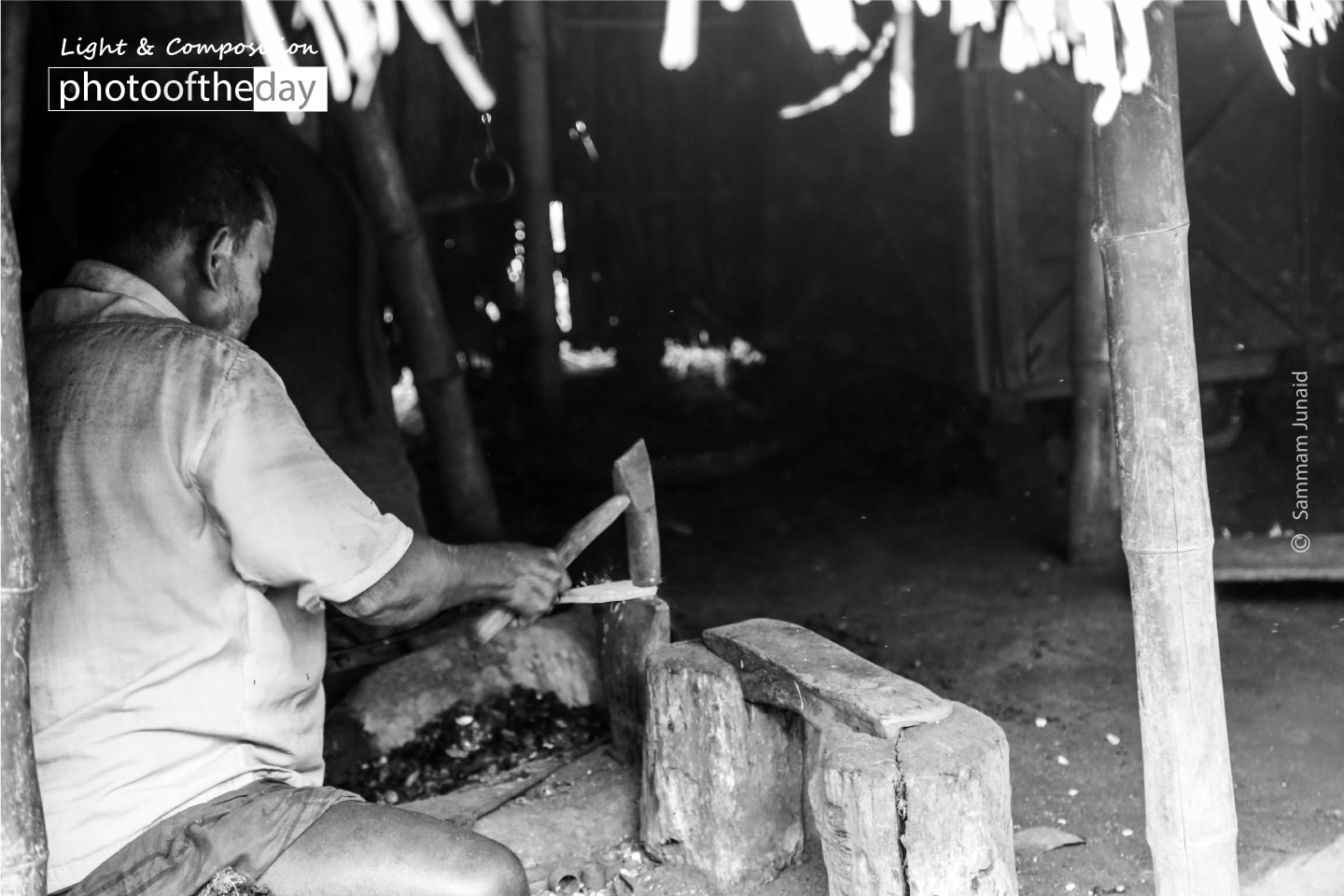
Exposure 1/80sec @ f/4.0 | ISO 1250 | Focal Length 24-105mm
Sammam Junaid
Born in Bangladesh in 2003, Sammam Junaid is a self-taught photographer currently based in Dhaka. Though he lacks formal academic training, his deep curiosity for natural beauty and human stories has driven him to become an active participant in the international photography community. A student at Notre Dame College, Junaid balances his academic pursuits with a dedicated practice in documentary photography, consistently seeking to capture the authentic, often overlooked realities of life within his home country.
Resonance Score Breakdown
Transparency Note: The resonance score (11.6/20) is calculated based on social engagement metrics collected before the award announcement.
Expert Photography Reviews · 8
The Weight of the Unseen
Seneca once observed that we are often more troubled by our own thoughts than by the actual circumstances of our lives. He argued that the mind has a peculiar tendency to amplify the burden of the present, turning a singular moment of fatigue into a narrative of permanent defeat.
Read the reflection →The Weight of the Unspoken
I often find myself lingering near the industrial docks of the city, where the air tastes of salt and heavy labor. There is a particular silence that settles over a person when the body has given all it can, yet the day refuses to end.
Read the reflection →Reviews & Comments
Share your thoughts about this award-winning photograph. Your reviews contribute to the community engagement score.
At f/4.0, the focal plane is razor-thin, isolating the laborer’s distress against a soft, atmospheric blur. The lens resolves the moisture in his eyes with clinical precision, capturing the refraction of light through those tears. It’s a haunting optical achievement. I’m genuinely shaken by how the diffraction of light across his weathered skin reveals such raw, unfiltered exhaustion. It’s rare to see a sensor capture the exact physics of human suffering with this much clarity.
The raw, salt-streaked exhaustion here echoes the visceral humanity of Dorothea Lange’s Depression-era portraits, yet Junaid’s framing feels sharper, more immediate. It’s a brutal, honest look at labor that avoids the trap of romanticized poverty. I’ve spent decades cataloging such suffering, but the specific, jagged grief in this man’s eyes actually caught my breath. It’s a rare, piercing moment of clarity that forces us to confront the human cost of our own comfort. Truly haunting work.
The frame holds a heavy silence. Salt, sweat, and the weight of Tushkhali. I’ve looked at this for an hour. It’s the space around his grief that hurts the most. The emptiness isn’t vacant; it’s a vessel for everything he can’t say. Nothing here is accidental. The empty corner is not empty. It’s a quiet room for his exhaustion. I feel a sudden, sharp ache in my own chest. He is alone. We are watching.
That tear on his cheek isn’t just grief; it’s the exact weight of a life lived in the mud. I’ve seen this look in Winogrand’s contact sheets, that raw, unvarnished humanity. If Junaid had blinked, the tension would’ve vanished. One tenth of a second later and the light shifts, the emotion retreats, and the frame collapses. It’s brutal, honest, and it hits me right in the gut. He caught the moment before it dissolved.
There’s a heavy, jagged grief in this man’s eyes that stops me cold. It’s not just the labor; it’s the exhaustion of a soul pushed past its limit. I wonder if he knew he was being watched, or if the camera just happened to be there. I’d have liked to see the photographer put the gear down and offer a hand instead. This face has a whole life in it, and it’s hurting.
You didn’t just capture a man crying; you sat with his exhaustion until the camera became invisible. I’ve seen enough staged misery to know when it’s real, and this is the genuine article. The way he’s slumped, that heavy, hollow look in his eyes—it actually made my chest tighten. You waited for the truth to break through the labor. And because you stayed, we’re forced to look. There’s something deeply honest happening here. You felt it.
The corrugated iron walls here act as a brutal datum, framing a life defined by enclosure rather than openness. The light raking across those rusted sheets emphasizes the material’s thinness, a sharp contrast to the laborer’s heavy, visceral grief. It’s a claustrophobic threshold. Looking at his posture against that unforgiving, repetitive fenestration, I feel a genuine ache in my chest. Architecture shouldn’t just house us; it shouldn’t be this cold, this indifferent to human suffering.
Watching a man break down under the weight of his labor feels like an intrusion I’m not sure I want to participate in. In my field, we learn that proximity without consent is just theft. I’ve spent weeks in blinds waiting for a bird to trust me; here, the camera feels like it’s extracting pain rather than observing it. It’s technically sharp, sure, but I can’t shake the feeling that the photographer’s presence was a burden.