Mobile Player by Ryszard Wierzbicki
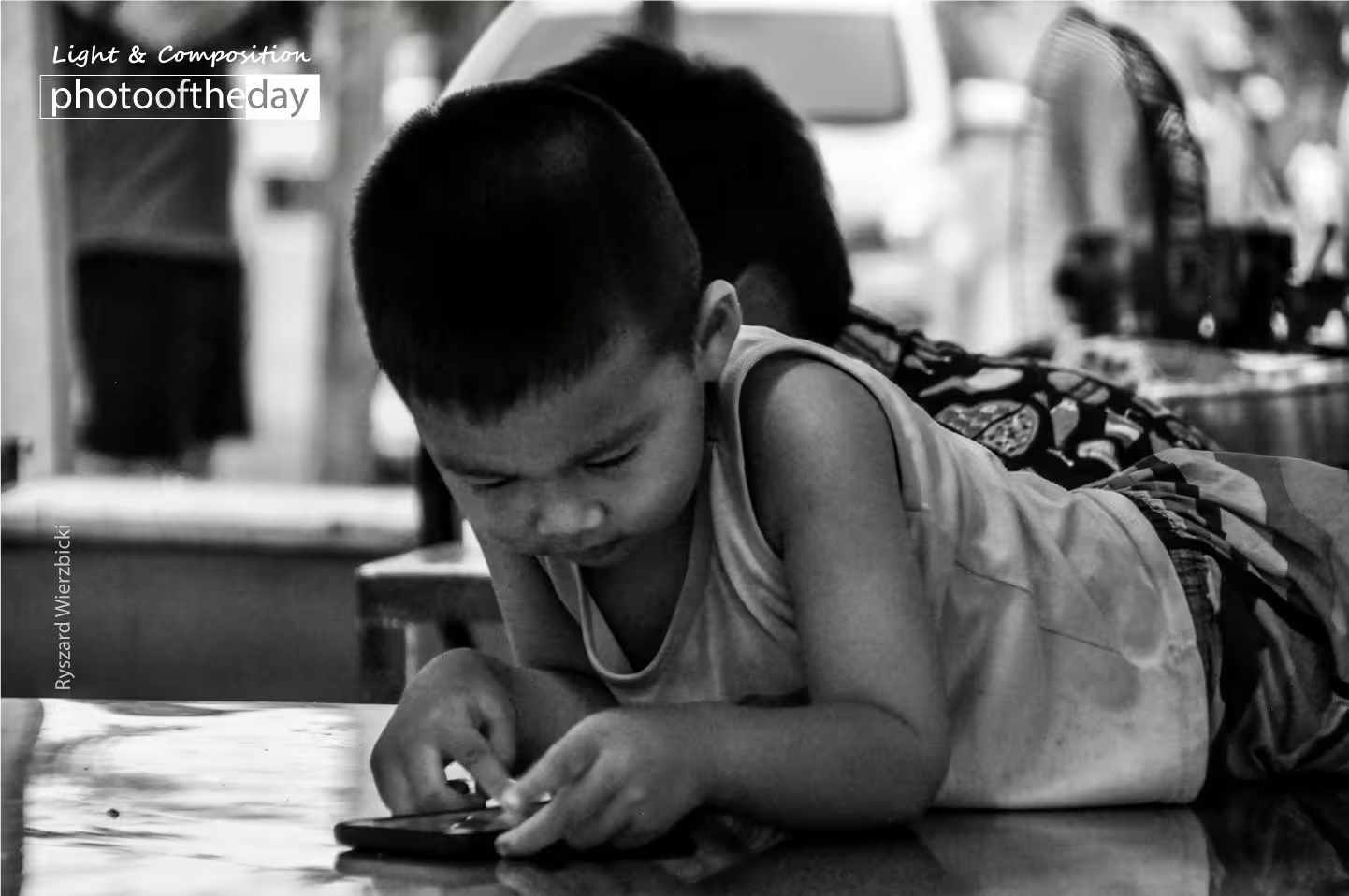
Captured at the vibrant Amphawa Floating Market in Thailand, this poignant black-and-white image documents a quiet moment of childhood amidst the bustle of daily commerce. As his mother prepares meals for tourists in their small, family-run restaurant by the canal, a young boy remains deeply absorbed in his mobile phone. The photograph offers a candid glimpse into the reality of many Thai children, who often spend their days assisting their parents in the absence of formal childcare. It is an award-worthy study of modern digital distraction set against a traditional, hardworking backdrop, masterfully highlighting the intersection of local culture and global connectivity.
Ryszard Wierzbicki
Born in 1963, Ryszard Wierzbicki is a Polish-born photographer and educator who transitioned from a career in social sciences and marketing to a life of global exploration. After relocating to the United Kingdom in 2006, he dedicated himself to documenting the cultures of South-East Asia, often volunteering his time with charitable organizations supporting orphans. Through his photography and travel forums, he shares his passion for discovery, balancing his professional life as a marketing advisor with his commitment to capturing the authentic, human stories he encounters across the globe.
Resonance Score Breakdown
Transparency Note: The resonance score (11.7/20) is calculated based on social engagement metrics collected before the award announcement.
Expert Photography Reviews · 6
The Digital Threshold
We often talk about the city as a physical environment—a collection of bricks, canals, and transit lines. Yet, the most significant infrastructure in any modern space is the invisible network we carry in our palms.
Read the reflection →The Quiet Anchor
There is a particular stillness found in the middle of a rushing tide. We often think of childhood as a season of constant movement, a frantic reaching toward what comes next.
Read the reflection →Reviews & Comments
Share your thoughts about this award-winning photograph. Your reviews contribute to the community engagement score.

The juxtaposition of the boy’s glowing screen against the murky, textured canal recalls the stark social observations of Helen Levitt’s New York street work, yet it’s undeniably contemporary. I’m struck by the way Wierzbicki captures the isolation of the digital age within a traditional, bustling market. It’s a haunting, quiet collision of eras. I’ve spent decades studying such transitions, but seeing this specific, lonely light in a Thai canal—it actually made me catch my breath.
Stripped of chromatic warmth, the scene dissolves into a charcoal-heavy chiaroscuro that recalls the melancholic, dust-choked interiors of a Morandi still life. It’s a haunting, silver-toned silence where the boy’s digital glow becomes a singular, piercing white note against the murky, canal-water shadows. I’m truly unsettled by how the absence of colour forces one to confront the cold, flickering isolation of his screen, turning a bustling market into a tomb of modern, quiet detachment.
You’ve caught a quiet, lonely truth here. While the market churns around him, that boy is miles away, tethered to a screen. It’s a scene I’ve seen a thousand times, yet it still hits me in the gut. You didn’t force the narrative; you just let the contrast between his digital escape and his mother’s labor sit there. And it works. You waited for the right second. There’s something honest happening here. I respect that.
f/2.8 at 35mm, 1/125s, ISO 800. A standard reportage setup. The shallow depth of field isolates the boy effectively, but the shutter speed is borderline for a handheld shot in low light. I’ve seen enough motion blur to know when a sensor is struggling. It’s technically sufficient, though barely. The noise in the shadows is distracting. I’m tired of seeing high ISOs used as a crutch. It’s a competent capture, nothing more.
Before the eye identifies the boy, a strange stillness settles in the chest. It’s the weight of a digital tether pulling him away from the canal’s humid, rhythmic life. I feel a sudden, sharp ache for his solitude amidst the commerce. When I return to this a year later, the screen’s glow feels less like a distraction and more like a sanctuary. It’s a quiet, lonely bridge between his small world and everything else.
We look at this boy, lost in a glowing screen while the Amphawa market hums behind him. It’s a quiet, heavy isolation. I’ve seen this look before—the digital tether pulling a child away from the wooden boats and the scent of the canal. It makes my heart ache for the stories he isn’t hearing from his mother’s side. He’s physically present, yet miles away. It’s a portrait that asks to be returned to, again and again.