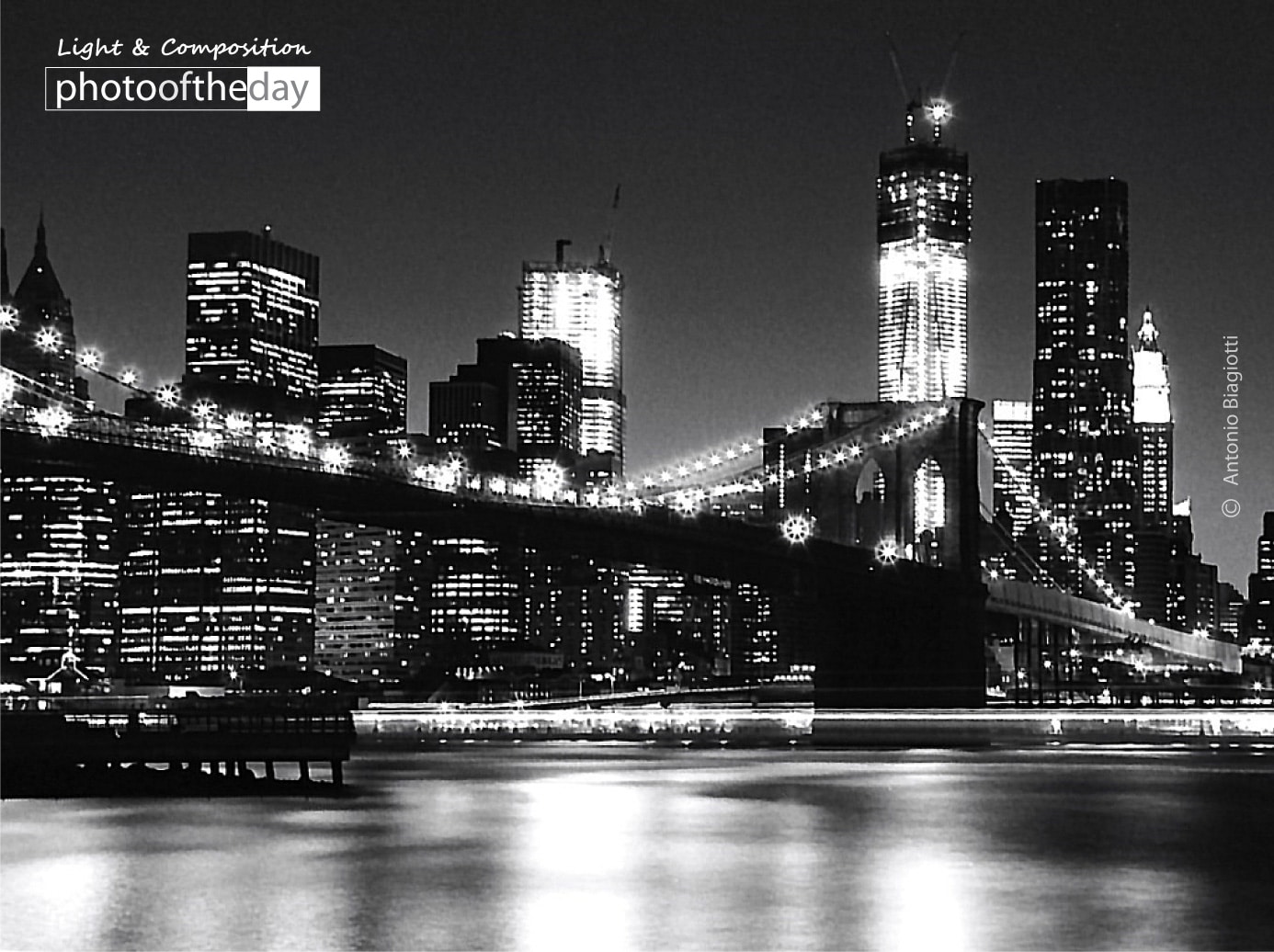
Brooklyn Bridge by Antonio Biagiotti
Capturing the iconic New York skyline, the photographer sought to emphasize the dramatic contrast between the city's glittering skyscrapers and the dark, reflective waters below. By utilizing a long 30-second exposure and intentionally over-developing the Ilford film, the photographer achieved a striking balance of light and shadow. This technical decision highlights the bridge as a monumental symbol of the city, transforming a familiar urban landmark into a timeless, atmospheric study of light. The resulting image stands as an award-worthy testament to the power of film photography in rendering the architectural grandeur of the Big Apple.
Antonio Biagiotti
Born in 1971 in Porretta Terme, Italy, Antonio Biagiotti is a dedicated photographer based in the scenic Appennino Tosco-Emiliano region. His artistic practice is deeply rooted in the traditional darkroom process, where he specializes in black and white film photography using large and medium format cameras. Driven by a passion for the technical nuances of shutter speed and framing, Biagiotti balances his creative pursuits with the support of his family, continuously refining his craft through meticulous manual development and printing techniques.
Resonance Score Breakdown
Transparency Note: The resonance score (11.4/20) is calculated based on social engagement metrics collected before the award announcement.
Expert Photography Reviews · 6
The Architecture of Stillness
Seneca once remarked that we are often more frightened than hurt, and that we suffer more in imagination than in reality. He understood that the human mind is a restless architect, constantly building towers of anxiety out of shadows and future possibilities.
Read the reflection →The Architecture of Silence
We often mistake the city for a roar, a frantic pulse of iron and glass that never sleeps. But there is a secret geography to the night, a quiet architecture that only reveals itself when the crowds have retreated into their own shadows.
Read the reflection →Reviews & Comments
Share your thoughts about this award-winning photograph. Your reviews contribute to the community engagement score.
The shutter stays open for thirty seconds, and the city breathes. It’s a long take, a slow pan across the East River that turns the water into a dark, velvet stage. I’ve seen this bridge a thousand times, but Biagiotti captures the exact moment the skyline stops flickering and starts to hum. The composition holds its weight perfectly. It’s the frame the editor keeps because it’s not just a bridge; it’s a quiet, cinematic exhale.
Thirty seconds at f/22 on a bridge that vibrates with every passing taxi? That’s a recipe for a blurry mess, yet Biagiotti has held it together. I’ve spent enough nights shivering on steel girders to know the patience required for this exposure. It’s a cold, calculated gamble. One suspects he didn’t just stumble upon this stillness; he waited for the city to hold its breath. I find myself genuinely impressed by the discipline here.
The steel cables slice through the night like charcoal strokes on a canvas, framing the city’s electric pulse. It’s the architecture here that breathes, turning the bridge into a silent, towering protagonist. I’m struck by how the long exposure softens the East River into a velvet void, grounding the skyscrapers’ frantic glow. Without a human figure, the bridge itself becomes the portrait, revealing a lonely, industrial soul that feels deeply intimate. It’s hauntingly beautiful, don’t you think?
Stopping down to f/22 pushes this Pentax lens well past its diffraction limit, softening the micro-contrast of the bridge’s steel cables. It’s a risky gamble with physics, yet the resulting starbursts from the city lights are undeniably hypnotic. I’m genuinely moved by how the long exposure turns the East River into a velvet void. It doesn’t resolve every bolt, but it captures the city’s pulse in a way that feels almost bioluminescent. It’s hauntingly beautiful.
Looking at the East River, I’m struck by how flat and opaque it appears compared to the vibrant, light-saturated depths I’m used to. There’s no backscatter here, no struggle against the refractive index of salt water to reclaim lost reds. It’s a stark, monochromatic stillness. While I usually crave the chaotic life of a reef, there’s something haunting about this urban abyss. It’s a clean, cold surface, lacking the beautiful, crushing physics of my world.
The bridge’s suspension cables slice the frame with cold, geometric precision. It’s a rigid architecture that anchors the chaotic luminosity of the skyline. The long exposure flattens the East River into a void, forcing the eye toward the bridge’s central fulcrum. I’m genuinely unsettled by how the dark negative space swallows the horizon. It doesn’t just hold; it demands total submission. The composition succeeds because it rejects sentimentality in favor of pure, structural weight.