The Road by Fatemeh Pishkhan
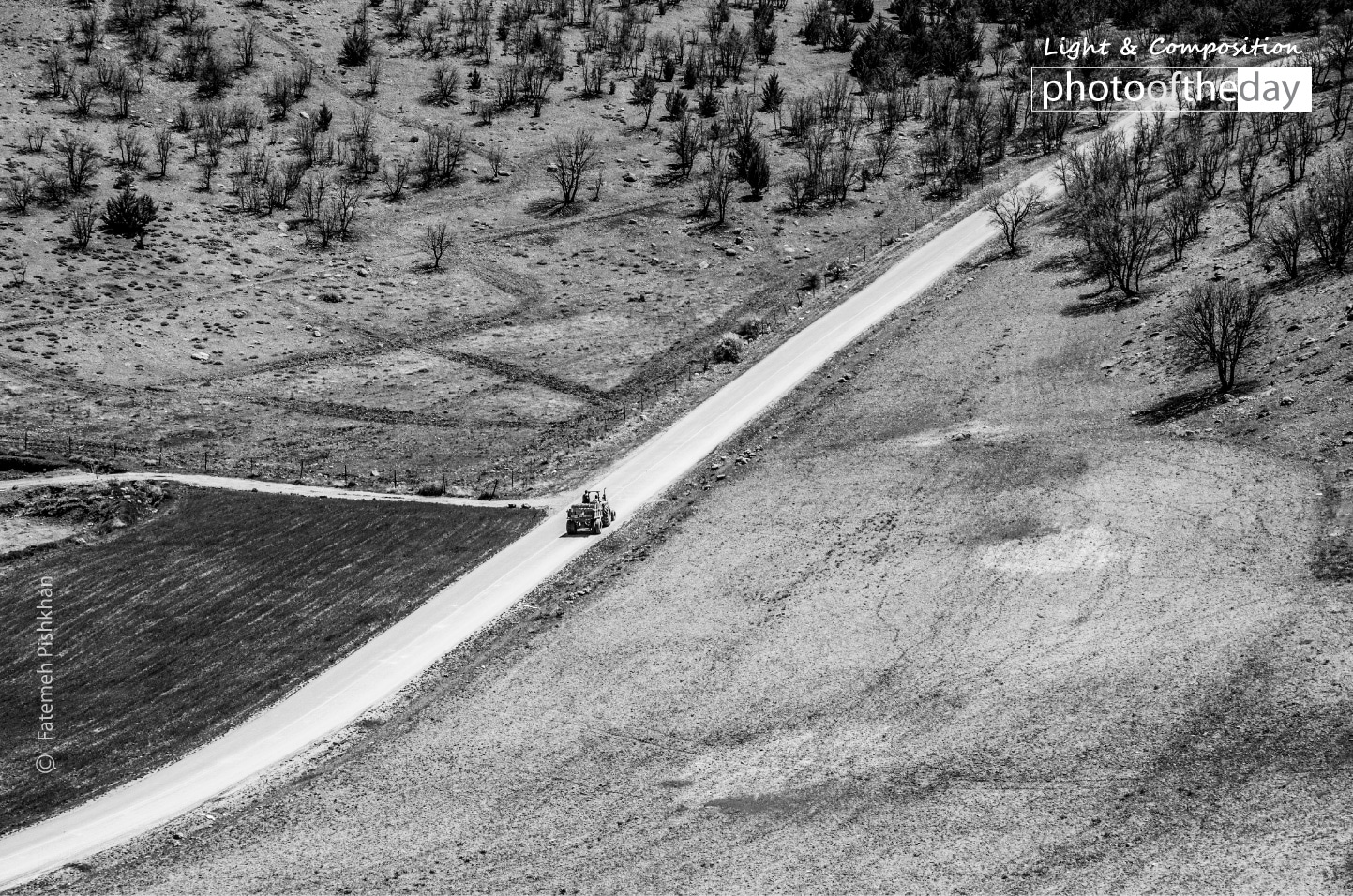
The Road captures the serene, expansive beauty of the Falard Rural District in Iran’s Chaharmahal and Bakhtiari Province. Taken with a keen eye for the interplay between the rugged terrain and the vast, open sky, the photograph highlights the untouched majesty of this 20,000-hectare forest region. The photographer’s decision to frame the winding path against the backdrop of the wild, mountainous landscape emphasizes the isolation and quiet grandeur of the area. This image is award-worthy for its masterful composition and its ability to transform a remote rural vista into a compelling, evocative narrative of the Iranian wilderness.
Exposure 1/320sec @ f/8 | ISO 100 | Focal Length 66mm
Fatemeh Pishkhan
Based in Isfahan, Iran, Fatemeh Pishkhan is a dedicated fine art photographer who balances her time between urban exploration and studio practice. Her work is defined by a deep interest in minimalism and formalism, often employing creative editing techniques to refine her vision. Having explored a diverse range of photographic genres, she now focuses on producing contemporary fine art that challenges traditional perspectives and highlights the unique shapes and forms found within her environment.
Resonance Score Breakdown
Transparency Note: The resonance score (11.6/20) is calculated based on social engagement metrics collected before the award announcement.
Expert Photography Reviews · 8
Where the Path Dissolves
Why do we feel the need to name the destination before we have even begun to walk? We are obsessed with the idea of a path, believing that if we can only see the way forward, we are somehow in control of our own unfolding.
Read the reflection →The Persistence of the Path
When a mountain goat traverses a steep, unstable slope, it does not look for a paved way; it follows the subtle, ancient lines of least resistance carved by generations of its kin.
Read the reflection →Reviews & Comments
Share your thoughts about this award-winning photograph. Your reviews contribute to the community engagement score.
The jagged, ochre earth of Falard doesn’t just sit behind the subject; it dictates their rhythm. That winding path draws the eye toward a horizon that feels ancient, almost biblical. I’m struck by how the vast, unforgiving terrain dwarfs the human element, turning the person into a mere punctuation mark in a grand, geological sentence. It’s a haunting reminder that we don’t own the land; we’re just passing through its quiet, enduring majesty. I’m truly moved.
The winding path through Falard suggests a photographer who didn’t just stumble upon the view. It’s a quiet, dusty sort of commitment. I’ve spent enough afternoons shivering in similar mountain passes to recognize the patience required to let that light settle across the ridge. It’s not a flashy shot, but it’s honest. One suspects she sat there until the shadows grew long and the air turned thin. I find myself wanting to walk that road.
The road winds through Falard like a vein, but it’s lonely. I’ve spent my life looking for the human pulse in a frame, yet here, the land is silent. It’s beautiful, sure, but it’s missing a heartbeat. I keep searching the horizon for a face, a hand, or a sign of someone living in this vastness. It’s a landscape that feels empty, and honestly, it makes me ache for a conversation with the people who walk it.
The road cuts through the frame like a slow pan across a silent set. It’s a wide shot that breathes. I feel the dust on my skin just looking at those mountains. The composition holds the tension of a long take perfectly; any closer and the mystery of the horizon would vanish. It’s the frame the editor keeps because it’s where the story finally stops moving and starts to live. Truly, it’s a beautiful, quiet cut.
The silence in this frame is what I crave. It’s rare to see a landscape that doesn’t feel like a staged intrusion. Looking at that winding path through the Falard forest, I can almost feel the crisp, thin air of the Zagros mountains. It’s a relief to see a photographer who let the terrain breathe instead of forcing a narrative. It’s honest, quiet, and frankly, it makes me want to pack my gear and just sit there.
The ochre dust of the Falard path bleeds into the bruised, violet-grey shadows of the Zagros mountains, a palette that recalls the dusty, melancholic stillness of a Morandi still life. It’s a haunting, arid symphony of earth tones that makes my heart ache for the silence of that high altitude. One finds the light here doesn’t just illuminate; it clings to the rugged terrain like a fading memory of a sun that’s already surrendered to the coming dusk.
The road acts as a datum, a man-made incision against the rugged, tectonic mass of the Falard mountains. It’s a fragile threshold between the wild void and human intent. I’m struck by how the light flattens the slope, turning the landscape into a series of overlapping planes. It’s a lonely, quiet geometry. I find myself wanting to walk that path, to feel the scale of those peaks shift as I move through the frame.
Before the eye identifies the winding path, something in the chest settles. The vastness of the Falard sky triggers a sudden, sharp stillness in my pulse. It’s an invitation to solitude that feels almost heavy. When I return to this frame, I don’t see a landscape; I feel the ache of a road leading nowhere. It’s the quietest place I’ve ever been, and honestly, it makes me want to leave everything behind and just walk.
Good frame and nice shot ??
many thanks
Screaming
Thank you dear