Farfalle Pasta with the White Sauce by Hanan AboRegela
Captured in the soft, diffused glow of early morning, this photograph highlights the delicate textures of farfalle pasta bathed in a rich white sauce. The photographer utilized natural window light to emphasize the intricate details of the dish, carefully arranging elements including cooking cream and chopsticks to create a balanced, inviting composition. By focusing on the interplay between light and the tactile quality of the ingredients, the image transforms a simple meal into a sophisticated culinary study. Its award-worthy quality lies in the masterful use of natural illumination to elevate food photography into a refined, sensory experience.
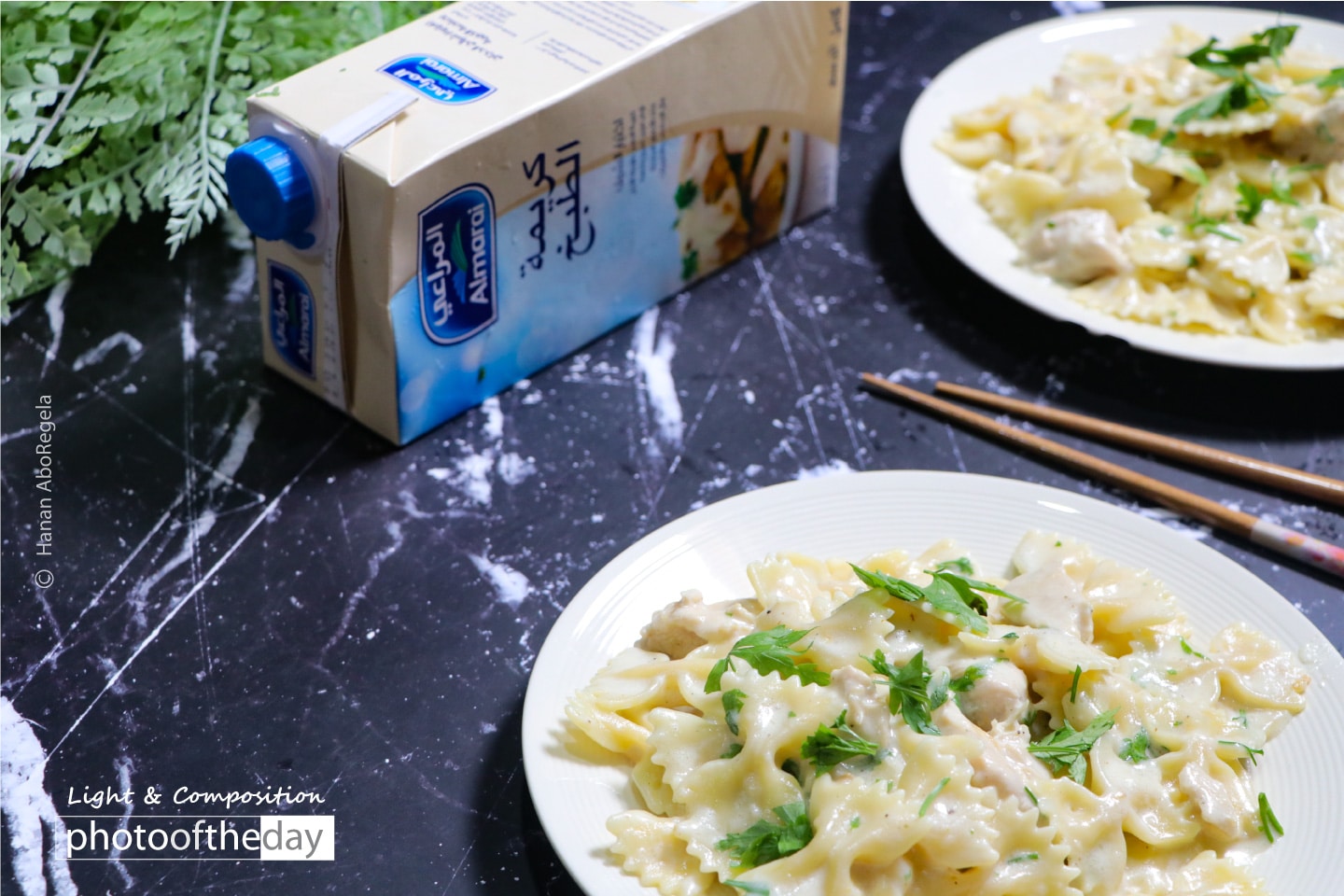
Exposure 1/25sec @ f/5.6 | ISO 1000 | Focal Length 128mm
Hanan AboRegela
Born in Cairo, Egypt, Hanan AboRegela is a dedicated photographer currently based in Al Jubail, Saudi Arabia. A graduate of Germanistic studies from Ain Shams University, she has transitioned her focus toward professional food photography, drawing inspiration from the techniques of industry experts. Her work is defined by a meticulous analysis of light and composition, reflecting her ongoing commitment to mastering the art of culinary storytelling through the lens.
Resonance Score Breakdown
Transparency Note: The resonance score (11.5/20) is calculated based on social engagement metrics collected before the award announcement.
Expert Photography Reviews · 8
The Table After the Guests
There is a specific silence that settles over a dining table once the steam has vanished and the voices have retreated to other rooms. It is not merely the absence of sound, but the absence of the hunger that brought us together in the first place.
Read the reflection →The Architecture of Comfort
There is a quiet holiness in the act of feeding oneself. We often treat the kitchen as a place of labor, a series of chores to be checked off before the day truly begins, yet it is the primary altar of our survival.
Read the reflection →Reviews & Comments
Share your thoughts about this award-winning photograph. Your reviews contribute to the community engagement score.
It’s refreshing to see such crisp, warm light. Down where I usually work, the water steals every bit of that golden glow within five metres, leaving us with nothing but monochromatic blues. Here, the farfalle’s texture is perfectly preserved without a hint of backscatter or refractive distortion. I’m honestly jealous of how easily those creamy highlights sit on the plate. It’s a clean, dry world, and I’m quite envious of that clarity.
The composition relies on a sharp diagonal vector formed by the chopsticks, slicing the frame into two unequal triangular masses. It’s a classic tension play. The farfalle clusters provide a chaotic, organic counterpoint to the rigid, linear geometry of the utensils. I’m genuinely captivated by how the sauce’s viscosity softens the harshness of these intersecting lines. It’s a perfectly solved spatial equation where the negative space balances the heavy, textured center of gravity. It’s mathematically elegant.
There’s a quiet, domestic dignity in how this pasta is arranged. It’s a scene that feels lived-in, like a morning spent preparing a meal for someone you love. I find myself wanting to pull up a chair. While it’s technically a still life, it carries the warmth of a kitchen where trust is the main ingredient. It’s not just food; it’s a gesture of care. I’d love to know who was waiting for that plate.
We look at this bowl and see more than just lunch; we see a quiet morning in Al Jubail. Hanan didn’t just photograph pasta; she listened to the stillness of the kitchen before the day began. The cream clings to the farfalle like a memory of comfort. It’s intimate, almost domestic. I feel a sudden, sharp hunger for the peace captured here. It’s a portrait of a meal that’s been deeply, lovingly heard.
At 128mm, the focal plane is razor-thin, isolating the farfalle’s starch structure against a creamy, out-of-focus backdrop. The bokeh, a function of that f/5.6 aperture, renders the sauce’s viscosity with a soft, almost bioluminescent quality. I’m genuinely moved by how the light catches the pasta’s ridges; it’s a tactile precision that transcends the simple meal. It’s rare to see such clarity at ISO 1000, where the sensor’s noise doesn’t compromise the delicate, microscopic texture of the cream.
The porcelain cream, a hue reminiscent of Vermeer’s milk-poured light, clings to the farfalle with a viscosity that feels almost devotional. It’s a quiet, monochromatic symphony where the shadows don’t merely fall; they breathe, softening the edges of the pasta into a gentle, chalky luminescence. I’m utterly seduced by how the light catches the starch, turning a simple meal into a hushed, Morandi-esque meditation on the tactile grace of the everyday. It’s simply divine.
1/25sec at f/5.6, ISO 1000, 128mm. It’s a technical mess. That shutter speed is far too slow for handheld work at 128mm; the micro-blur is inevitable. ISO 1000 on an 80D sensor introduces noise that muddies the sauce’s texture. I’m genuinely frustrated by the lack of a tripod here. You’ve traded sharpness for ambient light, and the image suffers. The optics were capable, but the execution failed the physics of the shot. It’s sloppy.
Morning light hits the porcelain. It’s quiet here. The farfalle rests in the sauce, a study in stillness. I’ve spent minutes watching the chopsticks. They don’t reach for the food. They wait. The negative space around the bowl isn’t just air. It’s a breath. It’s the pause before the meal begins. I feel a sudden, sharp hunger for this stillness. Nothing here is accidental. The empty corner is not empty. It’s a perfect, silent room.