Abelmosk by Siew Bee Lim
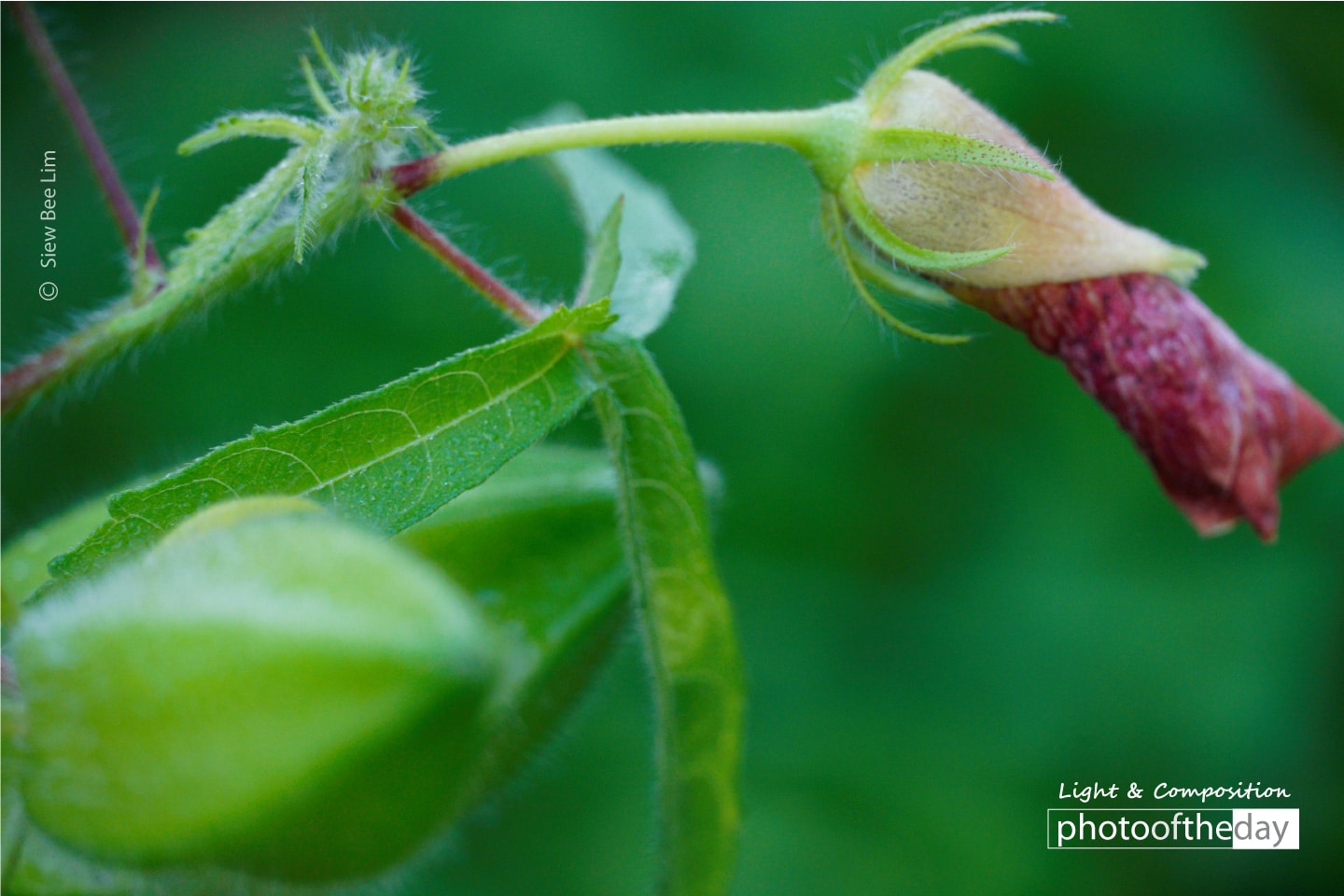
Captured in the soft light of an early February morning, this close-up study of an Abelmosk plant reveals the intricate textures of nature. The photographer focuses on the delicate interplay between a withering flower, a distinctive star-shaped fruit, and a vibrant red stem, all glistening with morning dew. By isolating these botanical elements, the image highlights the depth and dimension often overlooked in the natural world. This photograph is award-worthy for its meticulous attention to detail and the evocative way it transforms a simple plant specimen into a compelling, textured narrative of growth and decay.
Siew Bee Lim
Born in Singapore in 1965, Siew Bee Lim is a dedicated photographer who balances her professional background as a programmer with a lifelong passion for the arts. Though she initially explored photography during her early career, she has recently returned to the craft with renewed vigor, seeking formal education to refine her technical and creative vision. Drawing inspiration from her appreciation of Chinese painting and a deep-seated love for literature, she strives to capture the subtle beauty of the natural world through her lens.
Resonance Score Breakdown
Transparency Note: The resonance score (11.6/20) is calculated based on social engagement metrics collected before the award announcement.
Expert Photography Reviews · 6
The Architecture of Decay
In the quiet corners of a garden, we often mistake the end for a failure. We look at the shriveling petal or the darkening stem and see only the loss of what was once vibrant.
Read the reflection →The Unseen Borders of Growth
We often mistake the city for a collection of stone, glass, and steel, forgetting that it is a living, breathing organism that constantly negotiates its own boundaries. In the neglected corners of our concrete grid, nature performs a quiet, persistent reclamation.
Read the reflection →Reviews & Comments
Share your thoughts about this award-winning photograph. Your reviews contribute to the community engagement score.
1/160sec at f/5.6, ISO 800, 135mm. It’s a compromise. The focal length isolates the subject, but f/5.6 leaves the depth of field too thin to resolve the fruit and flower simultaneously. ISO 800 on an APS-C sensor introduces noise that muddies the dew’s clarity. I’ve spent years staring at these sensors; the grain here irritates me. It’s a technically lazy choice. You had the light, but you didn’t have the discipline to stop down.
We look at this Abelmosk and we don’t see a plant; we see a life cycle. Siew Bee Lim listened to the quiet rhythm of the morning, capturing the withering bloom alongside the star-shaped fruit. It’s a portrait of time itself. I’m moved by that vibrant red stem, holding everything together against the dew. It’s a fragile, honest conversation between growth and decay. This is a photograph that asks to be returned to, again and again.
It’s technically competent, but I’m left craving a subversion of that crisp, dew-laden clarity. Why resolve every vein of the Abelmosk with such clinical precision? I’d rather see the decay dissolve into abstraction, pushing closer to the ethereal blur of a Sugimoto long-exposure than this literal botanical cataloging. It’s a safe, polite observation of nature. I’m bored by the sharpness; I want to know what the photographer was afraid to leave out of focus.
Dew clings to the Abelmosk like a curated performance of nature. It’s technically precise, yet I’m left cold. Why do we insist on isolating botanical subjects from the messy, lived environments they actually inhabit? By stripping away the context of Quanzhou or Singapore, Lim turns a living organism into a sterile object. Does this aesthetic perfection serve the plant, or just our desire to possess it? I find myself craving the dirt, not just the glistening, detached dew.
Most close-ups of flora are forgettable, yet this one lingers. It’s the tension between the dying bloom and that rigid, star-shaped fruit that hooked me. I’ve seen thousands of botanical studies, but the way the dew clings to the red stem makes me feel the damp chill of that February morning. It’s a quiet, honest study of decay. It’ll endure because it doesn’t try to be pretty; it just captures the inevitable, messy truth of growth.
Before the eye identifies the Abelmosk, a sudden stillness settles in the chest. The dew-slicked red stem pulls at my pulse, a visceral reminder of life’s fragile friction. It’s the decay that lingers; I’ve felt that specific, quiet ache in my own joints. Returning a year later, the star-shaped fruit feels less like a botanical study and more like a ghost. It’s a beautiful, heavy weight I’m not quite ready to set down.