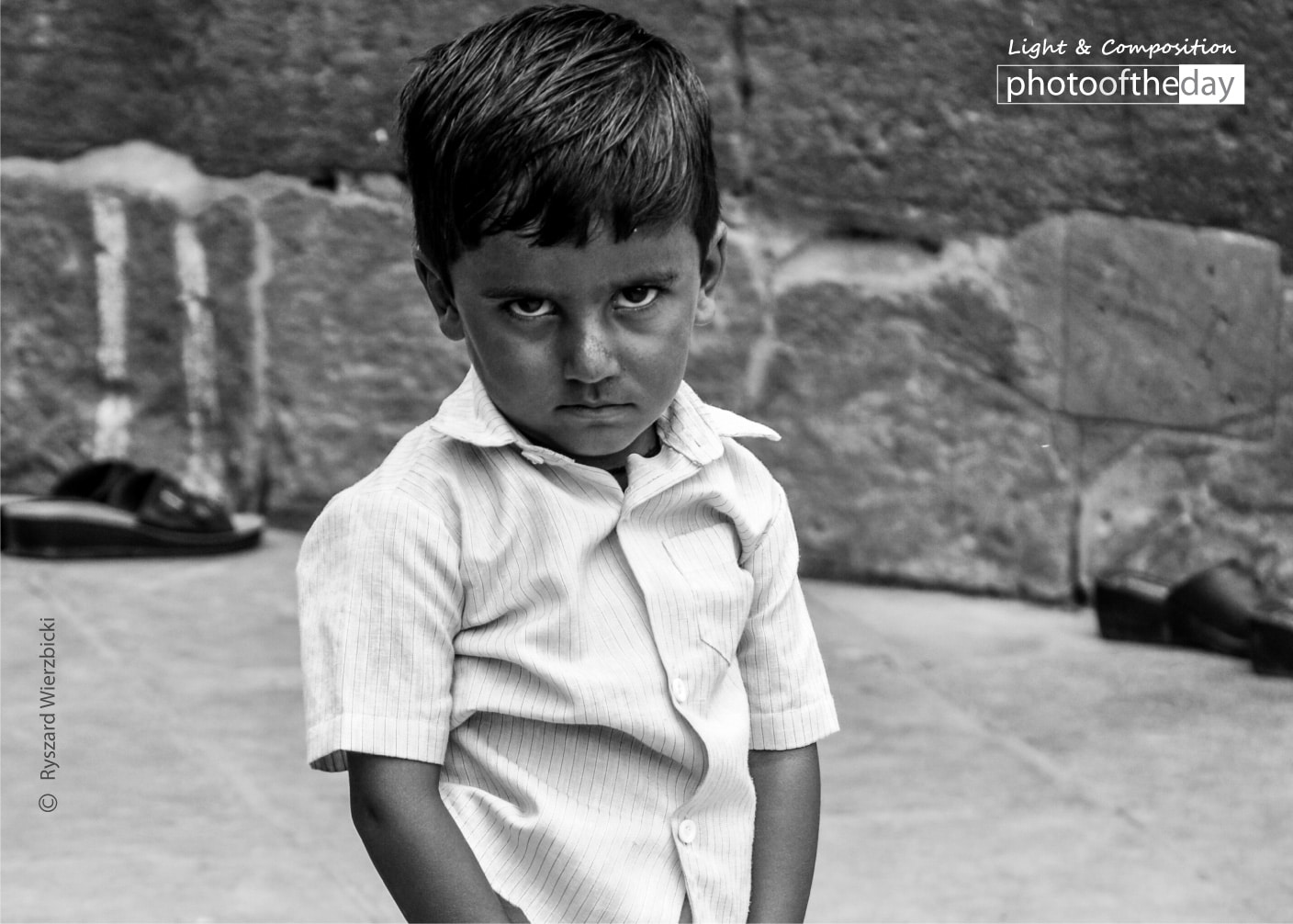
Suspicious by Ryszard Wierzbicki
In the vibrant streets of Ajmer, Rajasthan, the photographer encountered the natural hesitation children often feel toward foreign visitors. To bridge this cultural divide, he employed a patient, interactive approach, sharing the digital results of his DSLR with the subjects to build immediate trust. By engaging in play and offering small tokens of gratitude, he transformed a moment of suspicion into one of genuine connection. This photograph is award-worthy for its ability to capture a raw, humanizing interaction, demonstrating the photographer's profound empathy and his skill in navigating complex social dynamics to secure an authentic, candid portrait.
Ryszard Wierzbicki
Born in 1963, Ryszard Wierzbicki is a dedicated traveler and photographer who transitioned from a diverse career in social sciences and marketing to pursue his passion for global exploration. After emigrating to the United Kingdom in 2006, he began documenting his extensive travels across South-East Asia, often combining his photographic work with humanitarian efforts for orphanages. A PADI-certified scuba instructor and founder of multiple travel-focused forums, Wierzbicki now devotes his time to capturing the human experience through a lens, blending his background in child care education with a deep, empathetic approach to candid photography.
Resonance Score Breakdown
Transparency Note: The resonance score (11.0/20) is calculated based on social engagement metrics collected before the award announcement.
Expert Photography Reviews · 8
The Weight of a Glance
I keep a small, rusted iron key in a velvet pouch, though I have long since forgotten which door it once opened. It is heavy for its size, a cold, jagged reminder that there are thresholds we cross without ever knowing their significance.
Read the reflection →The Guarded Threshold
I remember sitting on a low stone wall in a village outside of Fez, watching a young boy track my every movement from behind a stack of crates.
Read the reflection →Reviews & Comments
Share your thoughts about this award-winning photograph. Your reviews contribute to the community engagement score.
There’s a guardedness in those eyes that tells me the transaction wasn’t quite finished. While Ryszard tried to bridge the gap with his screen, the boy’s posture remains braced, as if he’s still deciding if he’s a participant or a prop. I’ve spent years in these streets, and I know that look. It’s a heavy, weary gaze. This face has a whole life in it, but I’m not sure he’s truly given us his permission yet.
Most candid portraits of children in Rajasthan fall into the trap of exoticism, but this one avoids that pitfall by focusing on the tension in the boy’s eyes. It’s the guarded, sideways glance that makes this endure; it’s a raw, honest reaction to a stranger. I’ve seen thousands of travel shots, but the way he clutches his shirt here actually makes me ache for his vulnerability. It’s a rare, authentic moment of human hesitation captured perfectly.
You didn’t just take a picture; you earned it. I’ve spent enough time in crowded streets to know that look—the guarded curiosity of a child who isn’t sure if you’re a friend or a stranger. Because you stopped to show them the screen, that suspicion melted into something real. I felt a genuine ache in my chest seeing that hesitation turn into trust. You waited for the humanity, and it shows. That’s the only thing that matters.
Before the eye identifies the dusty street of Ajmer, something in the chest tightens. It’s that sharp, guarded hesitation in the child’s gaze. I feel a sudden, phantom urge to lower my own eyes, to retreat. When I return to this a year later, the suspicion has softened into a fragile, shared curiosity. It’s the vulnerability of the bridge built between them that haunts me. I’ve never quite shaken the weight of that wary, beautiful stare.
Ajmer’s dust settles, but the tension in those eyes stays. Ryszard caught the exact micro-second where suspicion flickers into curiosity. It’s that Winogrand-style dance—engaging the subject until the mask slips. I love the way the light hits that tentative hand; it’s electric. One tenth of a second later and the connection has vanished, the frame collapsed. He didn’t just take a portrait; he earned it. That’s the street, raw and breathing. It’s brilliant work.
The frame operates on a strict 3:2 ratio, anchored by the boy’s gaze along the primary diagonal. His face occupies the upper-right quadrant, creating a tension against the negative space on the left. It’s a perfect spatial equation; the geometry of his posture balances the chaotic textures of the background. I’m genuinely struck by how the vertical axis of his arm stabilizes the composition. It’s not just a portrait; it’s a solved problem of visual equilibrium.
The frame holds a tension that’s almost cinematic. It’s the hesitation before the scene shifts, that split second where the subject decides whether to run or stay. I love the way the light catches their eyes; it’s a gaze that cuts right through the lens. The cut would’ve been a mistake. Wierzbicki didn’t just take a photo; he directed a moment of genuine human friction. It’s the frame the editor keeps because it breathes.
Wierzbicki’s Ajmer portrait echoes the ethnographic intimacy of Henri Cartier-Bresson, yet it avoids the colonial gaze by centering the subject’s agency. The way these children hold their ground recalls the defiance in Helen Levitt’s street studies, but with a modern, digital-age reciprocity. I’m genuinely moved by the tension in their eyes; it’s a rare, unvarnished look at the friction between observer and observed. It’s not just a candid shot; it’s a dialogue I haven’t seen quite like this.