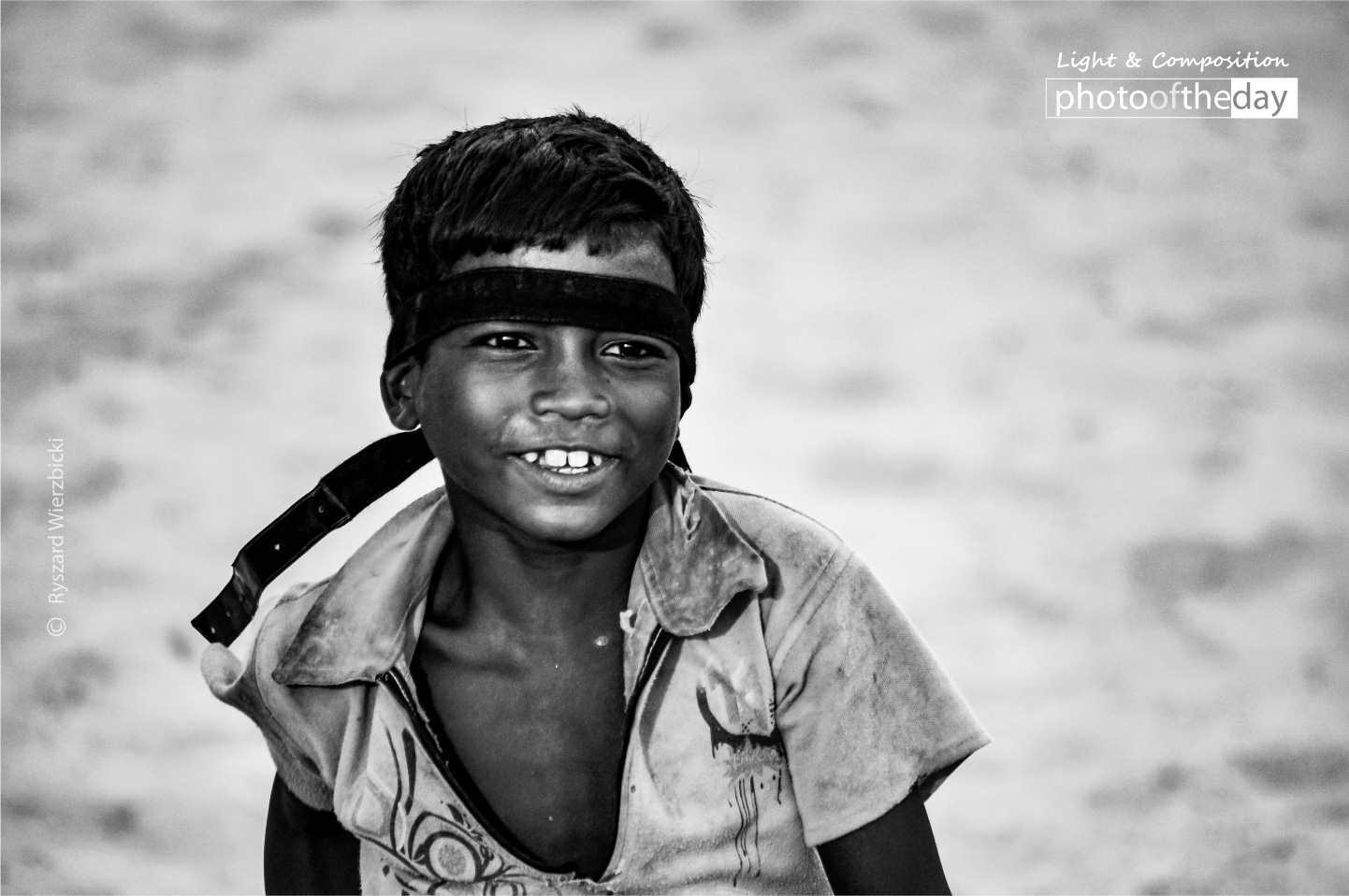
A Bodh Gaya Boy by Ryszard Wierzbicki
Captured near the historic Dungeshwari Cave Temples, this portrait of a local boy crossing a shallow river offers a poignant glimpse into life near the site of Buddha’s meditation. The photographer utilized a long focal length to isolate the subject against the natural landscape, emphasizing the boy's presence amidst the ancient, spiritually significant terrain. The image is award-worthy for its candid authenticity and the way it bridges the gap between the profound historical narrative of the region and the simple, everyday reality of the local youth. It serves as a visual testament to the enduring human spirit in a place of deep enlightenment.
Ryszard Wierzbicki
Born in 1963, Ryszard Wierzbicki is a Polish-born photographer and educator currently based in Swindon, United Kingdom. After a diverse professional career in social sciences and marketing, he transitioned to a life of exploration, focusing his lens on the cultures and landscapes of South-East Asia. Known for his commitment to humanitarian causes and his active role in travel photography communities, Wierzbicki combines his background in social work with a keen eye for candid storytelling, documenting the human experience with empathy and technical precision.
Resonance Score Breakdown
Transparency Note: The resonance score (8.7/20) is calculated based on social engagement metrics collected before the award announcement.
Expert Photography Reviews · 7
The River of Becoming
There is a quiet wisdom in the way a child moves through water. They do not fight the current, nor do they seek to master the depth; they simply exist within the flow, as much a part of the river as the stones beneath their feet.
Read the reflection →The Weight of Still Water
I keep a small, smooth river stone on my desk, worn down by years of being turned over in my palm. It is a heavy, quiet thing, cool to the touch even in the heat of summer.
Read the reflection →Reviews & Comments
Share your thoughts about this award-winning photograph. Your reviews contribute to the community engagement score.
The compression of that 190mm lens flattens the landscape, yet it’s precisely this distortion that defines the boy’s relationship to the terrain. He isn’t just walking; he’s navigating the threshold between the ancient, weathered mass of the Dungeshwari hills and the fluid void of the river. It’s a haunting scale shift. I find myself shivering at the way the harsh light catches his skin, grounding his fragile humanity against that vast, indifferent geological datum.
The boy’s vertical axis anchors the frame, creating a perfect 1:2 ratio between his figure and the negative space of the river. By compressing the depth with a 190mm lens, Wierzbicki flattens the terrain into a series of horizontal bands. It’s a beautifully solved spatial equation. I’m genuinely struck by how the diagonal ripple of the water disrupts the stillness of his posture. It’s rare to see such precise geometry breathe with this much quiet, human grace.
Most portraits from this region rely on tired tropes of poverty, but Wierzbicki avoids that trap. By using a 190mm focal length, he isolates the boy against the water’s texture, turning a simple crossing into a quiet, monumental act. I’ve seen thousands of portraits, yet this one lingers because of the boy’s unselfconscious gaze. It’s rare to find such stillness. Thirty years from now, we’ll still be wondering what he was thinking as he crossed that river.
A 190mm lens at f/5.6 suggests Wierzbicki didn’t just stumble upon this lad. He’s kept his distance, letting the boy move through that river undisturbed. It’s a quiet, disciplined bit of work. I’ve spent enough mornings in damp boots to know that catching a moment this natural requires a photographer who’s willing to be ignored for hours. It’s rare to see such restraint. I find myself wishing I’d been the one holding the shutter there.
At 190mm and f/5.6, the focal plane is razor-thin, isolating the boy against a beautifully compressed background. The bokeh, a function of that aperture, renders the river’s surface into a soft, chromatic wash that makes his skin tones pop with startling clarity. I’m genuinely moved by the way the light catches the water droplets; it’s a micro-moment of physics that feels almost sacred. It’s rare to see such technical precision capture such quiet, human grace.
The shutter speed freezes the water mid-splash, a perfect, kinetic pause. It’s a tracking shot that stopped dead. I’m struck by the boy’s gaze; it’s heavy with a stillness that defies the movement around him. Wierzbicki didn’t just capture a kid crossing a river; he caught the exact frame the editor keeps to anchor the scene. The compression of that 190mm lens makes the landscape feel like a backdrop in a classic feature. It’s pure cinema.
The boy’s gaze cuts through the frame, yet he remains a prop for our spiritual tourism. Why does the curator insist on tethering his existence to Buddha’s meditation? It’s exhausting. The long lens flattens the landscape, turning a child into a symbol of “ancient terrain.” I feel a sharp, uncomfortable ache watching him wade through that water. Does he know he’s being framed as a relic? We’ve commodified his reality to satisfy our own enlightenment.